


BlackSky has been nominated for the 2026 World AI Awards in the Autonomous Orbital Systems category, recognising its work at the intersection of satellite autonomy, artificial intelligence and real-time Earth intelligence.
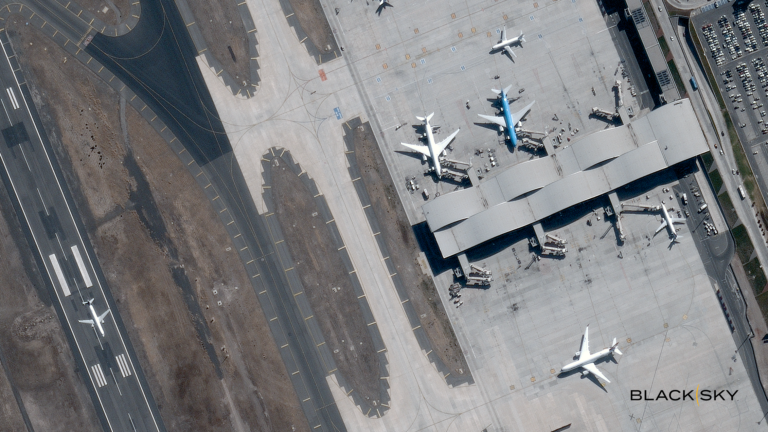
This is an unusually practical corner of space AI. BlackSky is not simply putting cameras into orbit and sending imagery back to Earth. Its Gen-3 satellites and BlackSky Spectra platform form an automated system built to task spacecraft, collect high-resolution imagery, analyse what appears in those images and move useful intelligence to customers quickly.
That matters when the subject being watched is moving.
Ships leave ports. Aircraft relocate. Vehicles disappear from a site. A traditional satellite image can become stale surprisingly fast.
BlackSky is trying to shrink that gap between observation and action.
The World AI Awards recognises organisations, individuals, products and technologies contributing to the development and practical application of artificial intelligence across industries.
Gen-3 brings sharper eyes into orbit
BlackSky’s latest generation of Earth observation spacecraft sits at the centre of its autonomous orbital strategy.
The company’s Gen-3 satellites provide 35-centimetre very-high-resolution imagery, with the system designed for frequent observations during both daytime and nighttime operations.
BlackSky reached an important operational milestone in March 2026 when its fourth Gen-3 satellite entered general availability less than one week after launch. The company had already reduced commissioning time considerably with its third Gen-3 spacecraft, which entered commercial operations within three weeks.
Speeding up commissioning sounds like an engineering detail. Commercially, it is significant. A satellite generating usable imagery sooner spends more of its orbital life providing capacity to customers.
BlackSky customers access those spacecraft through Spectra, its tasking and analytics platform.
The system allows users to request imagery while combining satellite collection with automated analytics. Gen-3 services include AI-enabled detection and identification of objects such as vehicles, aircraft and vessels.
The result is closer to a continuously responsive intelligence service than a conventional catalogue of satellite photographs.
AI looks for what changed, not simply what is visible
The sheer amount of imagery generated by modern Earth observation systems creates its own problem.
Someone still has to inspect it.
BlackSky uses artificial intelligence to automate parts of that process. Its analytics can detect and classify objects of interest, helping customers identify activity across locations without requiring an analyst to manually examine every new image.
That approach becomes more useful when combined with repeated satellite observations.
Instead of asking only, “What is at this location?”, analysts can begin asking, “What changed since the last collection?”
BlackSky has deployed this model for government, defence and intelligence customers. In April 2026, the company announced a $25 million multi-year contract with an international defence customer providing guaranteed access to Gen-3 imagery and real-time AI-enabled analytics.
The technology is therefore not confined to laboratory testing. Elements of BlackSky’s automated imagery and analytics architecture are already commercially available and operating for customers.
Tactical intelligence pushes AI closer to the mission
BlackSky is also developing more specialised AI capabilities.
In July 2026, the company announced a series of U.S. research and development contracts focused on Gen-3 artificial intelligence for real-time, space-based intelligence, surveillance and reconnaissance operations.
The work includes advancing automated target recognition and integrating battle damage detection into the Gen-3 architecture.
BlackSky says its proprietary detection and identification algorithms can be deployed directly within customers’ classified mission environments.
That changes where satellite intelligence can be processed.
Instead of every piece of imagery travelling through a long chain of manual interpretation, AI can help identify objects and changes earlier in the workflow. Human analysts remain important, particularly where intelligence informs consequential decisions, but automation can reduce the volume of raw imagery they need to process manually.
BlackSky joins a much larger orbital AI project
A bigger experiment is now taking shape.
In September 2026, BlackSky was selected as the exclusive provider of very-high-resolution electro-optical satellites for an international initiative designed to build an AI-enabled constellation involving 50 satellites.
The project is backed by a consortium involving Marlan Space, Loft Orbital, Mistral AI and other organisations, with a reported investment of $1 billion.
BlackSky’s Gen-3 spacecraft are expected to provide the electro-optical component of a constellation combining optical, radar and other sensors for users across France, Europe and the UAE.
The distinction between current capability and future ambition is important here.
BlackSky’s Gen-3 satellites and Spectra analytics are operational today. The wider 50-satellite AI infrastructure is a newly announced initiative whose planned capabilities still have to be deployed.
Still, the direction is difficult to miss. Satellite constellations are beginning to evolve from remote cameras into distributed information systems capable of collecting, analysing and prioritising data with increasingly limited manual intervention.
Graham Cooke, President of the World AI Awards, said:
“BlackSky’s nomination highlights an important shift in space technology. The opportunity is no longer simply to collect more satellite imagery, but to make orbital systems faster at identifying what matters and delivering useful information to the people who need it.
“BlackSky’s work across automated satellite tasking, high-frequency Earth observation and AI-enabled detection demonstrates how artificial intelligence can connect orbital infrastructure with real-world decision-making. We congratulate the BlackSky team on its 2026 World AI Awards nomination in Autonomous Orbital Systems and look forward to following the development of these capabilities.”
BlackSky joins organisations, researchers, entrepreneurs and technology developers being recognised through the 2026 World AI Awards.
The programme recognises organisations, individuals and technologies contributing to the development and application of artificial intelligence across industries.
BlackSky’s nomination in Autonomous Orbital Systems captures one of the more interesting changes happening in aerospace. Satellites are becoming less like isolated machines waiting for instructions and more like components of software-defined networks connecting sensors, automated tasking, artificial intelligence and human analysts.
Some of that future remains under development. Other pieces are already in orbit.
For BlackSky, that distinction may be the most important part of the story.
Learn more about BlackSky and its real-time space-based intelligence technology at blacksky.com.
Discover the World AI Awards 2026, explore the nominees and learn more about the awards at worldawards.ai.
