


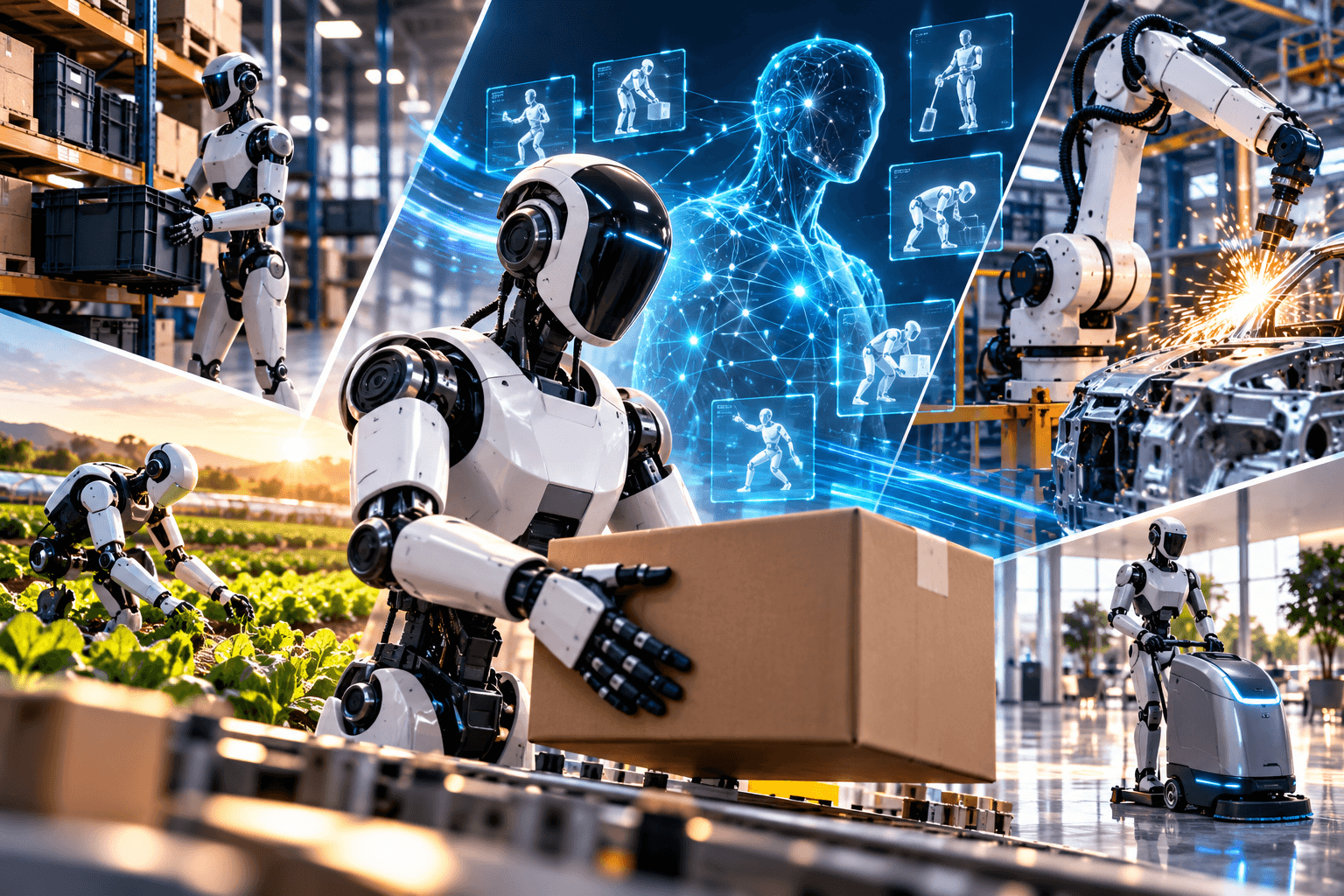
Robots are getting better at physical work. The more interesting question is how much work they can actually handle right now.
A new study from Anthropic puts a striking number on that question. The company estimates that robots can already perform 74% of physical work tasks in the US economy at some level. But that figure needs context. Most of those tasks take place in controlled or purpose-built environments, while only a tiny share can currently be performed in genuinely unstructured settings.
The research looks at around 900 occupations and roughly 19,000 individual tasks to examine where robots already have practical capabilities and where they still fall short.
The result is less about robots suddenly replacing workers and more about showing where the physical economy is becoming technically accessible to machines.
Robots Can Handle Much More Physical Work Than Expected
The headline figure comes from Anthropic’s attempt to measure robot exposure at the task level rather than simply asking whether an entire occupation can be automated. That distinction matters because most jobs contain a mixture of tasks, and robots may be able to handle some of them while leaving others entirely to people.
Anthropic divides physical tasks into four levels of robot capability. E0 represents tasks robots cannot currently perform. E1 covers work that robots can perform in purpose-built environments, such as specialized factories. E2 refers to structured human workplaces such as warehouses. E3 covers unstructured environments, including places such as public roads.
Using that framework, Anthropic estimates that 74% of physical work is exposed to robots at some level, representing approximately 34% of total working time in the US economy.
The distribution is uneven. About 23% of total working time involves physical tasks robots can perform in purpose-built environments, while another 10% falls into structured workplace environments. Only around 1% of total working time involves tasks robots can currently perform in unstructured environments.
That final figure is perhaps the most revealing part of the study.
Robots may be capable of doing a surprising amount of physical work, but the real world is still difficult for machines.
Driving and Warehouse Work Stand Out
Transportation and material movement are among the areas where robotics already has a particularly large footprint. These occupations often contain repetitive physical tasks or operate in environments where machines can be given predictable routes, defined objectives and extensive sensor coverage.
Anthropic identifies vehicle operators as especially exposed, with nine of its ten most exposed occupations involving vehicle operation. Taxi driving ranks particularly high because autonomous vehicles are already capable of handling the central driving task in unstructured road environments.
Warehouses provide a different example. Their environments can be deliberately organized around automation, giving robots marked pathways, predictable storage locations and standardized workflows.
Amazon’s Vulcan robot illustrates how that environment is changing. The system uses tactile sensing to interact with inventory, moving robotics beyond simply transporting objects from one location to another.
The technology still depends heavily on the environment around it.
A warehouse designed for robots is a very different challenge from a crowded retail store, construction site or private home.
Nurses and Repair Workers Are Harder to Automate
Physical work becomes considerably harder when a robot has to deal with unpredictable environments, delicate objects, human interaction or constantly changing circumstances. These conditions are common in healthcare, maintenance and personal services.
Nursing provides a good example. A robot can potentially transport supplies or perform specific repetitive activities inside a hospital, but healthcare work involves far more than physical movement. Patients respond differently, equipment varies and many procedures require direct interaction between people.
Repair work creates another difficult environment. Technicians may arrive at a site without knowing exactly what they will encounter. Equipment can be damaged in unusual ways, access can be restricted and the physical environment may bear little resemblance to the conditions in which a robot was trained.
Anthropic finds that delicate manipulation and face-to-face interaction remain important barriers to robot adoption. Personal care, healthcare support, installation and repair, and community and social service occupations retain significant amounts of work that current robotics systems cannot perform.
That gap could remain important even as robot intelligence improves.
The Robot Problem Is Not Just Intelligence
Much of the discussion around advanced robotics focuses on AI models becoming better at reasoning and decision-making. Anthropic’s research points to a more basic problem: machines still have to physically interact with the world.
The researchers estimate that capability limitations affect around 70% of physical tasks in their analysis. Manipulation is particularly important because a robot must be able to grasp, move and interact with objects reliably before it can take over many physical activities.
Planning and reasoning are also limitations, but Anthropic estimates that these account for a smaller share of the barriers. About 8% of physical tasks are restricted by limitations in planning or reasoning.
Then there are restrictions that technology alone cannot solve.
Anthropic estimates that existing regulations would prevent robots from performing about 14% of physical tasks. Healthcare, education and protective services are among the areas where regulation can limit deployment.
Human preferences add another layer. Even if a machine becomes technically capable of performing an intimate or socially sensitive task, people may not want a robot doing it.
Robots Are Still Much More Expensive Than People
Technical capability does not automatically create an economic case for automation. A robot can perform a task perfectly and still make little financial sense if purchasing, operating and maintaining the machine costs more than employing a person.
That is where Anthropic’s research produces another major gap.
The study estimates that robots are currently cost-competitive for only 0.3% of work. That is dramatically smaller than the 34% of total working time represented by physical tasks that robots can technically perform at some level.
The difference is important.
Anthropic uses packing and packaging work as one example. Under the assumptions in its analysis, a group of robots costing more than $2 million could produce roughly the annual output of 14 workers after accounting for factors including installation, maintenance, energy and human supervision.
For that particular type of work, the economics can begin to make sense.
Most physical occupations are nowhere near that point.
The researchers estimate that robot costs would need to fall by around 70% for robots to become cost-competitive with humans across 10% of current human work. If robot prices continue declining at roughly 3% per year, Anthropic estimates that reaching that level could take about four decades.
The economics could change much faster if hardware costs fall sharply or robot productivity improves.
Robots Expand the Automation Map Beyond LLMs
Large language models have already expanded automation into areas dominated by writing, analysis, programming and other forms of computer-based work. Robots introduce another dimension by giving AI systems a path into physical tasks.
Anthropic estimates that approximately half of work is exposed to LLMs under its measurement framework. Adding robot exposure increases that figure to approximately 81% of work.
Transportation and moving occupations show the difference particularly clearly. Less than 15% of their tasks are exposed to LLMs alone, while roughly 90% become exposed when robotics is included.
That does not mean 81% of jobs will disappear.
Anthropic’s measurement is about task exposure, not guaranteed job elimination. A job is usually a collection of activities. Some can be automated while others remain dependent on human judgment, physical dexterity, communication or responsibility.
A warehouse employee, for example, could spend less time physically moving products while taking on more work involving supervision, exceptions, quality control or maintenance.
The job can change without disappearing.
What Happens Next Could Depend on Robot Prices
The future of physical automation will depend on two variables moving together: what robots can do and what businesses can afford to pay for them. Capability without affordable hardware creates impressive demonstrations. Affordable hardware without sufficient capability creates machines that businesses have little reason to deploy.
Anthropic also examined historical relationships between robot exposure and later changes in employment and wages. Its analysis found that occupations with greater exposure to robots experienced larger subsequent declines in wages and employment. The researchers use this historical relationship as part of their effort to understand potential effects from current robot exposure.
The study also notes that robot capabilities have historically expanded into previously inaccessible physical tasks.
Anthropic estimates that robots became capable of roughly 2% of previously inaccessible physical tasks per year in its historical comparison.
The researchers also model a faster hypothetical scenario in which robot capabilities improve more rapidly and costs decline faster. Under that scenario, robots could become cost-competitive for half of today’s physical work by 2050.
That is a scenario, not a prediction.
The distinction is important because robotics has plenty of variables that can move in either direction, from hardware prices and battery technology to regulation, safety requirements and the availability of skilled technicians.
The Real Robotics Race Is Happening in the Workplace
The most useful takeaway from Anthropic’s research may not be the 74% figure on its own. It is the gap between what robots can technically do and what businesses can realistically deploy.
Robots already operate successfully in factories, warehouses, transportation systems and other controlled environments. Those workplaces have something that many everyday environments do not: structure.
A production line can be engineered around a robot. A warehouse can be reorganized to accommodate autonomous machines. A public street, hospital room, construction site or private home is considerably less predictable.
That makes the next phase of robotics less about simply building smarter AI models and more about building machines that can physically interact with the world with enough reliability to justify their cost.
They need better hands. Better sensors. Better mobility. Better safety systems.
And, perhaps most importantly, they need to become cheap enough for businesses to actually buy them.
The robot workforce is not arriving all at once. It is spreading task by task, workplace by workplace.
That process has already started.
Sources
- Anthropic — What work can robots do?
https://www.anthropic.com/research/what-work-can-robots-do - Anthropic — Claude plays robotics
https://www.anthropic.com/research/claude-plays-robotics - Amazon — Introducing Vulcan: Amazon’s First Robot with a Sense of Touch
https://www.aboutamazon.com/news/operations/amazon-vulcan-robot-pick-stow-touch - Anthropic — Project Fetch: Phase two
https://www.anthropic.com/research/project-fetch-phase-two
