


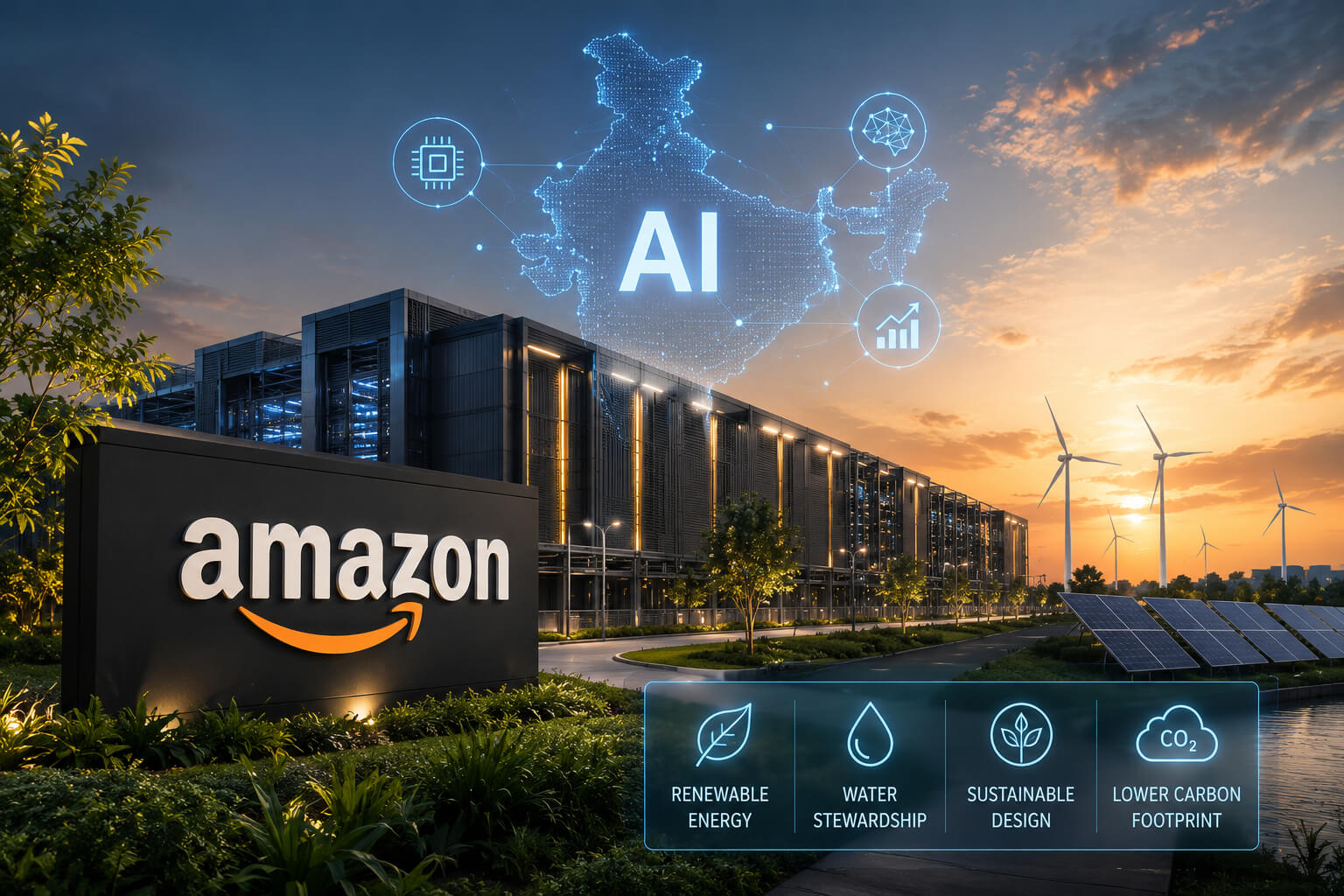
Amazon says its operations in India have reached a major sustainability milestone: the company now returns more water to local communities than it uses across its facilities in the country.
The announcement comes at a critical time for the artificial intelligence industry. As demand for AI tools, cloud computing, and data center capacity increases, technology companies are facing growing pressure to prove that digital growth can happen without worsening local environmental stress.
India is becoming one of the most important markets for cloud and AI infrastructure. At the same time, the country continues to face serious water scarcity challenges, especially in urban and technology-heavy regions. That makes Amazon’s water positive claim more than a corporate sustainability update. It is also a test case for how major AI infrastructure providers may need to operate in water-stressed markets.
What Does Amazon Being Water Positive in India Mean?
Being “water positive” means Amazon says it is giving back more water to communities than it consumes through its direct operations in India.
According to the company, this includes water used across facilities such as data centers, warehouses, and corporate offices. Amazon says it reached the milestone through a combination of reducing its own water consumption and supporting community-focused water projects.
These include watershed restoration, lake restoration, better irrigation systems and other conservation programs to support water-stressed communities. The company has also pointed out that its India data centers do not use water for cooling as many traditional data centers do.
That matters because data center cooling has become one of the big environmental issues associated with AI growth. Big computing centers need a lot of power and cooling to keep servers running efficiently. In some regions, that cooling process can add pressure to local water resources.
Why AI Growth Is Raising Water Concerns
The rapid growth of generative AI has changed the infrastructure conversation. Training and running advanced AI models requires huge amounts of computing power. That demand is pushing companies such as Amazon, Microsoft, Google, and others to expand their data center networks around the world.
India is a major part of this expansion. It has a rapidly growing digital economy, a large developer ecosystem and increasing demand for cloud services from startups, enterprises and government agencies.
But India also has water stress. Many of its large cities have experienced seasonal shortages, rationing and pressure on groundwater supplies. When large data center investments come to these regions, local communities and environmental groups often ask if the infrastructure will compete with residents, farmers and businesses for limited water supplies.
This is why Amazon’s India milestone matters. The company is trying to show that AI infrastructure growth and water conservation do not have to be in conflict.
Amazon’s India Strategy Goes Beyond Sustainability
Amazon’s water positive claim also fits into a much larger India growth strategy.
Amazon Web Services has already announced major cloud infrastructure investment plans in the country. AWS plans to invest billions of dollars into expanding its cloud infrastructure in Maharashtra by 2030, as part of a broader India investment strategy designed to support cloud computing and AI demand.
The expansion is anticipated to increase data center capacity, facilitate digital transformation, and grant businesses throughout India access to more advanced computing services. For AI companies and enterprises, this translates to additional local infrastructure for developing and deploying AI applications.
But for regulators and communities, it also raises a bigger question: can the infrastructure needed for AI scale responsibly?
Amazon’s answer is that water efficiency and replenishment must be built into the growth model. The company’s rapid achievement of its India water positive goal is establishing it as a leader in sustainable AI infrastructure.
Data Centers: An Environmental Battleground
Once viewed as purely technical infrastructure, data centers are now a battleground for environmentalists. Today, they are increasingly part of public debates around energy, water, land use, and climate impact.
AI has accelerated that debate. As more companies build and deploy AI systems, the physical infrastructure behind those systems is becoming more visible. Communities are paying closer attention to where data centers are built, how much power they consume, and how much water they require.
Amazon has said its data centers are significantly more water-efficient than the industry average. The firm has also pointed out water-reducing cooling techniques like air cooling for the majority of cases, and water cooling for when more is needed in warmer weather.
But claims of sustainability by big tech companies are unlikely to escape continued scrutiny. Water positive pledges rely on measurement, local project impact, and ongoing accountability. Participating in irrigation improvements or putting water back into a watershed can help—but critics may still challenge whether replenishment projects truly offset the local impact of large infrastructure.
Why India Is a Crucial Testing Ground for Sustainable AI Infrastructure
India could become one of the most crucial testing grounds for sustainable AI development.
The country has a healthy appetite for AI, cloud computing and digital services. It also has regions where water scarcity is a real and recurring issue. That combination forces technology companies to address sustainability not as a public relations issue, but as a business requirement.
If Amazon can grow its AI and cloud infrastructure in India and reduce its water footprint, it could provide a model for other markets. If it cannot, data center growth may face increased opposition from communities, regulators and environmental groups.
This is especially important as Microsoft, Google and other cloud players increase their investments in India. The battle is no longer just about computing power, pricing or AI services. It is also about which company can create infrastructure that is efficient, resilient and socially acceptable.
What This Means for AI’s Future
Amazon’s water positive milestone in India speaks to an emerging reality: The future of AI will not only depend on better models, faster chips, and larger data centers, but also on responsible resource management.
The AI industry requires physical infrastructure to grow. That infrastructure requires electricity, cooling, land, and local support. In water-stressed regions, companies will need to prove that their operations can support digital progress without worsening environmental problems.
Amazon’s announcement is a sign that major cloud providers understand this pressure. Sustainability is becoming part of the AI race, not separate from it.
For India, the stakes are high. The country wants to become a global hub for AI and cloud innovation. But that future will require infrastructure that can scale while protecting essential resources.
Amazon’s water positive claim may become a benchmark for the industry. As AI adoption grows, more companies will likely face the same question: can they build the future of computing without draining the resources communities need today?
