


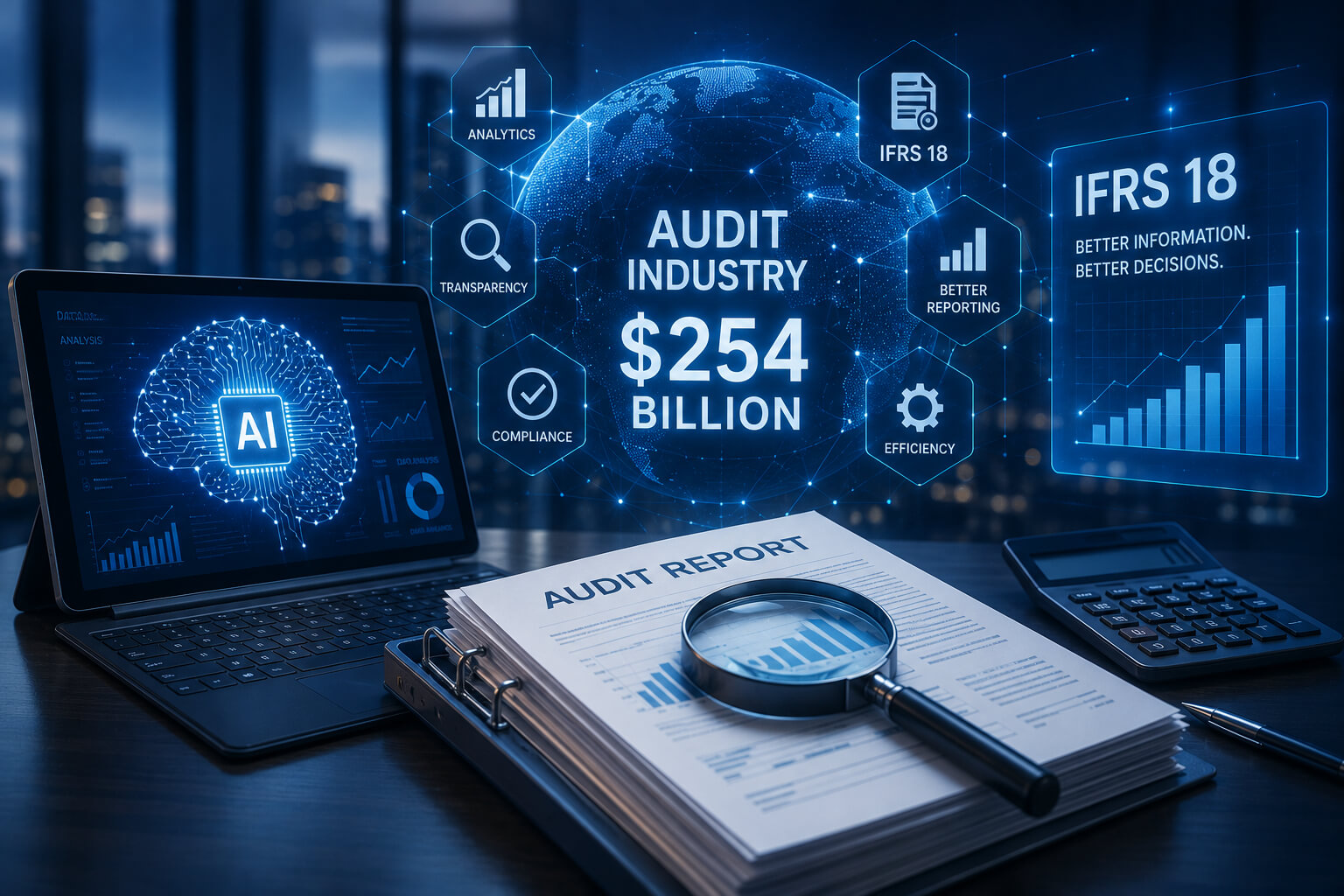
Artificial intelligence is beginning to change the accounting profession in places that rarely attract headlines. Transaction testing. Document reviews. Risk checks. The repetitive work that once swallowed entire audit teams’ schedules.
At the same time, companies face a major financial reporting shift through IFRS 18, a new accounting standard that will change how businesses present their financial performance.
Those two forces came together at an Institute of Chartered Accountants of India Dubai Chapter conference, where finance professionals discussed how AI and IFRS 18 could reshape the global accounting, auditing and assurance sector.
The conference, titled “The Great Shift: IFRS 18 and the Future of Audit,” took place on July 25, 2026, at the JW Marriott Hotel Marina in Dubai. More than 400 accounting professionals reportedly attended the event.
The message from speakers was fairly direct. Audit firms cannot treat AI adoption and IFRS 18 preparation as separate projects anymore.
AI Is Moving Beyond Basic Accounting Automation
Accounting software has automated routine calculations for years. The current wave of AI goes further.
Modern audit tools can examine large collections of transactions, compare documents, detect unusual patterns and flag accounts that may require closer inspection. That gives auditors more time to investigate risks rather than manually checking every entry.
AI can also support continuous auditing. Instead of waiting until the end of a reporting period to review financial activity, companies can monitor selected transactions and controls as they happen.
ICAI has highlighted several areas where AI-powered audit systems can help professionals, including anomaly detection, fraud analysis, documentation, evidence management and data-driven risk assessment.
None of this removes the auditor from the process.
A system may identify an unusual payment. It cannot automatically understand the commercial history behind that payment, the reliability of management’s explanation or the broader risk facing the company. Those decisions still require professional judgment.
The technology handles volume. Auditors remain responsible for meaning.
IFRS 18 Will Change How Companies Explain Performance
The accounting industry is also preparing for IFRS 18, officially known as IFRS 18 Presentation and Disclosure in Financial Statements.
The International Accounting Standards Board issued the standard in April 2024. It will apply to annual reporting periods beginning on or after January 1, 2027, although companies may adopt it earlier. IFRS 18 replaces IAS 1, the long-standing standard governing the presentation of financial statements.
It does not completely rewrite financial accounting. Its biggest changes focus on how companies present information in their statements of profit or loss and explain performance measures.
Under IFRS 18, businesses will need to classify income and expenses using defined categories. The standard also introduces required subtotals, including operating profit and profit before financing and income taxes.
That may sound like a formatting exercise. It is not.
Companies often calculate and describe performance differently, particularly when discussing adjusted earnings, operating results and other management-defined figures. Investors can struggle to compare one business with another when each uses its own labels and calculations.
IFRS 18 aims to bring more structure to those presentations.
Management Performance Measures Will Face More Scrutiny
One of the more significant parts of IFRS 18 involves management-defined performance measures.
Companies frequently publish figures that do not appear as specified totals or subtotals under accounting standards. These may include adjusted operating profit, underlying earnings or profit excluding certain exceptional costs.
Such measures can provide useful context. They can also make weak results appear cleaner than they really are.
IFRS 18 introduces disclosure requirements intended to show how these management-defined measures relate to figures reported in the financial statements. Companies will need to explain why they use the measure, how they calculate it and how it reconciles with the most comparable IFRS total or subtotal.
That creates additional work for finance teams and auditors.
It also creates a possible role for AI. Companies could use automated systems to trace calculations, compare disclosures across reporting periods and identify inconsistencies between internal reports and published financial statements.
The system might catch the mismatch. Someone still has to decide why it happened.
Audit Firms Face a Tight Implementation Window
The January 2027 effective date is no longer far away.
Businesses adopting IFRS 18 need to assess their chart of accounts, reporting software, internal performance measures and financial statement templates. Comparative information also matters, meaning companies may need to prepare earlier-period figures using the new presentation requirements.
Waiting until the final reporting cycle would create unnecessary pressure.
Audit firms face a similar problem. Their teams must understand the new classifications, subtotals and disclosure rules before reviewing client reports. They also need to determine how AI tools fit into their audit methodology without weakening oversight or evidence standards.
Training may become the real bottleneck.
Buying an AI platform is relatively easy. Teaching professionals when to trust its output, when to question it and how to document its use takes longer.
The $254 Billion Figure Needs Some Context
Conference coverage described the global accounting and auditing market as being worth approximately $254.36 billion in 2026, with annual growth estimated at 6.1%.
Market estimates differ considerably depending on which services researchers include. Some reports measure traditional external auditing, while others include accounting, tax, assurance, compliance and related advisory work.
The precise figure is less important than the direction of travel.
Demand for financial transparency, regulatory compliance and digital reporting continues to grow. At the same time, audit firms face pressure to complete more complex work without allowing costs and timelines to expand at the same pace.
AI becomes attractive in that environment because it promises scale. IFRS 18 adds urgency because firms must update systems and reporting practices whether they feel ready or not.
Dubai Is Becoming a Testing Ground for Digital Finance
The choice of Dubai for the discussion was not accidental.
The UAE has been moving toward more digital accounting and auditing practices while expanding its corporate tax and financial compliance framework. Government officials have previously signalled plans for regulations that support the digital transformation of accounting and broaden the role of chartered accountants.
Dubai also has a large professional community serving companies that operate across several jurisdictions. Those businesses often manage different tax systems, reporting requirements and corporate structures.
For them, AI is not merely a way to reduce administrative work. It could help finance teams handle growing volumes of cross-border data.
The risks increase with the scale.
Poorly governed automation can repeat errors across thousands of transactions. Sensitive financial information may pass through third-party systems. An AI-generated explanation may sound convincing while relying on incomplete evidence.
Speed is useful. Control matters more.
Auditors Will Need New Skills, Not Just New Software
The future audit team will probably look different from the traditional model built around large groups of junior staff manually examining samples.
Professionals will need stronger knowledge of data analytics, automated controls and AI governance. They must also understand how models produce recommendations and where those models can fail.
Accounting expertise remains central. It simply has to sit beside technical literacy.
The profession may also need to reconsider how it trains younger auditors. Repetitive testing once gave junior employees an imperfect but practical way to understand financial records. When AI performs much of that work, firms must find other ways to build professional judgment.
That question has no simple answer yet.
AI Will Accelerate Audits, but Responsibility Stays Human
AI and IFRS 18 are arriving through different doors. One comes from technology. The other comes from financial reporting regulation.
Inside an audit firm, however, they meet in the same place.
Both require cleaner data, stronger controls, updated workflows and professionals who can explain how conclusions were reached. AI may speed up testing and reveal patterns that people would miss. IFRS 18 may make financial performance easier to compare.
Neither guarantees better reporting on its own.
The audit industry will still depend on scepticism, independence and human accountability. Software can process the evidence. It cannot carry the responsibility.
