


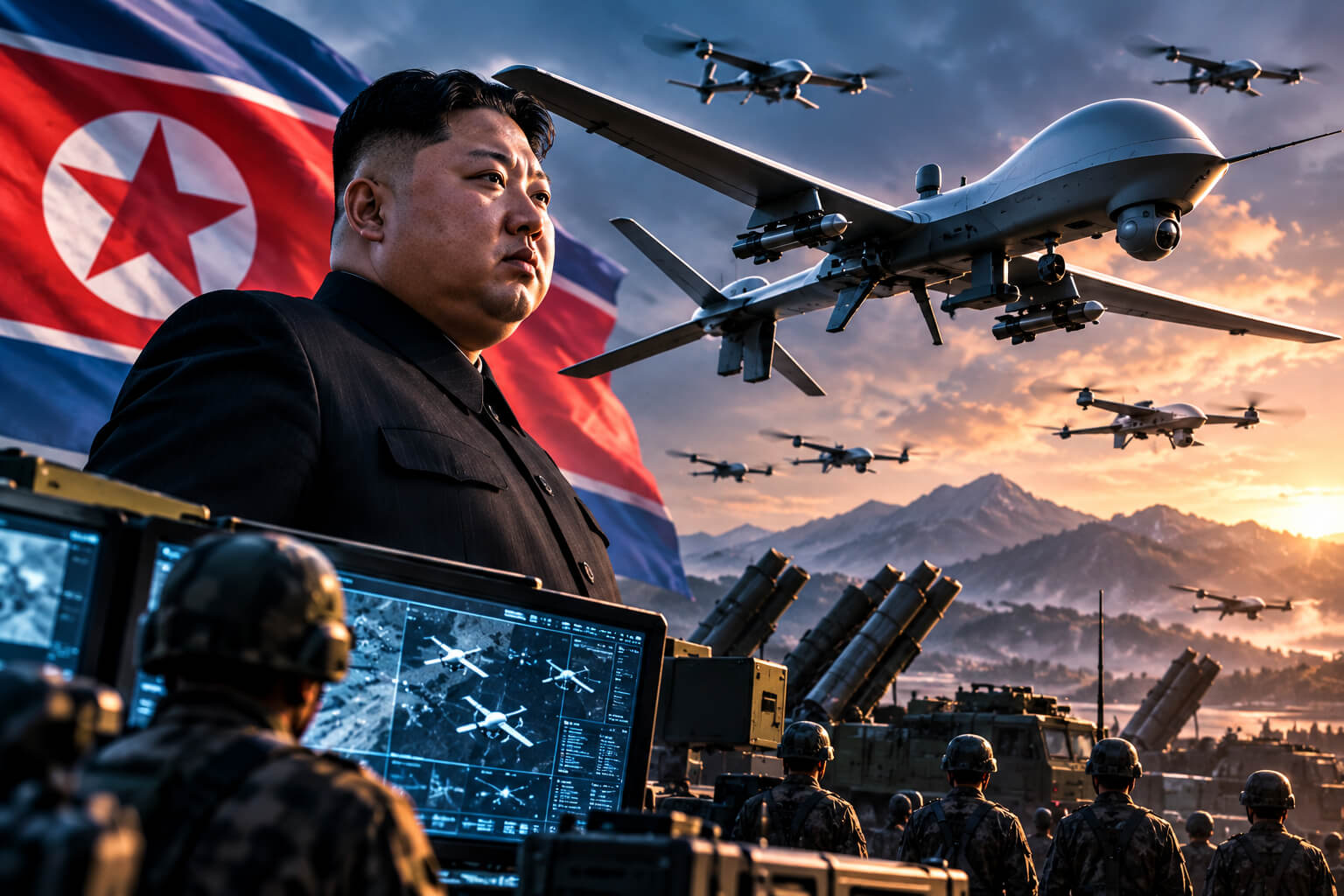
North Korea is stepping up its ambitions in military artificial intelligence, with leader Kim Jong Un calling for absolute superiority in drone technology as the country showcased new unmanned aircraft and advanced weapons systems.
During an unmanned aviation technology exhibition on October 29, 2026, Kim emphasized the importance of artificial intelligence in modern warfare and urged the country’s defense industry to accelerate its development of military drones.
According to North Korea’s state-run Korean Central News Agency (KCNA), the exhibition featured attack drones, tactical cruise missiles, multipurpose unmanned aircraft and large-caliber rocket launchers. The event also included weapons demonstrations intended to highlight Pyongyang’s progress in military technology.
The push comes as drones and AI-assisted systems become increasingly important in conflicts around the world, particularly in Ukraine, where unmanned aircraft have transformed battlefield surveillance and strike operations.
Kim Jong Un Wants North Korea to Dominate Drone Technology
Kim Jong Un has made unmanned weapons development a major priority for North Korea’s military modernization program. Speaking at the exhibition, he argued that achieving technological superiority in drones was essential as modern warfare continues to evolve. His remarks reflect Pyongyang’s growing recognition that unmanned aircraft are no longer supplementary battlefield tools but increasingly important components of military operations.
According to KCNA, Kim called for faster development of advanced drone systems and greater integration of artificial intelligence into military equipment. He described the pursuit of superiority in drone technology as an indispensable response to changing warfare conditions. Although North Korea has demonstrated several unmanned aircraft designs, the actual performance and technological sophistication of its systems remain difficult to independently verify.
North Korea Displays Attack Drones and Advanced Weapons Systems
The exhibition provided a rare public look at North Korea’s expanding collection of unmanned military equipment. State media photographs showed different drone configurations, including aircraft designed for reconnaissance and attack missions. A weapons demonstration featured tactical suicide drones, cruise missiles, multipurpose unmanned aircraft and 600-millimeter multiple rocket launchers, reflecting Pyongyang’s interest in combining traditional firepower with newer military technologies.
KCNA reported that the demonstrated weapons successfully struck designated targets, although those claims have not been independently confirmed. South Korea’s military also reported detecting approximately 10 projectiles, including short-range ballistic missiles, launched by North Korea on October 29. The demonstrations underline the country’s continued investment in weapons development despite international sanctions and persistent tensions on the Korean Peninsula.
Artificial Intelligence Becomes a Priority for North Korea’s Military
Artificial intelligence is increasingly influencing military technology, particularly in areas such as automated navigation, sensor analysis and object recognition. For North Korea, integrating AI into unmanned aircraft could potentially improve how its military systems process battlefield information and perform certain functions with reduced operator involvement. Kim’s latest remarks indicate that Pyongyang wants these capabilities to become an important part of its future armed forces.
Still, there is a considerable difference between announcing AI-powered weapons and demonstrating their effectiveness in real combat conditions. North Korea has released limited technical information about the systems it is developing, making it difficult to assess how much autonomy its drones possess. Advanced AI could support navigation and target identification, but available reporting does not establish whether the country’s weapons can independently make targeting decisions. What is clear is that Kim wants artificial intelligence to play a much larger role in military modernization.
Lessons From the Ukraine War Shape North Korea’s Drone Ambitions
Russia’s war against Ukraine has demonstrated how relatively inexpensive drones can influence military operations, from reconnaissance and battlefield surveillance to precision attacks against vehicles and equipment. These developments have attracted attention from governments seeking to modernize their armed forces without relying exclusively on expensive conventional platforms. North Korea appears particularly interested in adapting lessons from conflicts where unmanned aircraft and electronic warfare have become central to battlefield operations.
The country’s military cooperation with Russia may also provide valuable experience. According to South Korean intelligence cited by Reuters, North Korea has sent more than 16,000 personnel to support Russia since October 2024, exposing its forces to modern drone warfare, electronic systems and combined military operations. Analysts believe this experience could influence North Korea’s future weapons development, although the extent to which battlefield lessons have improved its domestic drone technology remains uncertain.
North Korea Has Been Developing AI-Equipped Drones for Years
North Korea’s latest exhibition is part of a broader effort to expand its unmanned weapons capabilities. In November 2024, Kim reportedly ordered the mass production of suicide attack drones after reviewing their performance during military demonstrations. The following year, state media reported tests involving AI-equipped unmanned aircraft, suggesting that Pyongyang was beginning to incorporate more advanced software into its drone development program.
By September 2025, Kim had identified artificial intelligence as a priority for modernizing the country’s weapons systems. The October 2026 exhibition continues that direction, with North Korea publicly displaying a wider range of unmanned aircraft while emphasizing technological improvements. The repeated announcements demonstrate sustained government interest, but independent information about production capacity, operational readiness and the effectiveness of its AI systems remains limited.
Military AI Development Raises Concerns About Autonomous Weapons
The growing use of artificial intelligence in military systems has raised difficult questions about accountability and human control over weapons. AI-assisted drones can potentially process large amounts of sensor information and support faster operational decisions, but errors in identification, unreliable data or unexpected battlefield conditions can create serious risks. These concerns become more significant when automated technologies are involved in decisions that could result in the use of lethal force.
North Korea’s limited transparency makes assessing those risks particularly challenging. While Pyongyang has repeatedly promoted AI integration in its weapons programs, it has not publicly disclosed sufficient information about the decision-making capabilities or safeguards built into its systems. International discussions about autonomous weapons have increasingly focused on maintaining meaningful human control and ensuring that emerging technologies comply with international humanitarian law. North Korea’s military ambitions add another dimension to those concerns.
Rising Tensions With South Korea Add Urgency to Drone Development
North Korea’s weapons exhibition took place during another period of heightened tensions with South Korea and the United States. Recent disputes along the heavily fortified border, military exercises and missile launches have contributed to growing uncertainty on the Korean Peninsula. Seoul has warned that it will respond firmly to perceived North Korean provocations, while Pyongyang continues to describe joint US-South Korean military activities as threats to its security.
The timing of Kim’s remarks gives the exhibition significance beyond technology development. Publicly displaying drones, missiles and other weapons allows North Korea to demonstrate its military ambitions while signaling that it intends to continue strengthening its defense capabilities. The increasing availability of unmanned systems could further complicate regional security, particularly if future drones become more capable of conducting surveillance and attack missions with limited human intervention.
North Korea’s AI Drone Push Reflects a Changing Era of Warfare
North Korea’s ambition to achieve superiority in drone technology reflects a wider shift in how countries approach military modernization. Artificial intelligence, autonomous navigation and unmanned platforms are becoming increasingly important alongside conventional weapons, creating new opportunities and challenges for armed forces around the world.
Kim Jong Un’s latest directive suggests that Pyongyang intends to pursue these technologies aggressively, drawing on domestic research and lessons from international conflicts. However, questions remain about whether North Korea can overcome the technical, industrial and computing limitations associated with developing sophisticated military AI.
For the global technology industry, the developments highlight the growing overlap between commercial artificial intelligence and military applications. Technologies originally associated with automation, robotics and computer vision are increasingly relevant to national defense.
North Korea has made its intentions clear. Whether it can translate those ambitions into reliable, advanced AI-powered weapons remains to be seen.
Sources
- Reuters — North Korea’s Kim Urges Absolute Superiority in Drone Technology at Weapons Exhibition — October 29–30, 2026.
- Associated Press — Kim Attends a North Korean Drone Exhibition and Calls for Boosting the Technology — October 30, 2026.
- Reuters via MarketScreener — North Korea’s Kim Urges Drone Dominance and Greater Military AI Use Amid Border Tensions — October 30, 2026.
- RTHK / AFP — DPRK’s Kim Calls for Drone Dominance — October 30, 2026.
