


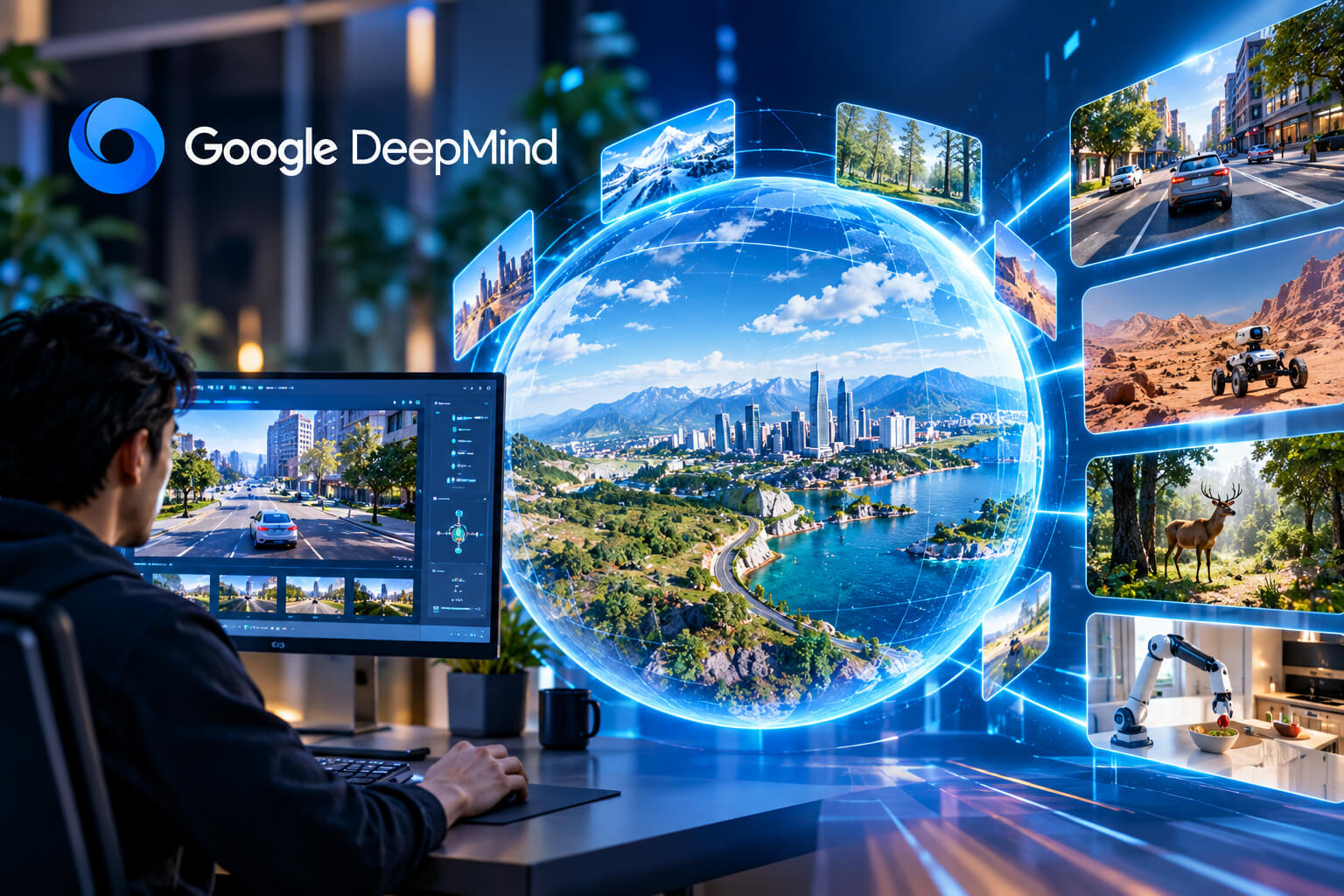
Google DeepMind has introduced Genie 4, its latest artificial intelligence world model, designed to generate interactive digital environments that respond to user actions in real time.
Announced on October 27, 2026, the technology takes AI-generated content beyond traditional video creation. Rather than producing scenes that people can only watch, Genie 4 allows users to explore simulated environments, interact with objects and influence events as they unfold.
The model combines visual generation, environmental audio and AI-driven interactions. Google DeepMind is exploring how these capabilities could support gaming, robotics, filmmaking and the development of more capable autonomous AI systems.
Genie 4 Creates Interactive Worlds That Respond to Users
Unlike conventional AI video generators, Google DeepMind Genie 4 focuses on environments that users can actively explore. A person can move through a generated landscape, introduce new objects or change environmental conditions while the model updates the surrounding scene. Natural language instructions help shape these interactions, allowing users to experiment with different settings without manually constructing every element.
Google DeepMind has demonstrated simulated environments featuring natural landscapes, fictional locations and interactive characters. The technology attempts to maintain visual consistency as users navigate through these worlds, making the experience feel closer to an interactive digital environment than a traditional AI-generated video. The company has also worked on improving how the model represents movement, collisions and other physical interactions, although its simulations are not always physically accurate.
Native Audio Makes AI-Generated Environments More Immersive
Sound plays an important role in Genie 4’s approach to world simulation. The model can generate environmental audio alongside visual content, allowing sounds to change as events unfold within a scene. A simulated coastal environment, for example, might include waves and wind, while an indoor setting could feature footsteps, movement and other background sounds.
The technology also introduces opportunities for interactive dialogue with AI-generated characters. Rather than relying entirely on prerecorded conversations, simulated characters can respond to changing situations. This could prove useful for developers experimenting with virtual experiences, interactive storytelling and training environments where audio and visual behaviour need to work together.
Gemini Integration Helps Genie 4 Handle Complex Simulations
Google DeepMind is exploring how Genie 4 can work alongside its Gemini AI models to support more sophisticated interactions. While Genie 4 generates the simulated environment, Gemini can help interpret objectives, plan actions and guide behaviour within the scene. The combination brings together visual world generation and AI reasoning, two capabilities that have traditionally developed along separate paths.
This approach could allow AI agents to practise completing tasks inside generated environments. A simulated robot, for instance, might receive instructions to identify objects, move through a room or perform a sequence of actions. Gemini could help determine what the agent should do next while Genie 4 provides the changing visual environment. Such experiments remain early-stage, but they point toward systems that could learn through simulated experiences rather than relying entirely on static training data.
Gaming and Filmmaking Could Benefit From Genie 4
For game developers, Genie 4 could provide a faster way to experiment with interactive environments during the early stages of production. Instead of building every landscape, object and movement sequence from scratch, creative teams could use AI-generated simulations to test concepts and explore different visual directions. The technology is not yet a replacement for established game engines, but it could become a useful tool for prototyping.
Filmmakers and digital artists may find similar opportunities. AI-generated environments could help creative teams experiment with lighting, camera perspectives and scene composition before committing resources to production. Interactive storytelling is another possibility, particularly for experiences where characters and environments respond dynamically to audience choices. The challenge will be maintaining consistency and giving creators enough control over the final result.
Genie 4 Could Support Robotics and Autonomous AI Research
Robotics researchers are increasingly interested in simulated environments because testing physical machines can be expensive, time-consuming and difficult to scale. Genie 4 could offer another way to expose AI systems to different environments, obstacles and situations before they encounter comparable conditions in the real world. A robot could potentially practise navigating unfamiliar spaces or responding to changing surroundings without requiring every scenario to be physically recreated.
There are important limitations, however. A visually convincing simulation does not guarantee that objects will behave according to real-world physics. Robots trained on inaccurate simulated interactions may struggle when transferred to physical environments. Google DeepMind’s research therefore represents a possible addition to existing robotics simulation methods rather than a complete alternative to them.
Google DeepMind Acknowledges Limitations in Genie 4
Despite its progress, Genie 4 remains an experimental technology. Maintaining consistency across extended interactions is particularly difficult for generative world models. Objects may change appearance, spatial relationships can become unstable and complicated physical interactions may not unfold as expected. These problems become more noticeable when users attempt to perform precise actions or explore an environment for longer periods.
Google DeepMind is also examining safety concerns associated with increasingly realistic AI-generated environments. As simulated scenes become harder to distinguish from genuine footage, identifying synthetic content becomes more important. Technologies such as Google’s SynthID watermarking system are part of the company’s broader approach to AI-generated media transparency, although watermarking alone cannot eliminate the risks of misleading content.
Genie 4 Signals a Bigger Shift Toward AI That Understands the World
Genie 4 reflects Google DeepMind’s broader interest in developing AI systems capable of reasoning about and interacting with their surroundings. Large language models have become increasingly effective at processing text, images and other information, but understanding how actions change an environment remains a difficult research challenge. World models attempt to address part of that problem by learning how scenes evolve and how different elements interact.
The implications extend beyond producing realistic virtual worlds. More capable simulation models could eventually help autonomous agents test decisions, anticipate outcomes and adapt to unfamiliar situations. Genie 4 is still an early step toward that ambition, and significant technical challenges remain. Its development nevertheless shows how generative AI is moving from creating content toward producing environments in which intelligent systems can act.
Sources
Primary Source: Google DeepMind — Genie 4: A New Generation of World Simulation
https://deepmind.google/blog/genie-4-a-new-generation-of-world-simulation/
Additional Reference: Google DeepMind — Genie Models
https://deepmind.google/models/genie/
