


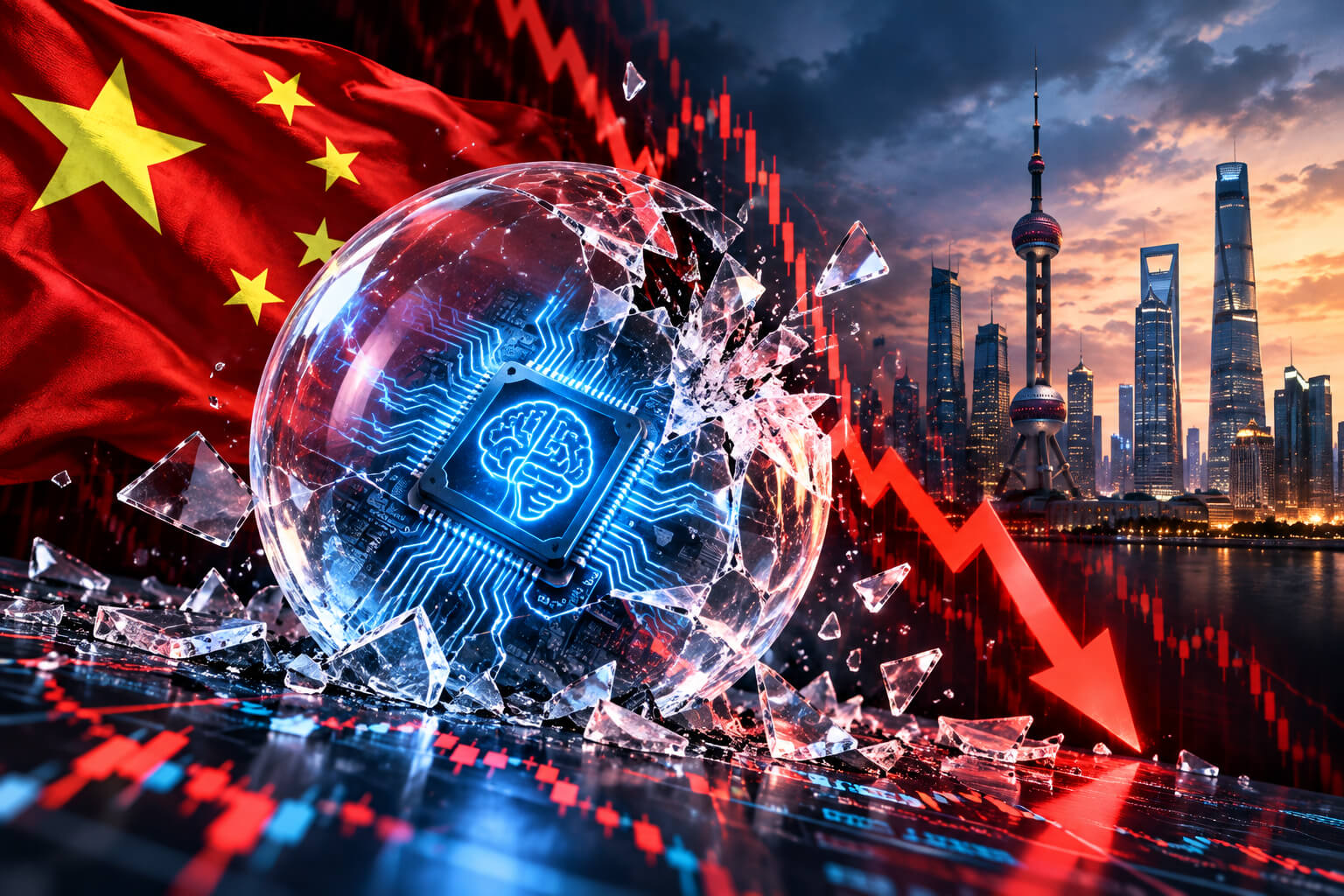
China’s artificial intelligence boom has run into trouble. After two years of soaring technology valuations and heavy investor enthusiasm, the country’s AI-focused stock market has suffered a sharp correction, wiping out approximately $480 billion in market value.
The sell-off has dragged China’s STAR50 index, which tracks major technology and semiconductor companies, down roughly 40% in less than four months. Several businesses once considered promising investments in China’s AI expansion have lost half their share value.
According to Reuters, concerns about excessive valuations, uncertain demand for AI technology and possible restrictions on Chinese equipment exports have contributed to the downturn.
The losses are particularly striking because artificial intelligence remains a major priority for Beijing. Investors who expected government support to protect the sector are discovering that even strategically important industries are vulnerable to market corrections.
China’s AI Stock Market Faces a Harsh Reality Check
The China AI bubble developed as investors poured money into companies involved in semiconductors, robotics, computing infrastructure and other technologies associated with artificial intelligence. Government efforts to strengthen domestic innovation added momentum, while expectations of sustained AI demand encouraged investors to pay increasingly high prices for technology shares.
That confidence has weakened. China’s broader blue-chip index has fallen approximately 20% from its June highs, while the STAR50 has experienced an even steeper decline. The reversal has also interrupted a two-year market rally that gained strength following promises of economic stimulus.
Unlike a market crash caused by one major announcement, China’s technology sell-off appears to reflect several overlapping concerns. High valuations left little room for disappointing earnings, while uncertainty surrounding export restrictions raised questions about future international sales.
Investors are now reconsidering whether the expected growth of China’s AI industry can justify the prices they previously paid for its leading companies.
Chinese AI Companies Suffer Heavy Share Price Losses
Some of China’s most closely watched technology companies have experienced dramatic declines. Robotics manufacturer Unitree, which attracted extraordinary investor interest during its stock market listing in August, has seen its shares lose approximately half their value since trading began.
The semiconductor industry has suffered similar setbacks. Memory chipmaker CXMT has declined more than 25% over the past month, while MetaX Integrated Circuits and Moore Threads Technology have each lost roughly half their value since July. Both companies had previously enjoyed remarkable stock market debuts, attracting investors eager to benefit from China’s expanding semiconductor industry.
Optical component manufacturers Zhongji Innolight and Eoptolink Technology have faced even sharper declines, with their shares falling around 60% from earlier peaks. Concerns about potential American restrictions on Chinese equipment used in US data centres have added pressure to these businesses.
The losses have affected retail investors who viewed AI-related companies as attractive long-term investments. Some had interpreted government backing as a sign of stability, only to watch their holdings decline as market sentiment changed.
Why the China AI Bubble Is Raising Investor Concerns
China’s AI market correction has exposed the risks of concentrating too much investment in a single technology trend. Artificial intelligence became a dominant theme across mainland Chinese and Hong Kong stock exchanges, drawing attention away from other sectors.
According to Goldman Sachs figures cited by Reuters, AI-related stocks accounted for approximately 42% of market capitalisation and 57% of trading turnover across mainland-listed A-shares and Hong Kong-listed H-shares.
Such concentration magnified the impact of the sell-off. As investors reduced their exposure to technology companies, declining prices affected a substantial portion of the wider market.
Valuations remain another concern. Even after the correction, the STAR50 index was trading at approximately 100 times trailing earnings, compared with around 30 times for the Nasdaq 100. Although the Chinese index had previously traded near 250 times earnings, its remaining premium suggests investors still expect substantial future growth.
The problem is that expectations do not always translate into profits. Developing advanced AI chips, robotics systems and computing infrastructure requires significant investment, and companies must eventually demonstrate that those expenses can produce sustainable financial returns.
China’s AI Market Crash Contrasts With US Technology Stocks
The downturn in Chinese AI stocks has been considerably more severe than the correction experienced by American technology companies during the same reporting period.
While China’s STAR50 lost approximately 40% in less than four months, the technology-heavy Nasdaq had declined around 6% from its recent record high, according to Reuters.
The difference reflects how investors assess the commercial opportunities and risks facing technology companies in each market. Chinese semiconductor and equipment manufacturers must navigate domestic competition while dealing with uncertainty surrounding access to international customers.
Potential restrictions on Chinese equipment entering American data centres are particularly concerning for businesses that previously expected global demand to support their expansion.
For investors, the comparison highlights an uncomfortable reality. The worldwide AI industry may continue growing, but companies operating within that industry will not necessarily experience the same financial success.
Some businesses could benefit from rising demand for computing power and AI services. Others may struggle with pricing pressure, expensive research programmes and limited opportunities to expand overseas.
Beijing’s Technology Ambitions Face Growing Pressure
China has spent years encouraging investment in artificial intelligence, semiconductor manufacturing and advanced robotics. These industries form an important part of Beijing’s efforts to reduce dependence on foreign technology and strengthen domestic innovation.
The market correction complicates that strategy. Falling valuations can make it harder for technology companies to raise capital through public offerings or additional share sales, particularly when investors become reluctant to finance businesses with uncertain earnings prospects.
Chinese authorities have also attempted to improve market stability by addressing excessive leverage and high-frequency trading. Their broader objective has been to encourage a more sustainable stock market rather than repeated cycles of speculation and collapse.
Yet enthusiasm surrounding AI appears to have pushed parts of the market beyond those ambitions. Some investment professionals have warned that the unusually large weighting of technology companies in major indexes distorted capital allocation and encouraged excessive speculation.
Despite the losses, not every institutional investor has abandoned Chinese technology stocks. Goldman Sachs has continued to identify selected AI-related companies as potential opportunities, while other market strategists believe lower valuations could eventually attract cautious buyers.
What China’s AI Bubble Means for Global AI Investments
China’s technology sell-off is likely to influence how investors evaluate artificial intelligence companies beyond its borders. The correction demonstrates how quickly enthusiasm can disappear when market prices move too far ahead of financial performance.
The consequences could extend to fundraising, corporate expansion and competition within the semiconductor industry. Companies that previously relied on strong investor demand may need to demonstrate clearer paths to profitability before securing additional financing.
Price competition could become another challenge. As Chinese manufacturers expand production capacity and compete for customers, pressure to lower prices may reduce profit margins even if demand for AI equipment continues increasing.
That creates a difficult environment for businesses investing heavily in research, manufacturing and infrastructure. Strong technological capabilities alone may not be enough to support expensive valuations.
Still, a stock market collapse should not be confused with the failure of artificial intelligence itself. Chinese companies continue developing AI models, robotics platforms and semiconductor technologies. The underlying industry remains active even as investors question how much its future growth is worth.
Can China’s AI Industry Recover From the Market Crash?
The future of China’s AI-related stock market will depend partly on whether technology companies can deliver the earnings growth investors previously expected.
Businesses with established customers, competitive products and reliable revenue streams may be better positioned to recover. Companies relying heavily on speculative expectations could face a longer period of weak valuations.
International trade policy will also matter. Restrictions affecting Chinese semiconductor equipment and data centre suppliers could limit opportunities in overseas markets, forcing some businesses to compete more aggressively for domestic customers.
There is still interest in China’s technology sector, but investors appear less willing to treat every company associated with artificial intelligence as a guaranteed growth opportunity.
The China AI bubble has delivered a costly reminder that technological progress and stock market performance are not the same thing.
Artificial intelligence may continue transforming industries, attracting investment and creating new businesses. Whether individual companies can generate enough profit to justify their valuations is a different question.
For China’s technology investors, that distinction has already become painfully clear.
