


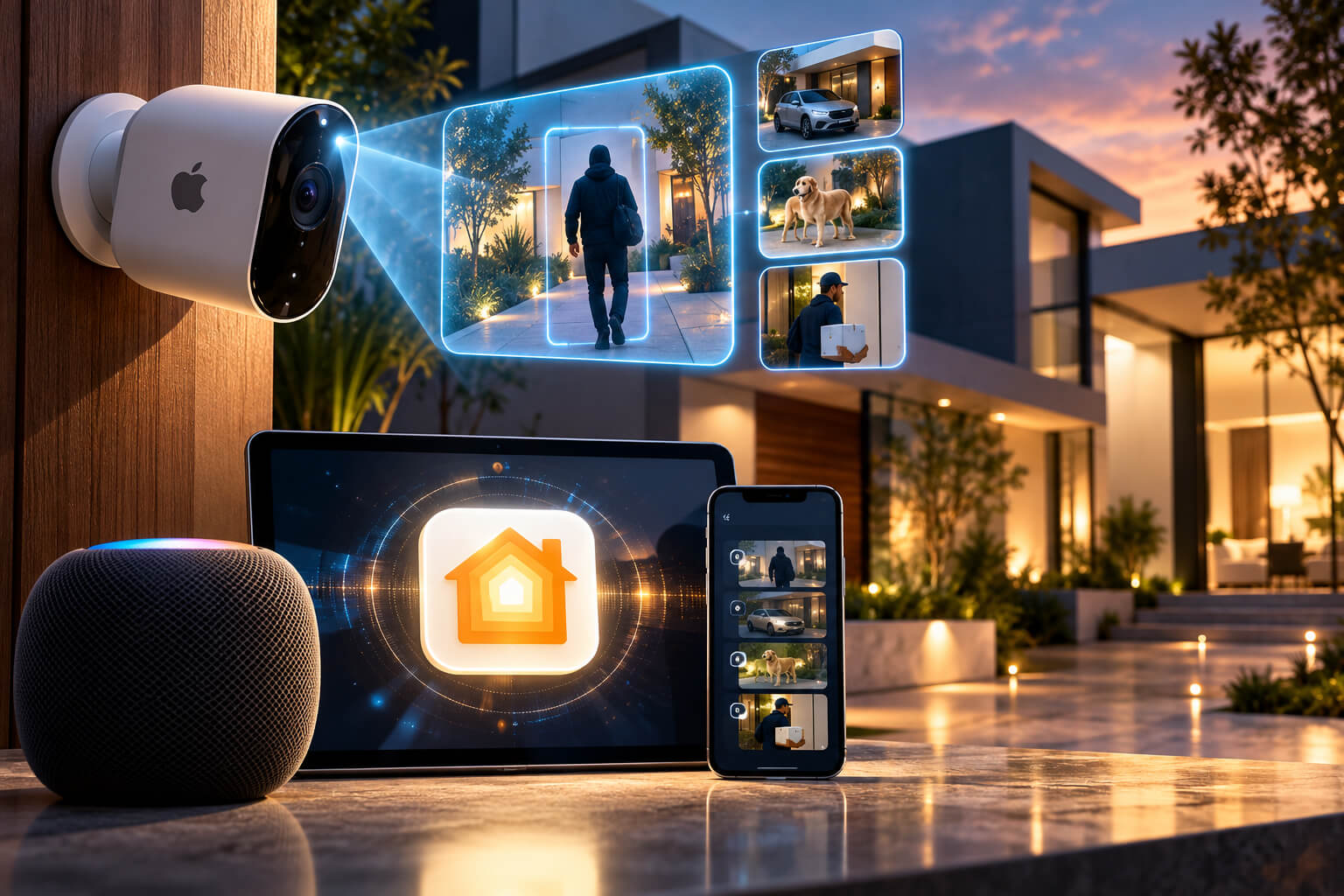
Apple is giving its Home app a more intelligent role in household security. With Apple Intelligence, compatible security cameras can now deliver AI-generated descriptions of recorded events, organize important activities and reduce unnecessary notifications.
The technology promises to make home monitoring easier. Instead of reviewing several camera recordings, homeowners can receive a summary explaining what happened outside their property.
Yet the convenience comes with questions about data privacy, cloud processing and the cost of accessing Apple’s latest smart home features.
Apple Intelligence Brings Smarter Video Monitoring to the Home App
Apple Intelligence is changing how homeowners interact with security cameras through the Home app. Rather than simply recording movement and sending notifications, the system can analyze detected activities and generate descriptions that explain what a camera captured.
The feature works with compatible HomeKit Secure Video cameras and helps users identify events involving people, pets, vehicles and packages. Homeowners can search for particular activities without manually reviewing long recordings.
For example, someone checking whether a package arrived can look for the relevant event instead of scrolling through an entire day’s footage. The Home app also highlights noteworthy activities, helping users focus on recordings that may require attention.
This approach moves Apple’s smart home ecosystem beyond traditional surveillance. Cameras are no longer just recording devices. They are becoming tools that interpret everyday activity and present information in a more useful format.
AI-Generated Summaries Help Reduce Unnecessary Security Notifications
Home security cameras often generate repeated alerts, especially when several devices monitor the same area. A person walking toward the front door might trigger notifications from a driveway camera, an entrance camera and other connected sensors.
Apple’s Reduced Notifications feature attempts to address this problem by grouping related activities into fewer alerts. Instead of receiving multiple interruptions, users can get a more organized notification that reflects what is happening around their home.
Apple Intelligence can also generate descriptive summaries of recorded events. These descriptions make it easier to understand camera activity without opening every video clip.
The two capabilities operate separately. Reduced Notifications is enabled by default, while users must manually activate Summarise Videos through the Home app.
For households with multiple security cameras, the difference could be significant. Less time spent checking notifications means users can concentrate on events that actually matter.
Apple’s AI Camera Features Put Data Privacy Under the Spotlight
Artificial intelligence introduces a different set of concerns when it begins interpreting footage captured around private homes. Security cameras can reveal personal routines, visitors, delivery schedules and other details that homeowners may not want exposed.
Apple says its system uses on-device processing for certain tasks while relying on Private Cloud Compute for more demanding AI operations. When compatible cameras identify relevant activity, selected footage may undergo additional analysis through Apple’s cloud infrastructure.
The resulting description returns to the user’s device, and Apple says Private Cloud Compute deletes the processed information after completing the request.
The company also maintains end-to-end encryption protections for HomeKit Secure Video recordings.
Still, the distinction between local processing and cloud-based analysis matters. Some AI-generated descriptions require footage to leave the user’s device temporarily, even when Apple applies privacy safeguards.
For consumers who prioritize privacy, understanding how these systems handle sensitive information will be just as important as the convenience they provide.
Apple Home AI Summaries Come With Higher iCloud+ Subscription Requirements
Apple’s latest security features also introduce additional costs for homeowners who want AI-powered summaries across several cameras.
According to MacRumors, access to AI video summaries depends on the user’s iCloud+ subscription tier. The 2TB plan, priced at $9.99 per month in the United States, supports summaries for one camera.
The 6TB subscription, costing $29.99 monthly, extends support to two cameras. Households seeking AI summaries for up to five cameras need the 12TB plan, which costs $59.99 per month.
These limits are separate from the number of cameras supported for standard HomeKit Secure Video recording.
That means users may already have enough storage and recording capacity for several cameras but still need a more expensive subscription to unlock AI summaries across their entire security setup.
For homeowners managing larger properties, the additional cost could influence whether they adopt Apple’s new features or continue using conventional camera notifications.
Apple Is Developing a More Privacy-Focused Approach to Home Security
Apple’s interest in artificial intelligence for home monitoring appears to extend beyond the software already available through the Home app.
Reports indicate that the company is developing its own security camera designed to analyze household activity without relying on conventional video recording.
The rumored device could use visual information to recognize activity and generate text-based descriptions rather than storing continuous footage.
Such an approach could reduce the amount of recorded video retained within a household security system. It could also support smarter home automation by identifying when people enter rooms or move through different areas of a property.
However, a camera that does not preserve footage would introduce practical limitations. Homeowners investigating suspicious activity may still need recorded video as evidence.
Apple has not officially announced the device, although reports suggest that its security camera could arrive in 2027.
Homeowners Can Manage Apple Intelligence Through Privacy Settings
Apple allows users to control how its AI-powered Home features operate, including whether video summaries are generated for compatible cameras.
Through the Home app, homeowners can access Home Settings and navigate to the Apple Intelligence section. From there, they can manage Reduced Notifications and Summarise Videos independently.
Users can also disable video summaries for individual cameras, allowing them to apply different settings depending on where each device is installed.
For example, a homeowner might enable AI summaries for an outdoor driveway camera while keeping the feature disabled for cameras monitoring more private areas.
These controls give users flexibility, although they still need to understand which features use local processing and which may involve Apple’s cloud infrastructure.
AI-Powered Home Security Faces a Growing Trust Challenge
Apple’s AI-powered Home features highlight a broader change taking place across the smart home industry. Security systems are becoming more capable of interpreting events, identifying patterns and delivering information without requiring users to review every recording.
The benefits are practical. Homeowners can receive fewer unnecessary alerts, locate important footage more quickly and understand what happened around their property through simple descriptions.
But the technology also changes the relationship between users and their security cameras.
A traditional camera records what happens. An AI-powered camera goes further by analyzing that activity and deciding which details deserve attention.
Apple is positioning privacy protections as an important part of this transition, particularly through encryption, device-level processing and Private Cloud Compute.
Whether those safeguards will satisfy privacy-conscious homeowners remains uncertain.
For now, Apple Home AI summaries represent another step toward intelligent household monitoring, where convenience increasingly depends on how much information users are comfortable allowing artificial intelligence to process.
