


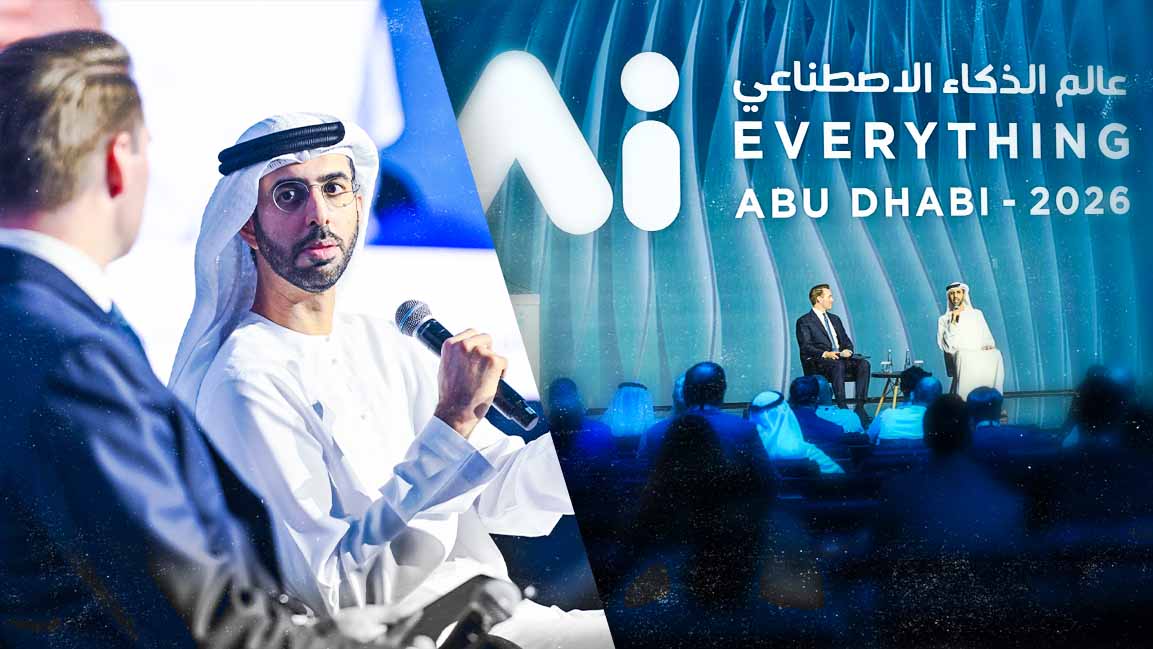
Artificial intelligence is moving deeper into the business and government systems of the UAE, and Ai Everything Abu Dhabi 2026 put that shift on display.
Held at ADNEC Centre Abu Dhabi on October 6 and 7, the event brought together AI companies, investors, government leaders, infrastructure providers and startups from around the world. The focus was less on flashy demonstrations and more on what happens when AI gets deployed inside real organisations.
The event brought together more than 400 AI infrastructure builders, model makers, unicorns and startups, along with more than 200 investors managing $91 billion in assets. More than 180 speakers participated, with attendees representing more than 60 countries.
For Abu Dhabi, the gathering also served a bigger purpose. The emirate is positioning itself as a place where AI can be developed, funded and deployed at scale.
Abu Dhabi Wants AI Embedded in Government
Abu Dhabi’s AI ambitions extend well beyond introducing chatbots or automating individual government services. The emirate is working toward becoming the world’s first AI-native government by 2027, a target that would put artificial intelligence much closer to the centre of how public services operate.
Ahmed Tamim Hisham Al Kuttab, Chairman of the Department of Government Enablement, told Ai Everything Abu Dhabi that countries and economies that build their AI foundations early will have a stronger position in the emerging economy. He highlighted three requirements in particular: compute, capital and customers prepared to adopt the technology.
That combination is important. Government can become one of the largest customers for AI, while infrastructure and investment provide the conditions for companies to build and scale. Abu Dhabi is attempting to connect all three.
Sovereign AI Becomes a Strategic Priority
The global AI conversation is increasingly moving toward sovereignty. Governments want greater control over their data, computing resources and critical AI systems, particularly as artificial intelligence becomes connected to public services, national infrastructure and strategic industries.
That issue featured prominently at Ai Everything Abu Dhabi. Faisal Al Bannai, Adviser to the UAE President and Secretary General of the Advanced Technology Research Council, discussed the importance of sovereign AI as governments consider how much control they should retain over the technologies shaping their economies.
The shift is bigger than simply developing a local AI model. Sovereign AI requires access to computing power, data, technical expertise, infrastructure and capital. Abu Dhabi is investing across those areas as it tries to build an AI ecosystem that does not depend entirely on external capabilities.
Mistral AI Adds a Global Perspective to the AI Debate
The sovereignty discussion also reached the commercial AI market, where businesses are increasingly concerned about where their data is stored, where models operate and who controls the underlying technology.
Arthur Mensch, co-founder and CEO of Mistral AI, was among the technology leaders participating in the Abu Dhabi event. His presence brought a European perspective to a debate that is no longer limited to governments. Enterprises are also asking questions about openness, security, model control and deployment.
For companies handling sensitive financial, government or customer information, those questions can determine whether an AI system moves from a pilot project into daily operations. The model may be powerful, but businesses still need to know how and where they can safely use it.
G42 Brings AI Into Executive Decision-Making
AI is also moving upward inside companies. Instead of being used only for productivity tasks, new systems are being designed to support management decisions, business intelligence and strategic planning.
That direction was visible at Ai Everything Abu Dhabi through the launch of Insight, an AI-native decision intelligence platform from Inception42, G42’s sovereign agentic AI company. The platform is aimed at boards and executive teams that need to work through large amounts of information before making important decisions.
The launch reflects a broader change in enterprise AI. Companies are beginning to explore systems that can analyse information, connect different sources and support decisions rather than simply respond to individual prompts.
That raises a different set of questions around governance and accountability. Once AI becomes part of an executive decision process, organisations have to be clear about who ultimately makes the call.
AI Infrastructure Is Becoming a Business Advantage
Behind every large AI deployment is an infrastructure problem. Advanced models require enormous amounts of computing power, while organisations deploying AI at scale need data centres, cloud systems, connectivity, energy and cybersecurity.
Those requirements were a major part of the wider Ai Everything Abu Dhabi programme. The event placed attention on sovereign cloud, semiconductors, quantum technology and other infrastructure needed to support the next phase of AI adoption.
This is where the AI race starts to look less like a pure software competition. Countries and companies that control access to compute and energy can influence how quickly AI systems are developed and deployed.
Abu Dhabi sees that infrastructure layer as an opportunity. Its investments in technology, data centres and advanced computing are part of a wider attempt to establish the emirate as a major AI hub.
Businesses Are Moving From AI Experiments to Deployment
The first wave of corporate AI adoption produced plenty of pilots. Companies tested generative AI assistants, automated small processes and experimented with internal tools.
The conversation is changing now. At Ai Everything Abu Dhabi, the emphasis was increasingly on real business applications across sectors including government, banking, healthcare, energy and education. Companies are being pushed to demonstrate what AI actually changes inside an organisation.
That means productivity gains, lower operating costs, faster processes, improved customer experiences or entirely new products. A convincing AI demonstration is no longer enough if it cannot survive contact with a real business environment.
This is also where the UAE’s government strategy becomes significant. Large-scale public-sector deployment can provide a demanding testing environment for AI systems while creating a substantial customer base for technology companies.
AI Skills Are Becoming Part of the Infrastructure
Computing infrastructure alone cannot create an AI economy. Companies also need people who understand how to build, deploy, supervise and work with AI systems.
Ai Everything Abu Dhabi placed workforce development alongside technology and investment, with training and workshops covering areas such as multi-agent workflows, rapid prototyping, model development and responsible AI.
That focus addresses one of the more difficult problems facing businesses. Organisations can purchase access to models and cloud platforms relatively quickly, but developing an AI-capable workforce takes much longer.
For the UAE, developing that talent base is closely connected to its wider ambition to become an international AI centre. Infrastructure may attract companies, but skilled people are needed to keep those companies growing.
Abu Dhabi Is Building an AI Economy Around Deployment
The broader message from Ai Everything Abu Dhabi was not simply that AI is important. Abu Dhabi is trying to create the conditions for AI companies to build, invest, deploy and scale from the emirate.
Government demand gives companies potential customers. Investment provides capital for expansion. Sovereign infrastructure supports sensitive applications. International technology companies bring models and expertise, while local organisations provide environments where those systems can be tested.
That creates a different proposition from hosting another technology conference. Abu Dhabi wants the AI ecosystem around the event to keep operating long after the exhibition floor closes.
The Next AI Race Will Be About What Gets Built
The most interesting part of Ai Everything Abu Dhabi was arguably not a particular product launch or model announcement. It was the attention given to the infrastructure surrounding artificial intelligence.
Compute, energy, data, capital, talent and customers are becoming strategic assets as AI moves into more important parts of the economy.
Abu Dhabi is attempting to assemble those pieces at the same time as it transforms its own government operations. Its goal of becoming the world’s first AI-native government by 2027 gives the strategy a very large real-world test.
The AI race is no longer just about who has the smartest model.
It is increasingly about who can build the ecosystem that puts those models to work.
Sources
- Fast Company Middle East — AI Gets Down to Business at Ai Everything Abu Dhabi
Read the original report - Ai Everything Abu Dhabi — Official Event Information
Read the official event announcement - Gulf News — Ai Everything Abu Dhabi
Read the Gulf News report
