


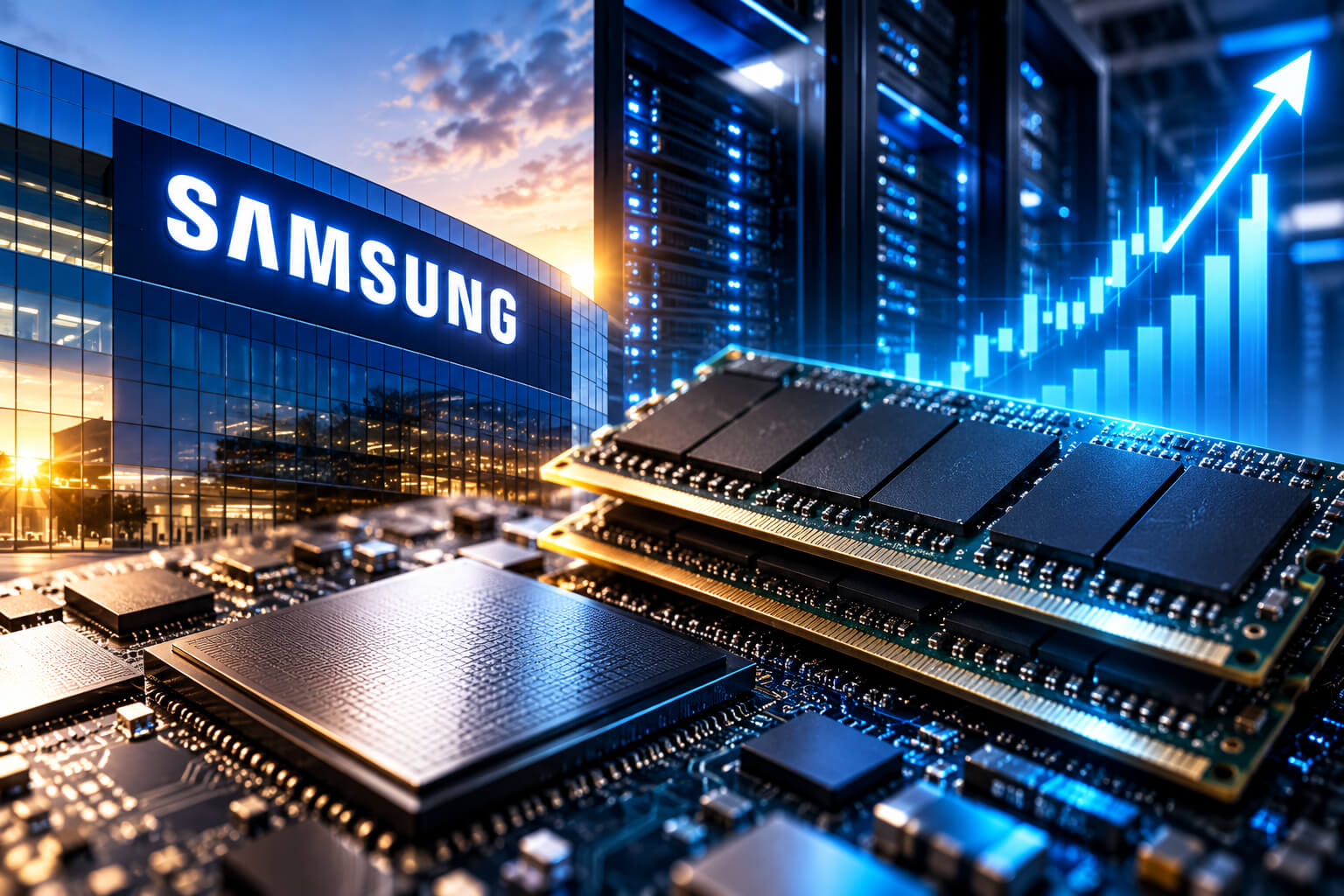
Samsung Electronics is getting a massive boost from the global AI infrastructure buildout, with the company forecasting quarterly operating profit of about $80 billion as demand for advanced memory chips accelerates.
Samsung expects third-quarter operating profit to reach 107.4 trillion Korean won, equivalent to roughly $80 billion, up 782.5% from 12.17 trillion won a year earlier. Revenue is expected to reach approximately 195 trillion won, according to the company’s preliminary earnings guidance.
The numbers show how deeply the AI boom has moved into the semiconductor supply chain. Data centres need huge amounts of high-performance memory, and Samsung is one of the world’s biggest suppliers.
AI Infrastructure Is Turning Memory Chips Into a Major Growth Engine
Samsung’s latest forecast arrives as technology companies continue spending heavily on AI data centres and computing infrastructure. The machines running large AI models need powerful processors, but those processors also depend on fast memory to move and access enormous amounts of data.
That demand has changed the economics of the memory market. Samsung’s semiconductor business is positioned to benefit as data-centre operators and AI companies increase their purchases of high-performance memory.
The company’s projected third-quarter operating profit is more than seven times its result from the same quarter last year. Revenue is also expected to more than double year over year, reaching around 195 trillion won.
High-Bandwidth Memory Is at the Centre of the AI Chip Race
High-bandwidth memory, or HBM, has become one of the most important components in modern AI computing. AI accelerators process enormous workloads, and faster access to memory can have a direct impact on system performance.
Samsung has been pushing to strengthen its position in HBM as demand from AI chipmakers and data-centre operators rises. The market has become increasingly important because newer AI systems require far more memory bandwidth than conventional computing workloads.
For Samsung, success in HBM is about more than selling another type of memory chip. It is about securing a bigger role in the infrastructure behind the AI models and applications driving the current technology spending cycle.
Memory Prices Are Rising as AI Demand Stretches Supply
The AI boom is also creating pressure across the wider memory market. Demand for DRAM and other memory products has increased as data-centre operators expand capacity, while manufacturers face limits on how quickly they can add new production.
That supply pressure can be particularly valuable for memory manufacturers because higher prices can quickly improve margins when demand remains strong.
Samsung’s latest numbers show the financial impact. Its projected operating profit of 107.4 trillion won compares with 89.49 trillion won in the second quarter and just 12.17 trillion won in the third quarter of 2025.
Samsung’s Record Profit Is Not Coming From Every Business
Samsung’s overall result looks spectacular, but the AI-driven semiconductor boom does not benefit all of its businesses in the same way.
The company’s memory operation gains when chip prices and demand rise. Consumer electronics and mobile businesses, on the other hand, can face higher component costs when memory becomes more expensive.
That creates an unusual situation for a company as diversified as Samsung. The same semiconductor cycle that strengthens its chip business can increase costs elsewhere in the organisation.
The detailed third-quarter results will therefore matter. Investors will want to see exactly how much of the improvement came from memory and how other divisions performed.
$80 Billion Profit Forecast Shows the Scale of AI Hardware Spending
Samsung’s projected $80 billion operating profit is striking not simply because of its size, but because of what sits behind it.
The AI industry has spent years talking about enormous infrastructure requirements. Samsung’s earnings forecast offers a tangible financial measure of that spending as it reaches the semiconductor supply chain.
AI companies need data centres. Data centres need servers. Servers need processors, storage and high-speed memory. Samsung sits deep inside that chain.
The company’s quarterly numbers are therefore becoming another useful indicator for the broader AI economy.
Samsung Is Still Fighting for a Bigger Share of the HBM Market
The memory boom does not mean Samsung has the AI semiconductor market to itself. Competition remains intense, particularly in high-bandwidth memory, where rivals such as SK Hynix have established strong positions.
Samsung has been investing in its HBM technology and production capabilities as demand shifts toward more advanced memory generations.
The next phase of the competition will revolve around supplying increasingly capable AI systems while meeting demanding requirements for performance, reliability and production volume.
Samsung Will Release Its Full Third-Quarter Results on October 29
The figures announced this week remain preliminary. Samsung has scheduled its full third-quarter financial results for October 29, 2026, when the company will provide more detailed information through its earnings release and conference call.
That update should provide a clearer breakdown of the company’s semiconductor performance and offer more detail on the factors behind the dramatic year-on-year increase in operating profit.
It will also give investors a better view of how sustainable the current AI-driven memory cycle could be.
AI’s Hardware Bill Is Showing Up in Samsung’s Earnings
The AI boom is often measured through model launches, data-centre announcements and billion-dollar investments in computing capacity. Samsung’s latest forecast provides another way to look at it: through the companies supplying the hardware.
A projected 107.4 trillion won operating profit, or about $80 billion, is a remarkable result for Samsung. It also shows how quickly AI demand has moved beyond software and into the physical infrastructure required to run it.
Memory may not attract the same headlines as AI models and GPUs, but the technology underneath those systems is becoming just as important.
Samsung’s third-quarter numbers are a clear sign that the AI infrastructure race is already producing enormous consequences for the semiconductor industry.
Sources
- Reuters — Samsung Q3 profit jumps 783% as AI memory boom lifts chip earnings
Read the Reuters report - Samsung Electronics Investor Relations — 3Q 2026 Pre-Earnings Guidance
Samsung Investor Relations - Samsung Newsroom — Samsung Electronics Announces Earnings Guidance for Third Quarter 2026
Samsung Newsroom
