


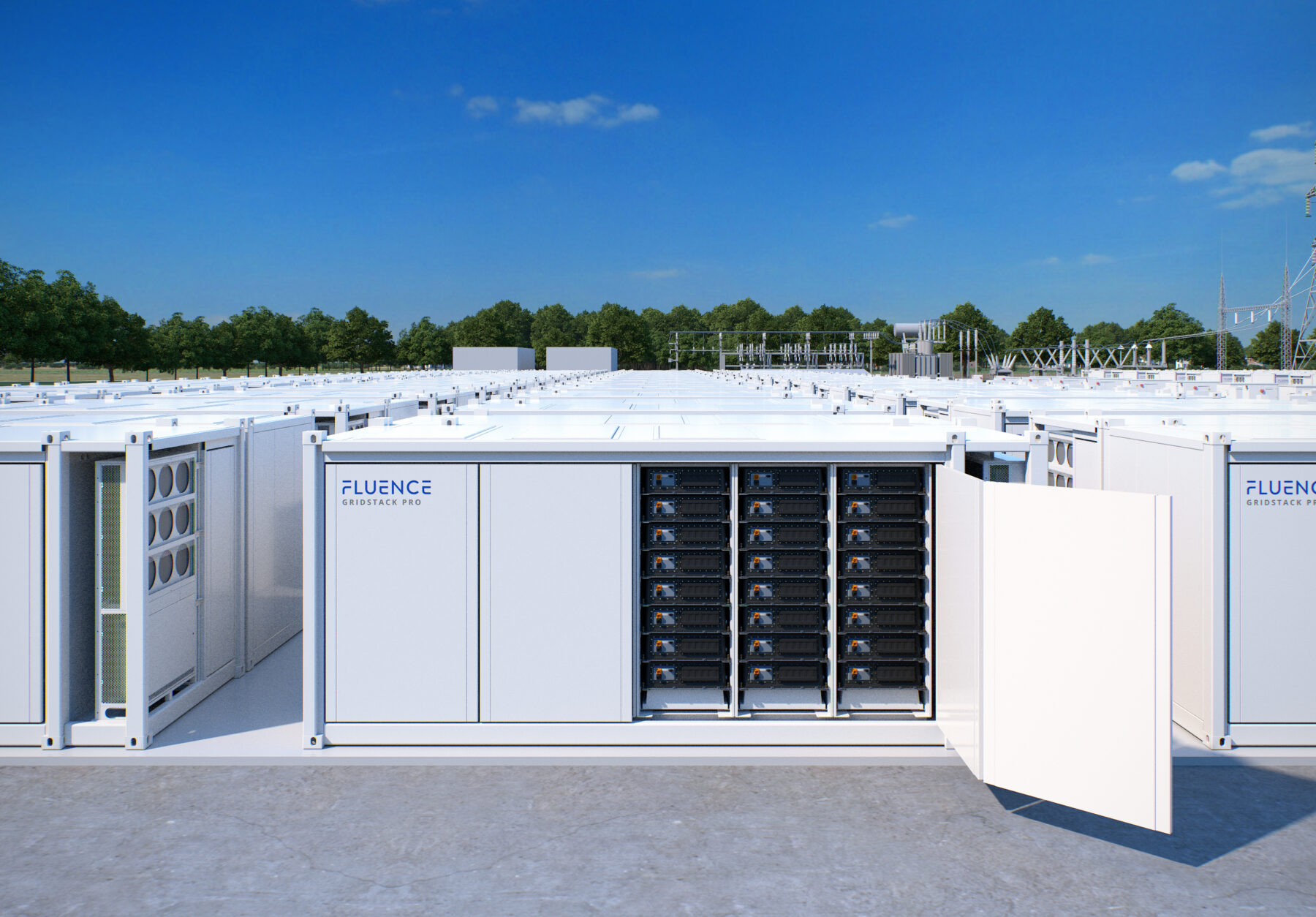
Fluence has been nominated for the 2026 World AI Awards in the Battery Management category, recognising the energy technology company’s work across battery management systems, AI-powered predictive maintenance and software designed to keep large-scale energy storage assets operating efficiently.
Grid-scale batteries create an unusual data problem. A large battery energy storage system can contain vast numbers of individual cells, each producing operating information that may reveal changes in temperature, state of charge or component behaviour. Finding the handful of signals that actually require attention is difficult.
Fluence is tackling that problem at several layers. Its battery management system works alongside Fluence OS to control and monitor storage hardware, while its Nispera software applies artificial intelligence and machine learning to identify potential performance problems before conventional alarms appear.
The World AI Awards recognises organisations, individuals, products and technologies contributing to the development and real-world application of artificial intelligence across industries.
Battery management starts much closer to the cell
Fluence’s approach begins inside the storage system itself.
The company’s battery architecture combines battery modules, its battery management system and Fluence OS. Together, these technologies manage functions including battery temperature and state of charge while continuously collecting operational data.
That matters because small differences between cells can become operational problems over time.
Fluence says its BMS can detect cell-level imbalances and automatically activate passive balancing resistors to correct them. Fluence OS can also identify areas of a system that require recalibration and target those areas rather than taking a broader approach that may unnecessarily interrupt normal operation.
This is less visible than the battery containers sitting at a grid-scale project, but it is central to their performance. A battery asset needs to know not simply when to charge or discharge, but what is happening inside thousands of components while it does so.
AI looks for trouble before the alarm arrives
Fluence’s Nispera asset performance management platform takes the process a step further.
Rather than waiting for a conventional SCADA alarm to indicate that something has already moved outside an acceptable range, Nispera uses AI to learn what normal battery-cell behaviour looks like under different operating conditions.
Temperature is one example.
The software examines variables including charge and discharge levels and cooling-system temperatures to estimate how hot a battery cell should be under current conditions. When measured temperatures begin deviating from the expected pattern, Nispera can flag the anomaly.
Fluence reports that these predictive alerts arrive an average of three days before a battery outage occurs.
That lead time can give technicians an opportunity to investigate whether the cause is a battery rack, cooling equipment, environmental conditions or another component before the problem forces the asset offline.
Importantly, the software is manufacturer-agnostic. Fluence says Nispera can integrate information from batteries supplied by different original equipment manufacturers, allowing operators with mixed fleets to monitor them through a common platform.
Managing a battery means managing a flood of data
The scale of the information involved helps explain why AI has become relevant to battery management.
Fluence estimates that an average 1 GW battery energy storage system can generate around 100 times as many data points as a conventional 1 GW power plant.
Watching every signal manually is not realistic.
Nispera instead uses machine-learning models and automated analytics to identify unusual behaviour and direct attention toward components that may require investigation. Fluence says the broader Nispera platform now supports an over 15.5 GW portfolio spanning storage, solar, wind and hydropower assets worldwide.
The technology does not remove technicians from the process. It changes where they look first.
That distinction is important. Predictive analytics can identify patterns associated with emerging problems, but engineers and maintenance teams still need to determine what is happening physically and decide how to respond.
From battery intelligence to grid-scale operations
Fluence’s battery management technology sits inside a much larger storage business.
As of June 30, 2026, the company reported 7.4 GW representing 19.3 GWh of deployed energy storage products and solutions. Its digital business had 22.8 GW of assets under management. Those figures include technologies beyond Nispera and should not be interpreted as the installed base of any single AI application.
Independent analysis has also provided some visibility into the performance of Fluence’s storage fleet.
In June 2026, DNV reported results from a review of Fluence-provided fleet data, contractual calculation methodologies and operational information from selected projects. DNV validated Fluence’s internal finding of 98.7% MW-weighted availability across the reviewed global fleet and reported 99.3% availability for the reviewed operating battery projects of 50 MW and above.
The figures do not isolate the effect of AI or battery-management software. Storage availability depends on hardware, engineering, operations, maintenance and other factors. Still, they provide a useful operational backdrop for technology being deployed at grid scale.
Graham Cooke, President of the World AI Awards, said:
“Fluence’s nomination highlights an important side of artificial intelligence that often sits behind the infrastructure people depend on. Large battery systems produce enormous amounts of operational data, and identifying the signals that genuinely matter can be a difficult task.
“Fluence’s work across battery management, cell-level monitoring and AI-powered predictive maintenance demonstrates the opportunity for intelligent software to help operators identify emerging issues earlier and make better-informed maintenance decisions. We congratulate the Fluence team on its 2026 World AI Awards nomination in the Battery Management category and look forward to following the development of these technologies.”
Fluence joins organisations, researchers, entrepreneurs and technology developers being recognised through the 2026 World AI Awards.
The programme recognises organisations, individuals and technologies contributing to the development and application of artificial intelligence across industries.
Battery management represents a particularly practical part of that landscape. As grids add more renewable generation and large-scale storage, operators are being asked to manage increasingly complex fleets containing huge numbers of battery cells.
For Fluence, AI is being positioned inside that operational problem rather than alongside it. The battery management system handles conditions within the storage hardware. Fluence OS provides system-level control and monitoring. Nispera adds another layer, analysing the resulting data for patterns that may indicate trouble before traditional alerts appear.
It is a fairly specific job for artificial intelligence. That is precisely what makes it interesting.
Learn more about Fluence and its energy storage technology at fluenceenergy.com.
Discover the World AI Awards 2026, explore the nominees and learn more about the awards at worldawards.ai.
