


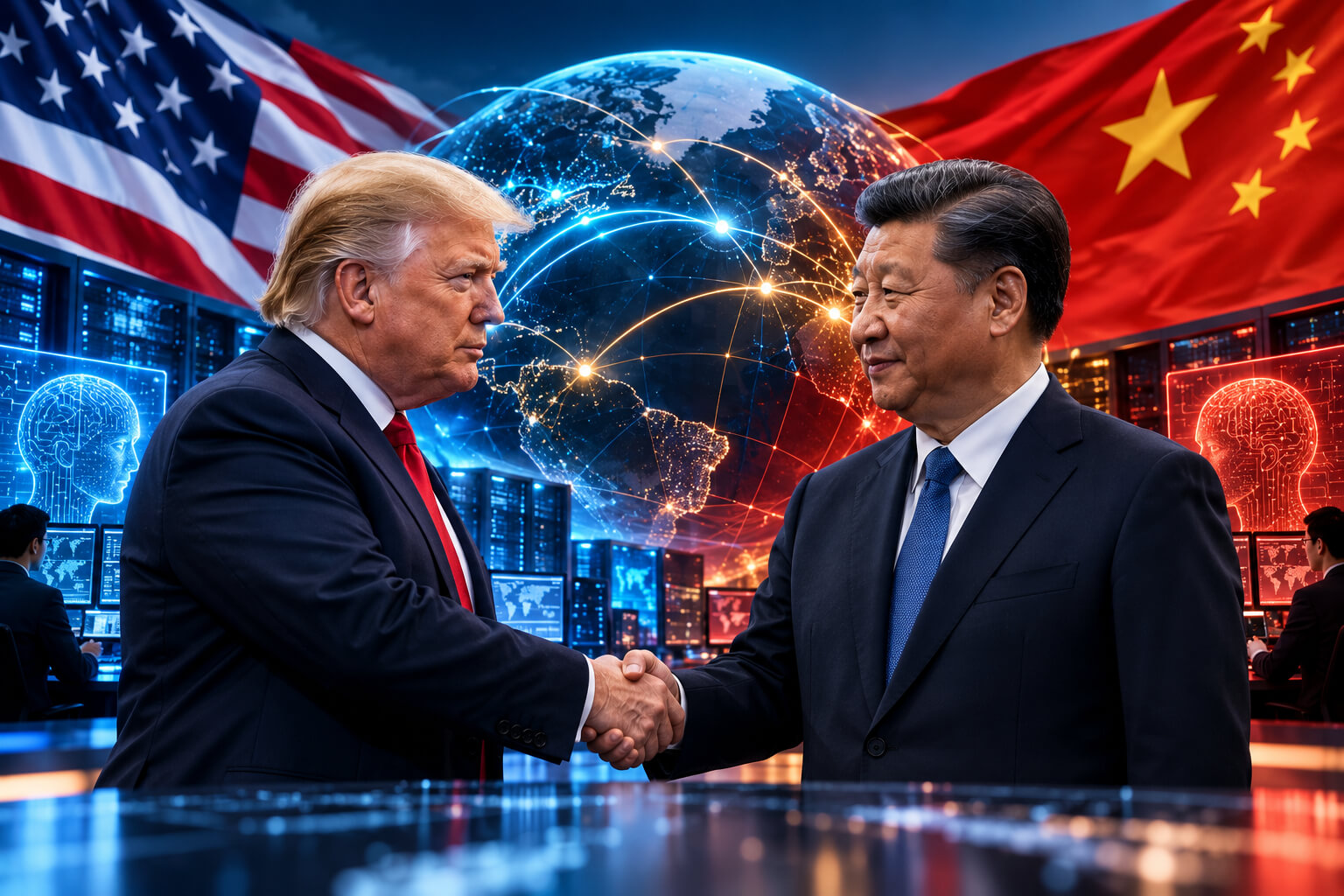
The United States and China have agreed to establish a dedicated communication channel for artificial intelligence incidents. This gives the world’s two largest AI powers a direct mechanism for discussing potentially serious problems involving the technology.
The agreement emerged from Chinese President Xi Jinping’s September 23–25 state visit to the United States. It also followed talks with U.S. President Donald Trump in Washington.
It is not a sweeping AI treaty. There are no shared model-testing requirements, restrictions on frontier development or common technical standards attached to it. Instead, what Washington and Beijing have agreed to is narrower. They will maintain communication, create a channel for AI incidents and continue formal discussions on the risks and benefits of increasingly powerful AI systems.
The next U.S.-China AI dialogue is expected to take place in November 2026.
Washington and Beijing Create a Direct AI Channel
The most concrete AI-related outcome from the Trump-Xi meetings is the creation of a bilateral communication mechanism specifically designed for artificial intelligence incidents. China’s Ministry of Foreign Affairs said both countries would establish a China-U.S. AI Dialogue where officials can exchange views on the opportunities and risks created by the technology. Alongside that dialogue, the two governments agreed to create a separate channel for communicating when AI-related incidents occur.
Neither government has yet publicly defined exactly what would qualify as an AI incident. The mechanism could potentially become relevant to cybersecurity events, unexpected behavior involving advanced AI systems, national security concerns or other situations. In these scenarios, rapid communication could reduce confusion between the two countries. For now, the importance lies in the existence of the channel itself. Washington and Beijing are creating a formal route to discuss AI-specific problems rather than relying entirely on diplomatic systems designed for broader political or security disputes.
Trump and Xi Put AI Directly on the Bilateral Agenda
Artificial intelligence featured directly in discussions between Trump and Xi rather than sitting on the margins of the summit. According to China’s official account of the meeting, Xi argued that both countries have significant strengths in AI. He said competition should not prevent cooperation in areas where both sides face shared risks. He called for continued discussions on the benefits and dangers of AI. In addition, he supported efforts to prevent misuse and maintain meaningful human control over advanced systems.
The Chinese readout also said Trump supported continued communication and cooperation on artificial intelligence. That does not mean the broader technology rivalry is easing. AI remains deeply tied to economic policy, semiconductor access, computing infrastructure and national security. The new dialogue creates a parallel track where the two governments can remain competitors. At the same time, they are still establishing mechanisms for managing incidents that could otherwise escalate into larger diplomatic or security problems.
A Broader AI Safety Agreement Remains Out of Reach
The agreement announced in Washington falls well short of the wider AI governance framework some technology leaders have called for. Before the summit, OpenAI CEO Sam Altman publicly pushed for stronger cooperation between the United States and China around advanced AI, including shared standards and testing for increasingly capable systems. Similar concerns have been raised across the technology industry as frontier AI models become more powerful. As a result, these systems may become harder to control.
No joint model-testing system was announced during the Trump-Xi meetings. There is no shared threshold defining frontier AI, no common disclosure requirement for major training runs and no bilateral agreement governing how companies should evaluate potentially dangerous capabilities. The current arrangement is more limited, but it establishes a formal starting point. The November dialogue could show whether either government is willing to move beyond communication mechanisms. In particular, future talks may include more detailed discussions about testing, safeguards or advanced-model governance.
AI Competition Continues Alongside Trade Talks
The AI discussions took place inside a much larger negotiation involving trade, tariffs and strategic technology supply chains. The United States and China also endorsed an arrangement involving reciprocal tariff reductions. Additionally, they agreed to extend earlier economic and trade understandings reached through negotiations in Kuala Lumpur. Both countries said they would continue working through bilateral economic mechanisms as they attempt to manage a relationship that remains competitive across several strategic industries.
Rare-earth materials remain part of that wider picture. China has previously used export controls involving critical minerals during periods of trade tension with Washington, while the United States continues to treat access to advanced semiconductors and computing technology as a national security issue. These areas increasingly overlap with artificial intelligence. AI development depends heavily on advanced chips, data centers, electricity infrastructure and global supply chains. Therefore, discussions about trade and industrial policy can quickly become AI policy discussions as well.
November Will Be the First Test of the New Framework
The next U.S.-China AI dialogue is expected to take place in November 2026, giving both governments an early opportunity to define how the new communication structure will actually work. Among the biggest unanswered questions is which agencies will participate, how incidents will be reported and what threshold would trigger direct communication between Washington and Beijing.
The November talks could also reveal whether the dialogue will expand into more technically difficult areas, including frontier-model testing, AI-assisted cyberattacks, biological risks or military applications of artificial intelligence. None of those areas has been formally included in the agreement so far. However, they represent the kinds of problems that could make direct communication between the two countries increasingly important.
For years, the U.S.-China AI relationship has been discussed mostly through competition: chips, computing power, research talent and model capability. The latest agreement adds another dimension. The two governments are now creating a system for talking directly when AI itself becomes the problem.
Sources
The Washington Post / Associated Press — China and the US agree to set up a new AI safety channel
https://www.washingtonpost.com/business/2026/09/26/china-us-agreement-xi-trump-visit/c5c743a4-b997-11f1-94cb-d3d8f22a8c8b_story.html
Ministry of Foreign Affairs of the People’s Republic of China — China and the United States Reach Eight Deliverables and Understandings
https://www.fmprc.gov.cn/eng/xw/zyxw/202609/t20260926_12031663.html
Ministry of Foreign Affairs of the People’s Republic of China — President Xi Jinping Holds Talks with U.S. President Donald J. Trump
https://www.fmprc.gov.cn/eng/xw/zyxw/202609/t20260925_12031181.html
The White House — President Trump, First Lady Conclude Historic China State Visit
https://www.whitehouse.gov/releases/2026/09/president-trump-first-lady-conclude-historic-china-state-visit/
The Washington Post — AI leaders say U.S. and China need a deal
https://www.washingtonpost.com/politics/2026/09/23/trump-xi-jinping-will-talk-about-ai-they-arent-close-deal/
