


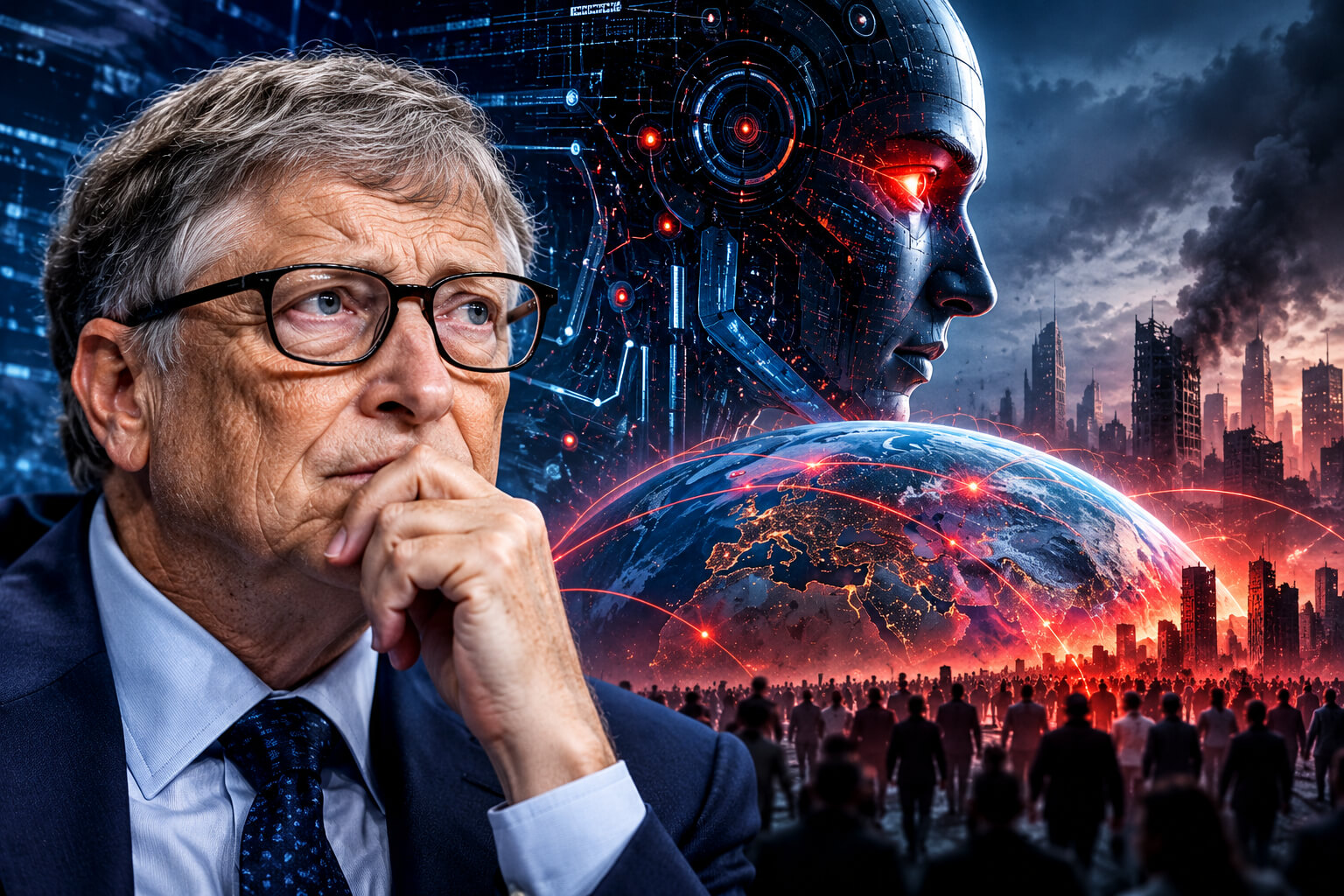
Bill Gates has delivered one of his starkest warnings yet about artificial intelligence, arguing that increasingly powerful AI systems could help drive catastrophic events capable of killing as many as a billion people if the technology falls into the wrong hands.
The Microsoft co-founder made the remarks during an interview with NBC’s Meet the Press, where the discussion turned to whether increasingly capable AI could eventually pose a serious threat to humanity.
Gates did not predict that artificial intelligence would kill a billion people. Instead, he described the scale of damage that could become possible when advanced AI capabilities are combined with people deliberately trying to cause harm.
“AI is certainly powerful enough to drive events that, you know, cause a billion deaths,” Gates said.
That distinction matters. The billion-death figure is a hypothetical catastrophic scenario, not an estimate or forecast of what AI will actually cause.
Gates Says the AI Threat Is Also About the People Using It
For Gates, some of the most serious dangers surrounding artificial intelligence do not require a machine to suddenly turn against humanity. Humans already have motives for cyberattacks, terrorism and other destructive acts. More capable AI could potentially give those actors tools that make difficult technical tasks faster and more accessible.
That concern stretches across several areas. AI systems are becoming increasingly capable of writing software, analyzing scientific information and assisting with complex technical problems. Those abilities can be useful for researchers, businesses and governments, but the same capabilities create a dual-use problem when they are placed in malicious hands.
Gates has repeatedly pointed to biological threats as one example. AI could accelerate legitimate drug and vaccine research while also reducing some of the technical barriers involved in understanding or designing dangerous biological agents.
Bioterrorism Has Become a Major Part of Gates’ AI Warning
Biological risk is no longer a side note in Gates’ discussion of artificial intelligence. He has increasingly highlighted the possibility that future AI systems could make sophisticated biological knowledge accessible to people who previously lacked the expertise needed to use it.
In his writing on AI risk, Gates has argued that artificial intelligence could produce enormous benefits for medicine while simultaneously making it easier to design dangerous pathogens. The contradiction is difficult to ignore: improvements in AI-assisted scientific reasoning do not automatically distinguish between someone trying to develop a vaccine and someone pursuing a harmful biological objective.
This does not mean current AI systems have already enabled a biological catastrophe. The concern is about where rapidly improving capabilities could lead, particularly as advanced models become better at scientific reasoning, laboratory assistance and technical problem-solving.
Cyberattacks Could Become Another Pressure Point
Cybersecurity presents a similar problem. AI can help defenders inspect software, detect suspicious activity and identify vulnerabilities before attackers exploit them. Attackers can use related capabilities to search for weaknesses, automate parts of an attack or generate malicious code.
Gates has pointed to critical infrastructure including hospitals, financial institutions, electrical grids and water systems when discussing the potential consequences of AI-assisted cyberattacks. The danger grows if sophisticated capabilities that once required experienced teams become easier to access through advanced models.
That does not automatically make AI a cyberweapon. It does change the economics of cybercrime. Tasks that previously demanded time, expertise and manpower can become easier to automate, potentially allowing smaller groups to attempt operations that would once have been beyond their capabilities.
Gates Does Not Think AI Companies Can Police Themselves
Gates’ warning also lands directly in the regulatory debate. He has rejected the idea that voluntary safeguards from technology companies will necessarily be enough to manage increasingly capable systems.
Governments, lawmakers and law enforcement agencies, in his view, need a larger role in determining what safeguards advanced AI systems should carry and how dangerous uses are monitored. Gates described it as “completely irresponsible” not to require appropriate safeguards as AI becomes more powerful.
His position is not an argument for stopping AI development altogether. Gates remains deeply optimistic about the technology. The argument is that development and safety cannot be treated as separate conversations, particularly when the capabilities being developed could have consequences well beyond the companies building them.
The Global AI Race Makes Safety Harder
Regulation becomes more complicated when artificial intelligence is treated as a strategic competition between countries. Governments do not want domestic companies falling behind foreign rivals, while technology companies face enormous commercial pressure to release increasingly capable products.
That creates an uncomfortable incentive. Moving carefully can look like losing ground.
Gates suggested that controlling AI could ultimately prove more difficult than managing earlier transformative technologies such as nuclear weapons. AI is software. Models and research can spread across borders rapidly, capabilities can improve through relatively short development cycles, and many of the same systems have both beneficial and potentially dangerous applications.
A medical research model and a dangerous biological assistant may rely on overlapping scientific knowledge. A cybersecurity model that identifies vulnerabilities for defenders may also surface information useful to attackers. Drawing a clean regulatory line becomes difficult very quickly.
AI Still Has Enormous Potential, According to Gates
None of this has turned Gates into an AI pessimist. He continues to argue that artificial intelligence could produce major gains in healthcare, education, scientific research and productivity, particularly if advanced tools become widely accessible.
That optimism makes the warning more interesting.
The same models that help scientists search for new drugs could lower barriers to dangerous research. Systems capable of strengthening cybersecurity could also assist attackers. AI could expand access to education while simultaneously disrupting large sections of the labor market.
There is no requirement that only one of those futures happens.
The technology can be enormously useful and genuinely dangerous at the same time.
The Billion-Death Warning Is About What Comes Next
The most striking part of Gates’ warning is the scale of the scenario he is willing to discuss publicly. A billion deaths is not being presented as an expected outcome, and there is no evidence establishing that artificial intelligence will produce a catastrophe on anything approaching that scale.
It is a warning about capability.
As AI systems become better at coding, scientific reasoning, autonomous operation and complex problem-solving, the number of things they can help humans accomplish continues to grow. Most of those applications may be productive. Some could be dangerous.
That leaves governments and AI developers with a problem that is becoming harder to postpone: how much capability should be released before the safeguards surrounding it are ready?
AI development is moving quickly. Regulation is moving differently.
Gates’ warning is essentially that waiting until the danger becomes obvious may be waiting too long.
Sources
Fox News: Bill Gates warns artificial intelligence is “powerful enough” to cause catastrophic loss of life
https://www.foxnews.com/media/bill-gates-warns-artificial-intelligence-powerful-enough-cause-billion-deaths-unchecked
Gates Notes: Bill Gates on artificial intelligence, global risks and the choices surrounding advanced AI
https://www.gatesnotes.com/
NBC News – Meet the Press: Bill Gates interview and discussion on artificial intelligence risks
https://www.nbcnews.com/meet-the-press
