


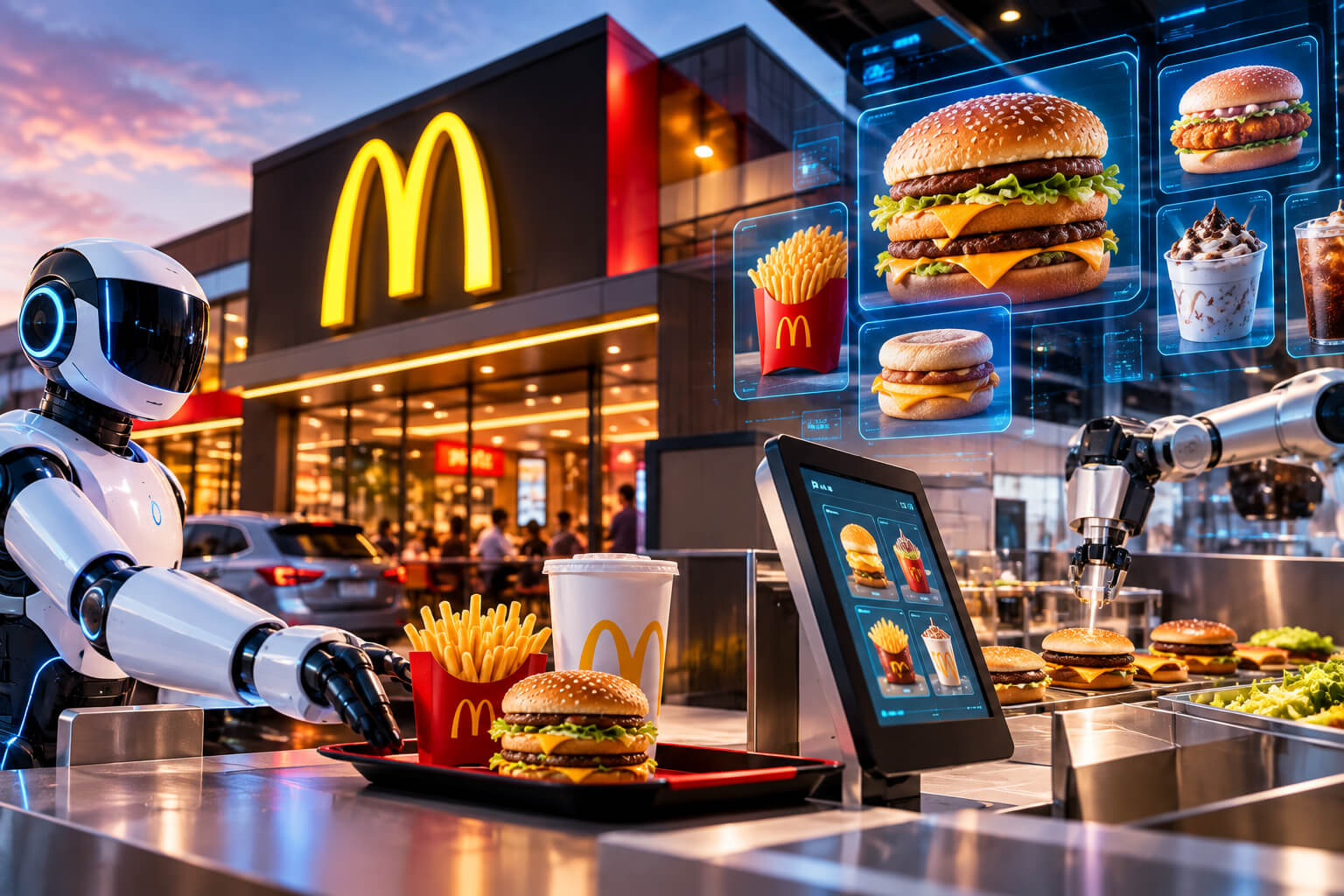
McDonald’s AI strategy is reshaping how the company puts artificial intelligence deeper into its restaurant operations as it looks for new ways to attract customers and improve efficiency.
The fast-food giant is pushing ahead with its McDonald’s > NEXT strategy. The plan combines AI-powered restaurant technology, new menu products and redesigned locations. McDonald’s is investing billions of dollars in the effort as it tries to modernize how its restaurants operate while giving customers more reasons to return.
The interesting part isn’t simply the arrival of AI at the drive-thru. Much of the technology will work quietly behind the counter, where McDonald’s sees opportunities to improve scheduling, inventory, order accuracy and everyday restaurant operations.
McDonald’s NEXT Strategy Puts AI at the Center
McDonald’s is making technology a larger part of its long-term growth strategy. Under NEXT, the company wants to improve restaurant performance while expanding categories such as chicken and beverages. It also wants to make individual locations easier and more efficient to operate.
Artificial intelligence fits directly into that plan. Rather than introducing AI as a standalone feature, McDonald’s is looking at places where the technology can handle repetitive work or provide employees with better operational information. That could mean helping restaurants manage inventory, organize schedules or spot problems before they slow down service.
The strategy reflects a broader shift in enterprise AI. Companies are moving beyond experimental chatbots and looking for technology that can solve routine operational problems at scale.
ArchIQ Brings AI Into Restaurant Operations
One of the central pieces of the technology strategy is ArchIQ, McDonald’s AI-powered restaurant platform developed with Google technology.
ArchIQ is designed to connect several parts of restaurant operations rather than treating each task as a separate system. McDonald’s sees potential applications across inventory, scheduling, equipment management and order accuracy.
That may not sound as dramatic as an AI assistant speaking to customers at the drive-thru, but the operational impact could be much larger. Even small improvements become significant when they are repeated across thousands of restaurants.
McDonald’s is essentially trying to reduce the amount of routine work that restaurant teams handle manually. Employees can then spend more time preparing food, solving customer issues and keeping service moving during busy periods.
AI Drive-Thru Ordering Gets Another Shot
Customers are more likely to notice McDonald’s AI ambitions at the drive-thru.
The company has been testing an AI ordering assistant known as Archy at selected restaurants. The system listens to customers, processes their orders and handles modifications before sending the final order through the restaurant workflow.
Voice ordering isn’t new territory for McDonald’s. The company previously tested automated drive-thru technology through a partnership with IBM before ending that program in 2024.
The latest attempt takes a different approach and uses Google technology. McDonald’s now has another opportunity to see whether generative AI and improved voice systems can deal with the messy reality of restaurant ordering. Background noise, accents, changing an order halfway through and highly customized meals can all make the job harder than a simple voice command.
AI Could Save Restaurants Hours of Work
Efficiency is one of the strongest arguments behind McDonald’s investment in AI.
The company believes AI-assisted restaurant technology could reduce the amount of time employees spend on repetitive operational tasks. Those savings could come from areas such as scheduling, inventory management, order processing and other routine work.
At restaurant scale, saving a few minutes here and there may not look impressive. Across thousands of locations, those minutes quickly become thousands of working hours.
McDonald’s has indicated that technology such as ArchIQ could save substantial labor time at individual restaurants. The company has framed those savings as an opportunity to redirect employees toward other tasks rather than simply removing people from restaurants.
That distinction will matter as the rollout grows. Customers may accept more automation behind the scenes, but hospitality still depends heavily on human interaction when something goes wrong or an order needs attention.
New Menu Items Remain a Big Part of the Strategy
Technology isn’t the only lever McDonald’s is pulling.
The company is also looking at its menu for new sources of growth, particularly in chicken and beverages. Those categories have become increasingly important as fast-food chains compete for customers who have more choices than ever.
McDonald’s has been experimenting with chicken products in several markets, including hand-breaded chicken. Grilled chicken sandwiches and wraps are also part of the broader product conversation.
Breakfast and protein-focused products offer another opportunity. Items such as egg bites and bowls could give customers options that sit outside the traditional burger-and-fries formula.
The company isn’t abandoning its core menu. Instead, it is trying to widen the number of occasions when someone might choose McDonald’s.
Beverages Could Become a Bigger Growth Engine
Drinks are becoming another important battleground.
McDonald’s has identified beverages as an area where it believes it can gain additional market share. That opens the door to more experimentation beyond traditional fountain drinks and McCafé products.
The opportunity is easy to understand. Customers do not necessarily need to order a full meal to buy a drink, which gives McDonald’s another way to generate visits throughout the day.
Beverage innovation could also help the chain reach customers who might otherwise choose coffee shops, convenience stores or specialist drink brands. It is a different kind of competition from the traditional fast-food burger battle.
McDonald’s Restaurants Are Changing Too
The physical restaurant is also part of NEXT.
McDonald’s has been experimenting with layouts that rethink how customers order, collect food and spend time inside restaurants. Some concepts include more visible coffee preparation, updated kitchens, expanded play spaces and dedicated areas for delivery orders.
Digital ordering has already changed restaurant layouts. Mobile apps, kiosks and delivery services mean fewer customers follow the traditional pattern of walking to a counter, ordering and waiting beside the register.
McDonald’s now has to design restaurants around several customer journeys at once. Someone collecting an app order has different needs from a family eating inside or a delivery driver picking up several meals.
AI may help coordinate those different workflows, but the physical restaurant still needs to support them.
Order Accuracy Gets Both High-Tech and Simple Solutions
Not every improvement requires artificial intelligence.
McDonald’s has also been using scales to help restaurants check whether orders contain the correct items before they leave the kitchen. The approach is simple: an order with missing food may weigh differently from what the system expects.
It is a useful reminder that restaurant modernization does not have to mean putting AI into every task.
The more practical strategy is often a mixture of technologies. AI can handle complex patterns and predictions, while simpler tools can solve straightforward problems cheaply and reliably.
For McDonald’s, both approaches ultimately target the same thing: fewer mistakes and a smoother customer experience.
McDonald’s Shows Where Restaurant AI May Be Heading
McDonald’s AI strategy offers a glimpse of what restaurant automation could look like over the next several years.
The most visible applications will probably continue to attract the most attention. An AI system taking a drive-thru order is easy to notice. Software predicting inventory requirements in the background isn’t.
Yet those quieter applications could have the greater business impact.
Scheduling, inventory, equipment monitoring, order accuracy and kitchen workflows happen every day across every restaurant. Improving those processes even slightly can create meaningful savings when applied across a global chain.
McDonald’s therefore isn’t positioning AI as something customers need to think about every time they order a Big Mac. The bigger goal is to make the restaurant operate more efficiently while keeping food and service at the center of the experience.
That may prove to be the more realistic future for AI in fast food: less robot restaurant, more invisible operating layer.
Conclusion
McDonald’s NEXT strategy brings together artificial intelligence, restaurant redesign and menu experimentation as the company prepares for its next phase of growth.
AI-powered platforms such as ArchIQ could reshape how restaurants manage routine operations. Voice AI may also return to more drive-thrus if the technology proves reliable enough for real-world ordering.
At the same time, McDonald’s isn’t relying on technology alone. Chicken, beverages, new restaurant formats and improved order accuracy remain central parts of the strategy.
The result is a broader modernization effort rather than a single AI experiment. McDonald’s is testing whether artificial intelligence can disappear into the background of restaurant operations and simply make the business run better.
Sources
NBC News — McDonald’s leans into AI and new menu items to attract customers
https://www.nbcnews.com/video/mcdonald-s-leans-into-ai-and-new-menu-items-to-attract-customers-270449733950
McDonald’s Corporation — McDonald’s Advances NEXT Strategy
https://corporate.mcdonalds.com/corpmcd/our-stories/article/NEXT-growth-strategy-advances.html
