


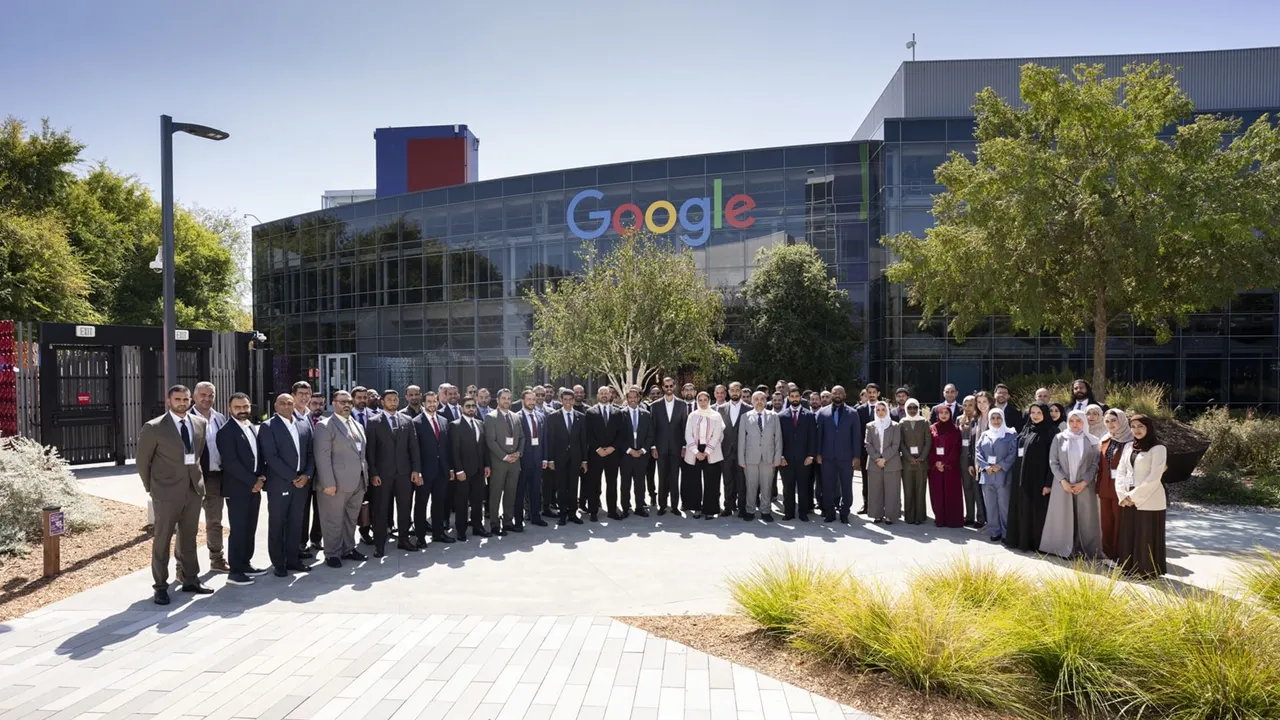
The United Arab Emirates is sending more than 50 government AI leaders to the United States for a five-day technology mission focused on agentic AI.
Organised by the UAE Government’s Artificial Intelligence Office in collaboration with the Dubai Centre for Artificial Intelligence, the visit brings together Chief AI Officers and senior leaders from federal and local government entities. The delegation will meet major technology companies, AI developers and research institutions as the UAE pushes to expand artificial intelligence across government operations.
The mission comes as the UAE works toward an ambitious target: transforming 50% of government sectors, operations and services into agentic AI-powered operating models within two years.
UAE Chief AI Officers Head to the US Tech Ecosystem
The delegation will spend five days meeting organisations that are shaping the current AI market. Scheduled engagements include NVIDIA, Microsoft, Google, AMD, Dell Technologies, Salesforce, Cognition, Poolside, Snowflake and Databricks. The programme also includes academic and research institutions such as Stanford University and the Institute of Foundation Models at Mohamed bin Zayed University of Artificial Intelligence.
The mix is significant because the UAE is not focusing on just one part of the AI industry. Government officials will get exposure to chips, cloud computing, enterprise software, large-scale data platforms and foundation models. That gives participants a broader view of how agentic AI systems are built and how they could eventually be introduced across public-sector operations.
Agentic AI Is Becoming a Government Priority in the UAE
Agentic AI goes beyond the traditional chatbot model. Instead of waiting for users to issue one instruction at a time, AI agents can plan tasks, make decisions within defined boundaries and complete several steps toward a particular goal.
For government agencies, that could open the door to a different kind of automation. AI agents may eventually support administrative processing, data analysis, internal coordination and public services that require several actions rather than a single response.
The UAE has already placed agentic AI near the centre of its future government strategy. In September 2026, the Ministerial Council for Artificial Intelligence and Development reviewed the second phase of the country’s Agentic AI Project, reinforcing the government’s intention to move from experimental AI tools toward systems that can handle more complex workflows.
The UAE Is Targeting 50% Agentic AI Adoption Across Government
The clearest signal of how seriously the UAE is taking this shift is its 50% target. The government wants half of its sectors, operations and services to operate through agentic AI-powered models within two years.
That makes the US mission more than a technology study tour. The officials taking part are expected to bring home practical insights that can be applied across ministries and government entities. Exposure to major AI companies may help them understand what works, what remains experimental and where security or infrastructure requirements could slow deployment.
Omar Sultan Al Olama, UAE Minister of State for Artificial Intelligence, Digital Economy and Remote Work Applications, said the initiative is designed to strengthen the capabilities of Chief AI Officers while connecting them with global technology expertise. The wider objective is to turn those lessons into practical government applications.
UAE Is Building AI Leadership Inside Government Entities
One of the UAE’s more distinctive AI strategies has been the creation of specialised AI leadership roles within government bodies. Instead of treating artificial intelligence purely as an IT function, the government has positioned Chief AI Officers closer to strategic decision-making.
That structure gives individual government entities dedicated leadership for questions involving AI models, data, governance, infrastructure and implementation. The US visit builds on that approach by putting those officials directly in contact with the companies developing many of the systems they may later evaluate or deploy.
The UAE conducted a similar mission in 2025, when 50 Chief AI Officers travelled to the United States for a longer programme focused on the broader AI ecosystem. The 2026 mission appears more targeted, with agentic AI receiving much stronger attention.
Safe and Responsible Deployment Remains Part of the Agenda
Greater autonomy also creates greater risk. AI systems that can act across several steps may require tighter controls around access, data handling, approvals and human oversight.
The UAE delegation is expected to examine those issues during the trip. Government officials are looking not only at how quickly agentic AI can be deployed, but also at the conditions required to use it safely and responsibly.
That discussion matters because there is a large difference between an AI system that suggests an action and one that can carry it out. Government deployments may involve sensitive information, regulatory procedures and public services, making governance and accountability just as important as technical capability.
UAE-US AI Cooperation Continues to Expand
The visit also sits inside a broader period of technology cooperation between the UAE and the United States. The two countries have been building stronger ties around artificial intelligence, advanced computing, data infrastructure and emerging technologies.
In June 2026, the UAE participated in the second Pax Silica Summit in Washington, where governments and technology companies discussed trusted AI supply chains and secure digital infrastructure. UAE technology companies including G42, Core42 and MGX were also represented.
Earlier in the year, UAE officials held talks with US government representatives on cooperation in critical and emerging technologies. The latest delegation pushes that relationship further into practical deployment, with UAE government AI leaders meeting the companies developing the tools that could eventually reshape public services.
What the US Mission Could Mean for UAE Government Services
The real impact of the mission will depend on what happens after the delegation returns to the UAE. Meetings with major technology companies can provide access to new ideas, but the harder work comes when government entities try to integrate those systems into real workflows.
If the UAE meets its 50% target, residents and businesses could increasingly interact with public services supported by AI agents capable of handling multi-step requests. Government employees may also rely on AI systems for research, administrative processes and operational coordination.
The timeline is aggressive, and many technical, governance and security questions remain. Still, the direction is clear. The UAE is no longer treating agentic AI as a distant concept. It is starting to build it into the way government itself could operate.
Sources
Middle East AI News — UAE sends 50-strong team on US AI trip: https://www.middleeastainews.com/p/uae-sends-50-strong-team-on-us-ai
Emirates News Agency (WAM) — UAE delegation visits United States to explore latest Agentic AI applications: https://www.wam.ae/en/article/c2ajejc-uae-delegation-visits-united-states-explore-latest
UAE Cabinet — Ministerial Council for Artificial Intelligence and Development reviews second phase of Agentic AI Project: https://uaecabinet.ae/en/news/ministerial-council-for-artificial-intelligence-and-development-reviews-second-phase-of-agentic-ai-project
Gulf News — UAE sends 50+ government AI leaders to US as it accelerates agentic AI push: https://gulfnews.com/uae/government/uae-sends-50-government-ai-leaders-to-us-as-it-accelerates-agentic-ai-push-1.500678422
UAE Ministry of Foreign Affairs — UAE-US cooperation on emerging technologies: https://www.mofa.gov.ae/en/MediaHub/News/2026/5/13/UAE-Economic-opportunities
