


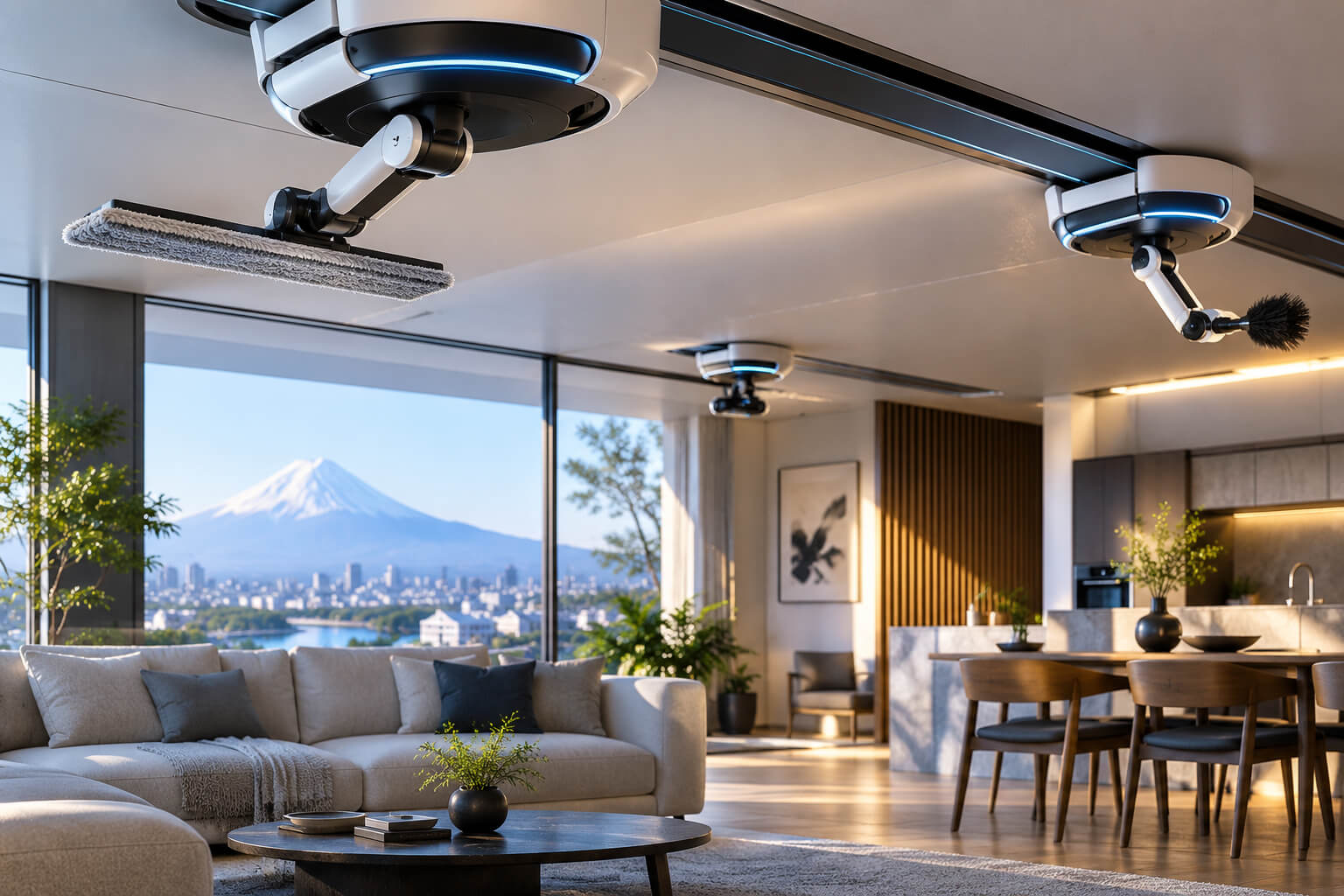
Japan’s next home robot might not walk through the front door. It could already be hanging from the ceiling.
Tokyo-based startup MW is developing a new kind of AI-powered home where robotic arms travel along ceiling-mounted rails and take on everyday household chores. Instead of putting a humanoid robot into a conventional house, MW is approaching the problem from the opposite direction: build the house around the robot.
The company calls the concept MW Living Home. Its robotic system, known as MW bot, uses articulated arms equipped with grippers to interact with household objects. The idea is to eventually automate routine jobs such as handling groceries, organizing items and folding laundry without filling living spaces with free-roaming machines.
MW plans to introduce a demonstration home equipped with the technology in 2027, followed by a targeted commercial rollout in 2028.
MW Takes a Different Route From the Humanoid Robot Race
Humanoid robots have become one of the hottest areas in physical AI, with technology companies trying to build machines capable of walking through homes, factories and workplaces designed for people. MW is taking a noticeably different route. Rather than spending years teaching a bipedal robot how to navigate furniture, stairs, people and pets, the startup wants to give its robots a predictable path through the building. Ceiling-mounted rails allow the robotic arms to move around while keeping most of the floor clear, something that could be particularly useful in Japan, where residential spaces are often compact. The approach sacrifices some of the flexibility promised by general-purpose humanoids, but it could make household automation easier to control and potentially more practical.
Robotic Arms Can Already Sort Groceries and Fold Laundry
MW has demonstrated the technology in Tokyo’s Toyosu district, giving observers an early look at how the system might operate inside a real home. During the demonstration, robotic arms handled groceries and sorted items based on whether they belonged in a pantry or refrigerator. The robot also worked with laundry and successfully folded a hand towel, although folding a T-shirt proved more difficult. That small failure highlights one of the biggest challenges facing household robotics. Tasks that humans barely think about can become complicated when a robot encounters soft fabrics, irregular shapes, clutter or objects positioned differently from what its training data expects. A factory robot may perform the same controlled movement thousands of times, while a household machine has to deal with an environment that changes constantly.
The Robot Still Needs Human Help
Despite the futuristic appearance, MW bot is not yet operating as a completely autonomous household assistant. Human operators are still involved remotely while MW gathers the enormous amount of real-world data needed to train its AI models. The company reportedly wants to collect around 150,000 hours of household-task data, while only a fraction of that target had been accumulated around the time of the demonstration. This data challenge could prove just as important as the hardware itself. A household robot needs to recognize objects, understand where they belong, manipulate them safely and react when something unexpected happens. Kitchens, bedrooms and living rooms rarely remain perfectly organized, which means MW needs its AI to learn from messy, unpredictable situations rather than carefully staged demonstrations.
MW Wants the House Itself to Become an AI System
The ceiling-mounted robotic arms are only one part of MW’s broader plan. The startup sees the entire home as a connected AI system built around sensors, software and physical robotics.
Sensors placed throughout the property collect information about what is happening inside the home. MW’s software then interprets that data and decides what action to take. MW bot acts as the physical layer that carries out the task.
The concept goes beyond the smart-home products already found in many houses. A smart light can switch itself off. A robot vacuum can clean the floor. However, these devices usually operate as separate products.
MW wants to create a more integrated system. In its vision, the building understands its surroundings and coordinates physical actions on its own. Residents would no longer need to manage several disconnected gadgets to automate everyday tasks.
Physical AI Could Be Built Into the Architecture
MW’s strategy raises an interesting question for the wider physical AI industry: does every robot need to become dramatically more capable, or can designers make robotics easier by changing the environment?
Much of today’s robotics research focuses on machines that must adapt to spaces built entirely for humans. These robots rely on advanced computer vision, navigation, spatial reasoning and object manipulation to operate safely and effectively.
MW takes a different approach. Instead of forcing robots to handle every challenge on their own, the company makes architecture part of the robotics system. Ceiling rails create predictable movement paths. Builders can integrate sensors directly into the home, while dedicated spaces can give robots easier access to household tasks.
This approach may offer less flexibility than a humanoid robot that can theoretically work almost anywhere. Still, specialization could become an advantage. In a controlled home environment, designers can optimize both the robot and the building around reliable automation rather than expecting one machine to adapt to everything.
Japan Is Backing Household Physical AI Research
MW’s ambitions also fit into Japan’s wider push to strengthen domestic capabilities in generative AI and robotics.
The company said its work on a robot foundation model for residential environments was selected under the government-backed GENIAC initiative. The program involves Japan’s Ministry of Economy, Trade and Industry and NEDO.
MW plans to use the initiative to improve its next-generation robot hardware. It also wants to expand data collection and develop AI models built specifically for household tasks.
Building its own homes gives the startup another advantage. Those properties can serve as real-world testing environments for its robotics systems.
Robots operating inside the homes can generate valuable interaction data. MW could then use that data to improve future models. Over time, this creates a feedback loop in which the homes help train the AI that will eventually operate inside them.
Robot-Ready Homes Won’t Be Cheap
The first generation of MW’s robot-ready homes sits firmly in the premium property market. Projects associated with the company have reportedly been priced at roughly ¥200 million to ¥400 million, including land, with developments spanning locations such as Tokyo, Yokohama, Fukuoka, Futtsu and Karuizawa. Some properties being sold today do not yet contain the robotic arms. Instead, MW is preparing homes so that the technology can be installed once it reaches commercial readiness. The company has also indicated that the robotic service could eventually cost around ¥5,000 to ¥10,000 per month. Those numbers make it unlikely that MW Living Home will immediately become a mainstream housing product, but premium buyers could provide the company with an early market while its hardware becomes cheaper and its AI improves.
MW Targets 10,000 AI-Powered Homes a Year
MW’s longer-term plans stretch well beyond a handful of futuristic luxury properties. CEO Shuzo Narita has discussed a goal of eventually producing as many as 10,000 homes annually by 2035, while overseas expansion could begin earlier if the technology proves commercially viable in Japan. Scaling that vision will require considerably more capital, engineering talent and training data. MW has already raised billions of yen and is expected to continue investing heavily in AI, robotics, architecture and construction. Bringing those disciplines under one company is central to its strategy because MW is not simply trying to sell a household robot. It is attempting to develop the machine, the intelligence behind it and the environment where both will operate.
An Iron Man Idea Moving Closer to Reality
Narita has pointed to Tony Stark’s fictional smart home and JARVIS from Iron Man as inspiration for MW’s vision. The comparison makes sense, although the real technology remains far more limited. MW’s robots still rely on human assistance, seemingly simple chores can expose weaknesses in robotic manipulation, and the first compatible homes are expensive. Even so, the concept offers a different answer to one of the biggest questions in consumer robotics. Instead of waiting for humanoid machines to become intelligent enough to navigate every unpredictable corner of a normal house, MW is redesigning the environment to meet robots halfway. If that approach works, the household robot of the future may not be a machine walking beside you at all. It may simply be part of the building.
What MW’s Robotic Home Means for the Future of AI
MW Living Home shows how physical AI could move beyond standalone robots and become embedded directly into everyday infrastructure. The bigger story is not simply a robotic arm that can fold laundry. It is the possibility that homes, offices, hotels and other buildings could eventually be designed around autonomous systems from the beginning. Humanoid robots will continue attracting attention because of their general-purpose potential, but specialized machines operating inside robot-ready environments may reach useful levels of reliability sooner. MW still has plenty to prove before its 2028 commercial target, particularly around autonomy, safety, affordability and large-scale data collection. Yet its approach adds another possibility to the physical AI race: rather than forcing robots to adapt completely to the human world, we may start building parts of that world specifically for them.
Sources
The Japan Times / Bloomberg — Japanese startup bets Iron Man-inspired homes can beat humanoids
https://www.japantimes.co.jp/business/2026/09/11/companies/robotic-housekeeping-arms/
MW — Official company announcement
https://prtimes.jp/main/html/rd/p/000000005.000182267.html
RobotStart — MW unveils AI robot home and MW bot
https://robotstart.info/article/2026/09/11/382409.html
TBS News DIG — MW household robot demonstration
https://newsdig.tbs.co.jp/articles/-/2940072
