


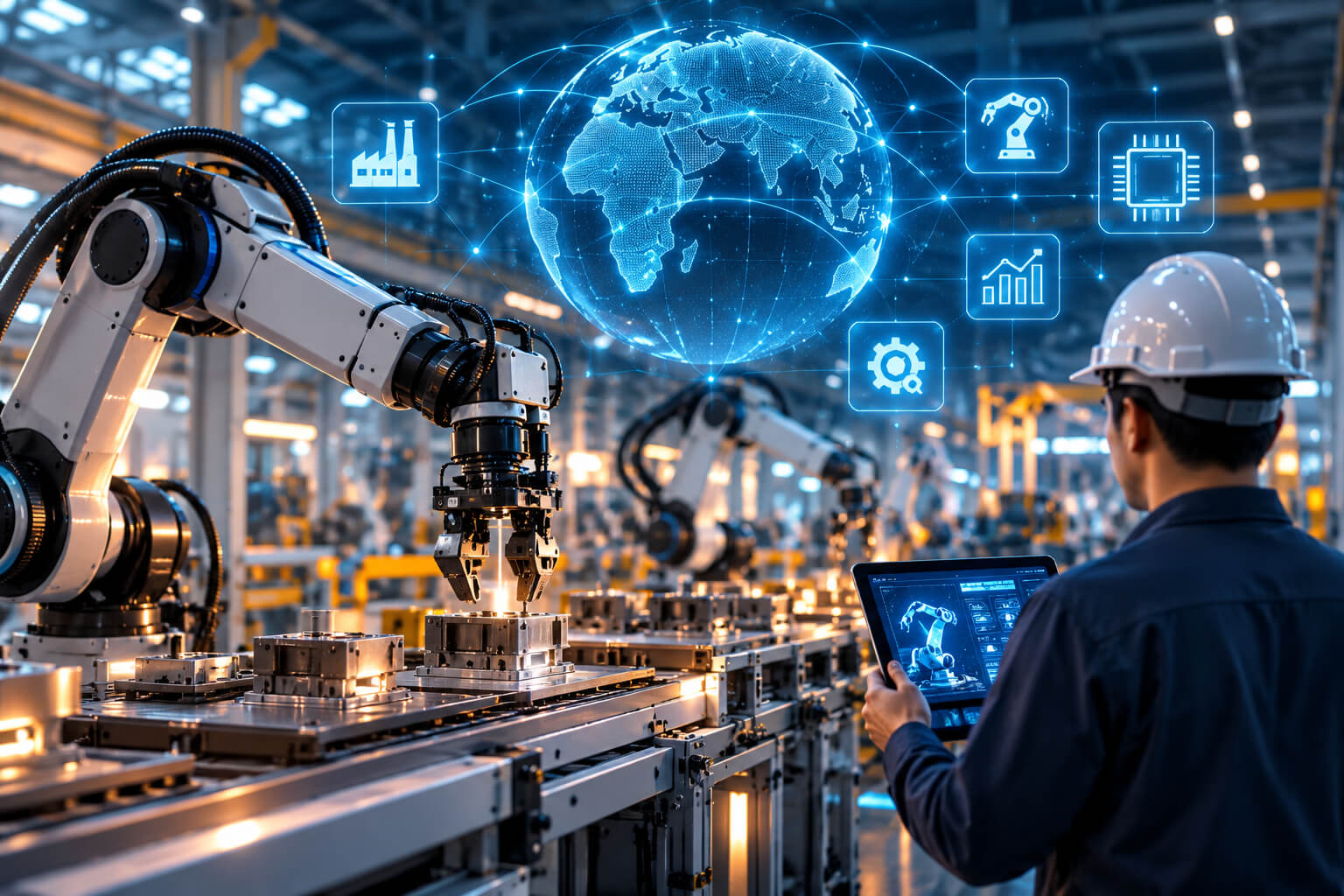
Artificial intelligence inside factories is starting to look very different from the experimentation that dominated the past few years.
Manufacturers are moving beyond controlled AI pilots and asking a harder question: how can the technology work at scale inside engineering environments where precision, safety, cost and physical constraints matter?
Samson Khaou, executive vice-president for Asia-Pacific at Dassault Systèmes, said the shift reflects a more mature stage of manufacturing AI adoption. Companies increasingly understand what AI can do. The bigger challenge now lies in deployment, particularly in connecting AI with engineering workflows and turning those systems into measurable industrial results.
General-Purpose AI Is Not Enough for the Factory Floor
ChatGPT, Gemini and other general-purpose AI systems have pushed artificial intelligence into everyday business conversations, but manufacturing presents a much tougher test. An industrial system cannot simply generate a plausible answer and move on. Engineering tolerances, regulatory requirements, material behaviour and safety limits leave little room for error.
That difference is pushing manufacturers toward more specialised systems, including agentic AI. Instead of waiting for individual prompts, these systems can work toward defined goals, perform certain tasks and make decisions within controlled limits. Dassault Systèmes is seeing growing customer interest in this area because industrial companies want AI that can operate inside real engineering and manufacturing processes rather than function as another chatbot sitting beside them.
AI Is Starting to Redesign the Engineering Process
Design and engineering productivity is becoming one of the clearest areas where industrial AI can create value. Traditional product development often involves long revision cycles in which designers create a product, engineers test it, problems appear and the design returns for another round of changes.
AI-driven simulation can shorten that loop. Manufacturers can use simulation models much earlier in the development process, allowing engineering requirements, performance targets and compliance considerations to influence a product before companies commit heavily to production. Instead of designing something first and discovering problems later, AI-supported simulation can help teams identify issues much earlier.
That matters because fewer design iterations can mean lower development costs, shorter time to market and fewer surprises once manufacturing begins.
Predictive Maintenance Gives AI Another Practical Role
Predictive maintenance may not attract the same attention as generative AI, but it is one of the areas where the financial case for industrial AI becomes easy to understand. Factories traditionally maintain machinery according to fixed schedules or respond after a failure occurs, and neither approach is particularly efficient.
By combining AI with industrial sensors and equipment data, manufacturers can continuously monitor how machines and components behave. AI systems can detect unusual patterns, estimate remaining operating life and flag equipment that may need maintenance before it breaks down.
For manufacturers running high-value production lines, avoiding even a few hours of unexpected downtime can make a major difference. Predictive maintenance turns AI into a tool for protecting productivity rather than simply automating paperwork.
Aerospace, Automotive and Semiconductors Have More at Stake
Industrial AI becomes especially important in aerospace, automotive, semiconductor and defence manufacturing because the consequences of mistakes are much greater. These sectors operate with strict quality requirements, complex engineering processes and high costs when production problems occur.
Malaysia already has exposure to several of these industries, which gives the country an interesting position as manufacturing AI adoption accelerates. The aerospace sector also highlights another issue that AI could help address: knowledge loss.
Many experienced engineers are approaching retirement, and when they leave, decades of practical knowledge can disappear with them. New employees can study manuals and technical documentation, but that does not automatically replace years of experience. AI systems grounded in historical engineering information could help organisations preserve part of that expertise and make it easier for younger engineers to access.
Adding a Chatbot Is Not Industrial AI Transformation
There is still a temptation for companies to treat AI as another software feature. A business adds an AI assistant to an existing system, creates a conversational interface and calls the operation AI-powered.
That approach may work for some office tasks, but industrial transformation runs much deeper. Manufacturers seeing more meaningful results are embedding AI directly into design, simulation, production and maintenance processes rather than placing it on top of legacy workflows.
A factory can buy AI software without fundamentally changing how it operates. Real manufacturing AI adoption usually requires companies to reconsider processes, prepare employees for new responsibilities and rethink how people, engineering software and automated systems work together.
The Hard Part May Be Organisational, Not Technical
Technology is only one part of the industrial AI challenge. Manufacturers also need reliable data, skilled employees, clear use cases and management teams willing to change processes that may have been in place for years.
Workforce readiness can become just as important as model performance. Companies sometimes underestimate the amount of training and organisational change required, especially when AI begins affecting engineering decisions or production workflows.
Malaysia illustrates the gap between AI awareness and AI capability. Many businesses already understand the potential of artificial intelligence, but fewer have reached the stage where they can integrate it deeply into industrial operations. Closing that gap will become increasingly important as companies move from experimentation into full deployment.
Global Supply Chains Are Accelerating AI Adoption
Pressure to adopt industrial AI is not coming only from technology companies. Manufacturers connected to international supply chains increasingly face customers and partners that expect stronger digital capabilities, greater efficiency and better visibility across production.
Once those expectations begin influencing contracts and supplier decisions, AI adoption becomes less optional. Manufacturers that can combine artificial intelligence with simulation, engineering data and digital twins may gain advantages in speed, flexibility and production reliability.
Companies that continue relying on fragmented legacy systems could find themselves competing against factories operating with completely different cost structures and decision-making speeds.
Malaysia Has an Opening in Southeast Asia’s Industrial AI Race
Southeast Asian economies are not adopting industrial AI at the same pace. Singapore continues to benefit from advanced infrastructure and regulatory clarity, while Indonesia and Vietnam are pushing forward with their own AI ambitions but still face challenges around skills and implementation.
Malaysia sits in an interesting position. Its manufacturing base, digital workforce, English proficiency and government support could make the country a strong environment for industrial AI adoption.
The opportunity goes beyond building more data centres or giving employees access to generative AI tools. The bigger economic value could come from applying artificial intelligence directly to engineering, manufacturing, simulation, maintenance and product development.
That type of AI adoption is harder to implement, but it is also much harder for competitors to replicate quickly.
Manufacturing AI Is Entering Its Deployment Era
The industrial AI conversation is becoming less about demonstrations and more about execution. Manufacturers have already seen what the technology can do in controlled environments. The next stage is figuring out how to connect AI to physical operations, trust it with increasingly complex tasks and prove that the investment improves productivity, reliability or product development.
Agentic AI, predictive maintenance, AI-driven simulation and virtual twins all point toward that direction. Factories are unlikely to become fully autonomous overnight, and not every manufacturing process needs an AI model attached to it.
The companies that move ahead may not be the ones experimenting with the largest number of AI tools. They may simply be the manufacturers that identify where AI genuinely improves the industrial process and deploy it there effectively.
Sources
The Edge Malaysia / Digital Edge — “Industry: AI adoption among manufacturers enters a more mature phase.”
https://theedgemalaysia.com/node/817757
Dassault Systèmes — Official company and industrial technology resources.
https://www.3ds.com/
