


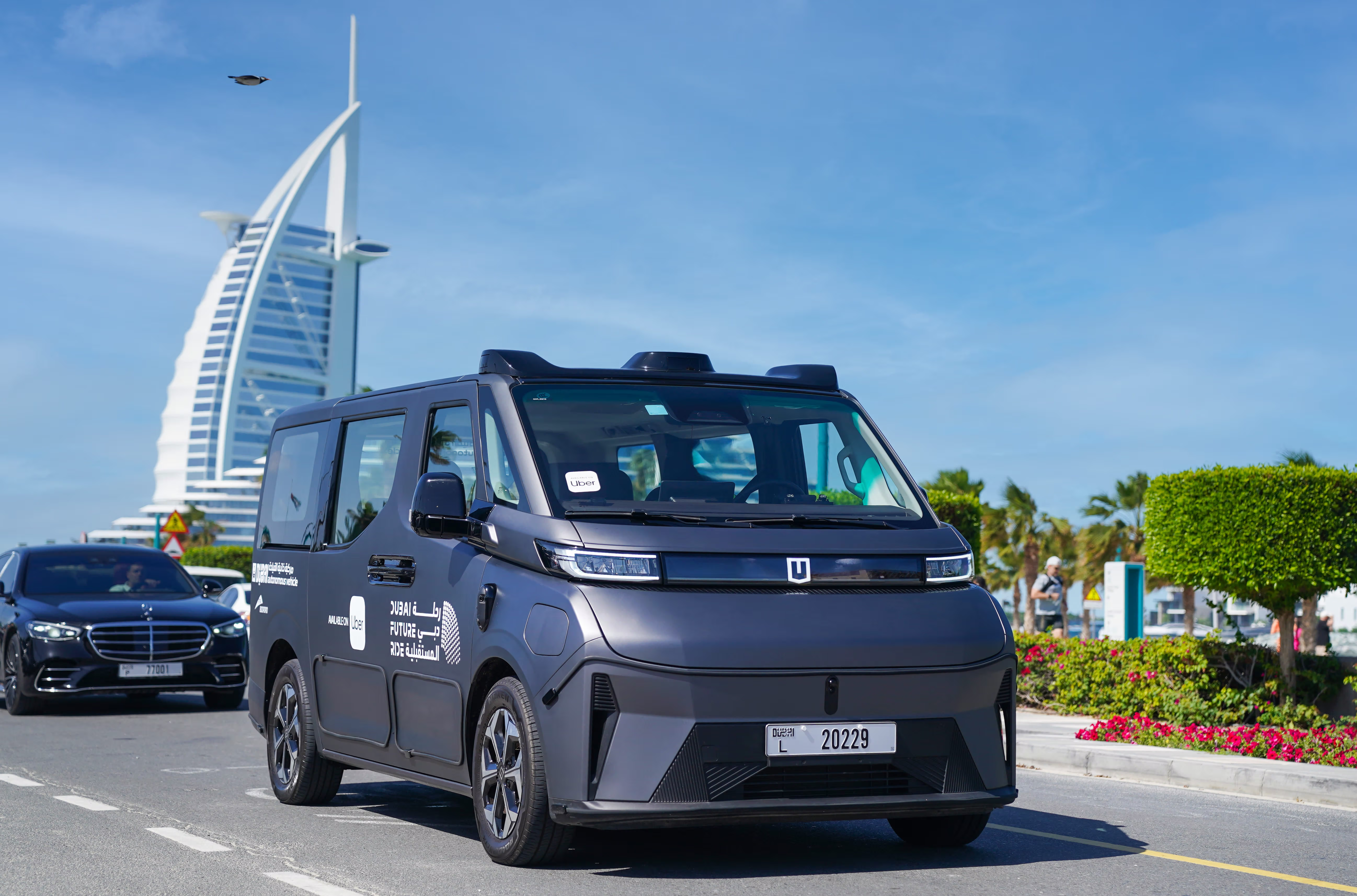
Dubai’s autonomous vehicle experiment is starting to look less like an experiment.
The emirate’s Robotaxi fleet has now travelled more than 4 million kilometres, while completing 7,613 passenger trips since operations began. Dubai officials also say customer satisfaction has reached 97%. This figure suggests riders are becoming increasingly comfortable with vehicles that do more of the driving themselves.
The numbers were released as Dubai pushes deeper into autonomous transportation. Robotaxis are moving from tightly controlled trials toward everyday passenger services.
Dubai Robotaxi Fleet Reaches 144 Vehicles
Dubai’s Robotaxi fleet currently consists of 144 vehicles, according to Ahmed Bahrozyan, CEO of the Corporate Technology Support Services Sector and Chair of the Autonomous Transport and Aerial Taxi Committee.
Of those vehicles, 48 are actively operating, completing roughly 50 trips per day.
Four million kilometres matters for another reason. Autonomous driving systems need real roads, unpredictable traffic, different weather conditions and countless small interactions. These experiences prove they can operate reliably outside a test environment.
Dubai is accumulating that experience quickly.
The program is being expanded in phases. Defined operating zones allow autonomous systems to be tested and validated before broader driverless deployment.
AI Is Moving From the Lab Into Dubai Traffic
There is a practical AI story buried inside the transport statistics.
Modern autonomous vehicles depend on a combination of artificial intelligence, cameras, sensors, mapping systems and onboard decision-making software. These technologies help interpret what is happening around them and react in real time.
Dubai’s Roads and Transport Authority previously described Baidu Apollo Go’s autonomous taxis as using AI alongside advanced sensing and autonomous decision-making systems. The official operation of Baidu’s fully autonomous RT6 taxis was launched in Dubai in February 2026.
That makes the city an interesting proving ground for physical and autonomous AI systems moving into real-world environments. These are systems that do not simply generate an answer on a screen. Instead, they make decisions in streets filled with pedestrians, taxis, delivery vehicles and ordinary drivers.
The stakes are obviously different.
Baidu, WeRide and Pony.ai Are Part of the Push
Dubai is not betting on a single autonomous driving company.
The RTA is working with Baidu’s Apollo Go, WeRide and Pony.ai, bringing several major autonomous vehicle developers into the emirate’s transport ecosystem.
The partnerships give Dubai access to different autonomous driving platforms. At the same time, they give the companies something equally valuable: a large urban environment where their technology can operate commercially.
Uber is part of that equation too.
Fully driverless Baidu Apollo Go vehicles are available through Uber in Dubai, with New Horizon Luxury Transport handling fleet operations. Earlier in 2026, Uber and Baidu announced plans to introduce Apollo Go vehicles through the Uber platform in selected parts of the Jumeirah area.
WeRide has also moved beyond supervised testing. In March 2026, WeRide and Uber launched fully driverless fare-charging Robotaxi operations across parts of Jumeirah and Umm Suqeim. Passengers are able to request autonomous rides through Uber.
So this is no longer one pilot car driving around for a technology demonstration. Several autonomous driving companies are now competing, testing and operating inside the same city.
Dubai Wants 25% of Trips to Be Autonomous by 2030
There is a much bigger target sitting behind the Robotaxi rollout.
Dubai wants 25% of all transportation trips in the emirate to become autonomous by 2030.
That is ambitious enough that robotaxis cannot remain a niche service.
The technology would eventually have to connect with a transport network that already moves enormous numbers of people. During the first half of 2026, public transport, taxis and shared mobility services in Dubai carried around 348 million riders. This averages approximately 1.9 million riders per day.
Dubai’s population has also passed four million residents. This adds more pressure to build transportation systems that can scale without simply putting more conventional vehicles and drivers on the road.
Autonomous fleets are being positioned as one piece of that answer.
The More Interesting Number May Be 97%
Four million kilometres makes the headline.
The 97% customer satisfaction rate may end up being the more revealing figure.
Autonomous vehicles face a problem that cannot be solved purely with better AI models: people have to trust them enough to get inside.
A system can perform well technically and still struggle commercially if passengers remain uncomfortable handing control to software. Dubai’s early satisfaction figures suggest that resistance may be falling, at least among people already using the service.
It is still relatively early. Thousands of passenger trips are meaningful. However, they are tiny compared with the millions of journeys taking place across Dubai every day.
The direction is becoming harder to miss, though.
Robotaxis in Dubai have moved from demonstrations to paying passengers, from supervised trials toward fully driverless service, and now beyond 4 million kilometres of accumulated driving.
The next test is scale.
If Dubai can move from dozens of active autonomous vehicles to hundreds — and eventually thousands — without compromising safety or reliability, the city could become one of the clearest real-world examples. This would show what AI-controlled urban transportation actually looks like.
Not in a prototype video.
In traffic.
Sources
- Government of Dubai Media Office — “Dubai accelerates autonomous mobility as Robotaxi hits 4 m km, 97% satisfaction”
- Dubai Roads and Transport Authority — “Hamdan bin Mohammed Launches Official Operations of Driverless Taxi Service”
- Uber Technologies — “Baidu and Uber Partner to Bring Apollo Go Autonomous Ride-hailing to Dubai”
- Uber Technologies — “WeRide and Uber Launch Fully Driverless Robotaxi Fare-Charging Operations in Dubai”
