


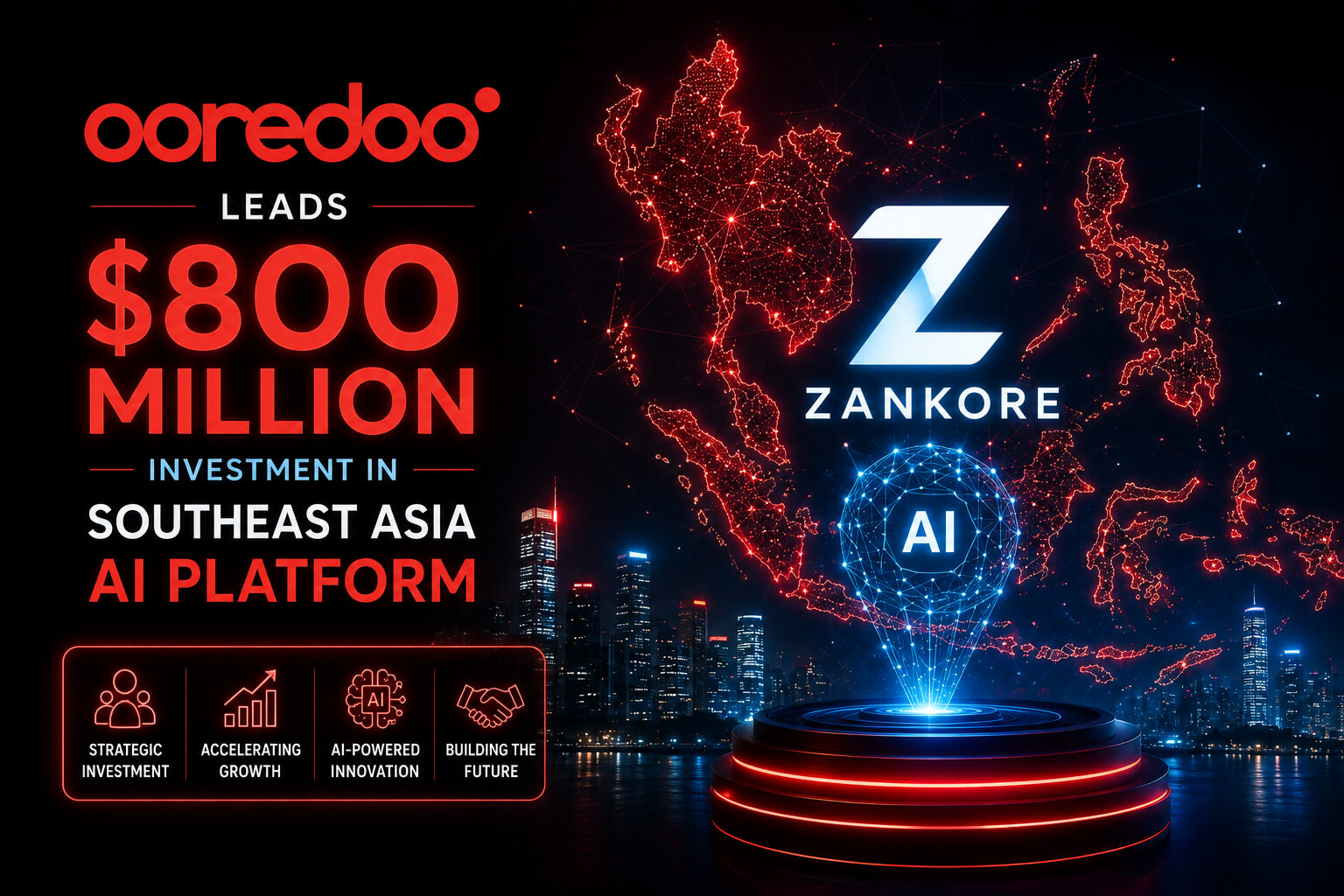
Ooredoo Group is making an unusually large bet on the AI infrastructure market outside its traditional Middle East base. One significant move is the Ooredoo investment in Zankore, which marks a new direction for the company.
The Qatar-based telecommunications company has committed approximately $800 million to Zankore, a newly launched AI computing and neocloud platform based in Indonesia. Ooredoo will become Zankore’s founding shareholder and lead investor, taking a 49% stake in the business.
This is not simply another telecom company adding artificial intelligence to a product announcement. Ooredoo is moving directly into the expensive physical layer of the AI economy: data centers, accelerated computing, networking and access to high-performance GPUs.
Zankore is being developed alongside Indosat Ooredoo Hutchison, Nokia and NVIDIA. The group wants to build what it describes as Southeast Asia’s largest AI infrastructure platform.
Zankore Is Starting in Indonesia
Indonesia will serve as Zankore’s first market and initial headquarters.
That choice carries weight. Indonesia has a large digital economy, a growing base of technology companies and an expanding need for local computing capacity. Running advanced AI models requires more than ordinary cloud storage. Companies need dense GPU clusters, reliable networking, huge amounts of electricity and cooling systems capable of handling the resulting heat.
Much of that infrastructure is still being built across Southeast Asia.
Zankore intends to offer full-stack AI neocloud services, giving businesses, government agencies and developers access to computing infrastructure designed specifically for training and deploying AI models.
The company plans to expand beyond Indonesia as demand develops across the region.
The Platform Is Targeting One Gigawatt of AI Capacity
Zankore’s long-term goal is to deploy one gigawatt of AI computing capacity.
The first phase is expected to provide 200 megawatts by the first half of 2027. That is an aggressive timetable for a platform that has only just been announced.
Its infrastructure is expected to use NVIDIA GB300 NVL72 systems. These rack-scale platforms are designed for demanding AI workloads, including large model training and high-volume inference.
Zankore also plans to use NVIDIA’s power-optimization technology. According to the announcement, the system could increase computing output by as much as 40% without requiring a corresponding increase in available power.
That detail matters. Electricity is becoming one of the hardest constraints facing AI data center developers. More GPUs are useful only when operators can secure enough power to run them.
Ooredoo Expects a Significant Financial Return
Ooredoo’s commitment is substantial, but the company is not presenting the investment as a distant research project.
The group expects Zankore to contribute approximately $600 million in cumulative contracted EBITDA during the initial investment period, covering the platform’s first five years of operation.
Those projections suggest that at least part of the planned capacity is already connected to expected customer demand or commercial agreements. They also show how Ooredoo sees AI compute becoming a meaningful business line rather than a side project attached to its telecommunications operations.
There is risk, of course. AI infrastructure requires heavy upfront spending, and hardware can age quickly. The economics depend on utilization rates, energy costs, customer contracts and whether demand for accelerated computing continues growing at its current pace.
Still, Ooredoo is entering with something many new AI cloud companies do not have: an established telecommunications network, regional operating experience and relationships with major infrastructure suppliers.
Nokia and NVIDIA Give Zankore More Than Brand Recognition
NVIDIA will provide the accelerated computing foundation behind Zankore’s AI capacity. Nokia’s role brings networking and data center infrastructure experience to the project.
Indosat Ooredoo Hutchison adds local market reach in Indonesia, where it already operates a nationwide telecommunications business and has been working with Nokia and NVIDIA on AI-enabled network technology.
The combination is deliberate. Ooredoo brings capital and international infrastructure experience. Indosat brings its Indonesian presence. Nokia provides networking expertise, while NVIDIA supplies the computing architecture at the center of the platform.
Zankore will be led by CEO Ulf Ewaldsson. Its board is expected to include Ooredoo Group CEO Aziz Aluthman Fakhroo, Indosat President Director and CEO Vikram Sinha, and independent director Arijit Ranjan Sarker.
Ooredoo Is Extending an AI Strategy Built in the Middle East
The Zankore investment does not appear out of nowhere.
Ooredoo has already been building AI-ready data center capacity across the Middle East and North Africa. The company previously secured a QAR 2 billion financing facility—approximately $549 million—to support the expansion of regional data centers and AI cloud infrastructure.
It has also worked with NVIDIA to deploy accelerated computing infrastructure across markets including Qatar, Kuwait, Oman, Algeria, Tunisia and the Maldives.
Zankore pushes that strategy into Southeast Asia. Instead of limiting its AI infrastructure plans to existing Middle Eastern operations, Ooredoo is attempting to build a cross-regional computing business.
That changes the shape of the company. A telecom operator earns money by connecting customers. An AI infrastructure provider earns money by selling scarce computing power. Ooredoo now wants to do both.
Southeast Asia’s AI Infrastructure Race Is Getting Crowded
Southeast Asia is attracting data center investment from cloud providers, telecom groups, private equity firms and infrastructure developers.
The appeal is easy to understand. The region has a large population, fast-growing digital services and companies that increasingly want to process data closer to local users. Governments are also paying more attention to data sovereignty, making domestic or regional AI capacity more valuable.
But the market is not guaranteed to reward every new project. Developers still face power shortages, lengthy construction timelines and competition for advanced NVIDIA systems. A one-gigawatt target sounds impressive; securing the land, electricity, equipment and paying customers needed to reach it is another matter.
Ooredoo’s $800 million commitment gives Zankore a serious starting position. Whether it becomes Southeast Asia’s dominant AI neocloud will depend on how quickly that capital turns into functioning, occupied infrastructure.
For now, the investment sends a fairly blunt message: telecom companies no longer want to provide only the connections leading to AI data centers. Some of them want to own the computing inside.
