


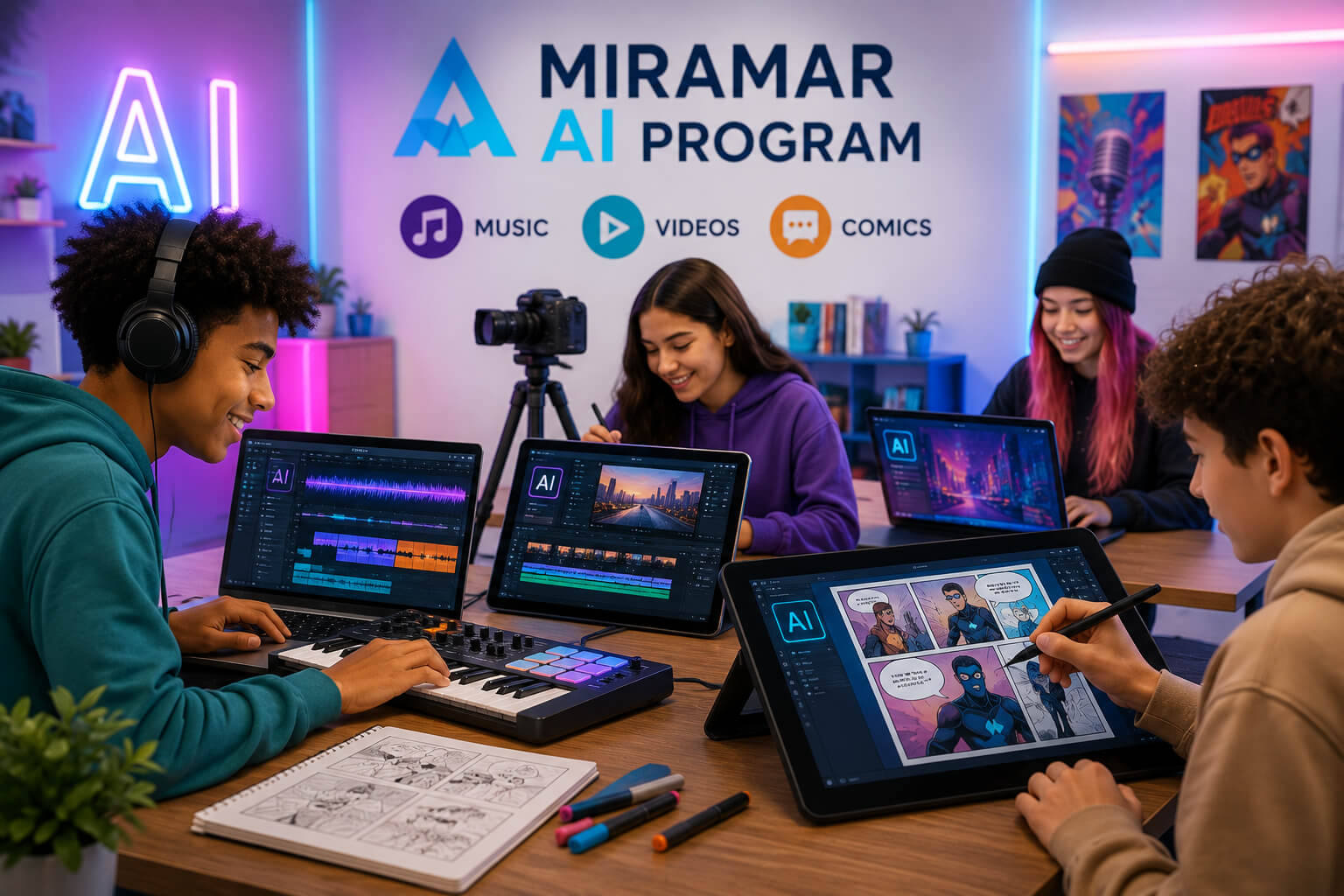
Miramar is bringing artificial intelligence into youth creativity, and honestly, this is the kind of local AI story that deserves more attention.
The city has launched an AI program for teens focused on creative projects like music, videos, and comics. Not corporate dashboards. Not another chatbot pitch. This one is about young people learning how to make things with AI.
That matters because teenagers are already using AI tools. Some use them for homework. Some use them for ideas. Others are experimenting with images, songs, short videos, characters, and stories. Miramar seems to be leaning into that reality instead of pretending it is not happening.
Miramar’s AI Program Turns Technology Into a Creative Workshop
The program gives teens a space to use AI as a creative tool rather than just a search box or homework shortcut. Music, videos, and comics are smart entry points. They feel familiar. A teen does not need to start with code or machine learning theory to understand what AI can do. They can begin with a beat, a character, a short scene, or a visual idea.
That is usually how interest starts. A student makes something. Then they ask how it worked. Then they want to improve it. Suddenly, AI is no longer some abstract technology being debated by adults online. It becomes part of their own creative process.
Why AI Education for Teens Is Getting Harder to Ignore
AI is already in schools, phones, apps, browsers, and social platforms. Teenagers are not waiting for permission to encounter it.
A Pew Research Center study published in 2026 found that AI is now part of the teen technology landscape, with many young people using AI chatbots and forming early opinions about how the technology may affect their future. That makes local programs like Miramar’s more important. They can help turn casual use into guided learning.
There is a big difference between a teen randomly prompting an AI tool alone and a teen learning how to use AI responsibly inside a structured program. One is experimentation. The other can become digital literacy.
Music, Video and Comics Make AI Less Intimidating
The creative angle is important. AI education can sound heavy when it starts with algorithms, data models, or job disruption. Most teens will not immediately connect with that. But ask them to create a comic character, generate a short video concept, or build a music idea, and the door opens faster. That does not mean the program is only about fun.
Creative AI projects can teach prompt writing, editing, storytelling, visual planning, media literacy, copyright awareness, and ethical use. Those are real skills. They also travel well across school, content creation, marketing, design, entertainment, and business. This is where AI learning becomes practical without feeling like a lecture.
Local AI Programs Could Shape the Next Generation of Creators
A city-led AI program for teens may sound small compared with major model launches from OpenAI, Google, Meta, or xAI. But local programs often shape how technology actually reaches people.
Not every young person will become an AI engineer. That is fine. Some may become designers, editors, musicians, marketers, filmmakers, teachers, business owners, or community organizers who understand how to work with AI tools.
That kind of exposure matters. Miramar’s move also reflects a bigger shift in AI education. The conversation is moving beyond “Should students use AI?” and toward a more useful question: “How should students learn to use AI well?”
The Safety Piece Still Matters
Of course, AI programs for teens need guardrails. Creative AI tools can raise questions about originality, misinformation, deepfakes, copyrighted content, and privacy. Teens need room to experiment, but they also need clear guidance on what is acceptable, what is risky, and what should never be published.
That balance is not always easy. Still, avoiding AI entirely is not a serious plan anymore. Young people are going to meet these tools somewhere. A guided city program is a better setting than a random app with no context and no adult support.
Miramar Is Treating AI as a Youth Opportunity
The interesting part is not just that Miramar launched an AI program. It is what the program says about where AI is going. AI is no longer only for software companies, big labs, or enterprise teams. It is entering libraries, classrooms, community centers, youth programs, and local creative spaces. That shift may be quieter than a major AI product launch, but it could have a deeper impact.
A teen who learns how to create with AI today may not think of it as “future technology” at all. For them, it may simply become another tool. A camera offers one comparison. Editing software is another. So is a keyboard. And that is probably where AI is headed. Not always dramatic. Not always polished. Just sitting there, ready to help someone make something.
