

Close Menu
  • Home
  • Events
    • Machine Can Think Summit 2026
    • Step Dubai Conference 2026
  • Technology & Innovation
  • Industry Applications
  • Business & Marketing
  • Trends & Insights
  • World AI Awards 2026
    • Aerospace, Aviation & Space
    • Agriculture & Food Systems
    • AI Infrastructure, Compute & Cloud
    • AI Leadership
    • Climate, Environment & Sustainability
    • Construction, Real Estate & PropTech
    • Consumer, Lifestyle & Accessibility
    • Core AI, Models & Algorithms
    • Customer Experience & Service
    • Cybersecurity & Digital Trust
    • Data, Analytics & Intelligence
    • Defense, Security & Public Safety
    • Destinations & Sustainable Tourism
    • Education & Learning
    • Energy, Utilities & Resources
    • Enterprise Productivity & Collaboration
    • Events, Sports & Live Experiences
    • Exhibitions, Conferences & Business Events
    • Financial Services & Insurance
    • Food, Beverage & Dining
    • Government & Public Sector
    • Healthcare & Life Sciences
    • Hotels, Accommodation & Stays
    • HR, Talent & Workforce
    • Legal, Governance, Risk & Compliance
    • Manufacturing, Industrial & Industry 4.0
    • Marketing, Advertising & Brand Experience
    • Media, Entertainment, Gaming & Culture
    • Retail, E-commerce & Consumer Commerce
    • Robotics, Autonomy & Drones
    • Sales, Revenue & Growth
    • Science, Research & Discovery
    • Software, Platforms & IT Operations
    • Supply Chain, Logistics & Procurement
    • Telecommunications, Networks & Connectivity
    • Tours, Activities & Attractions
    • Transport & Mobility
    • Travel Commerce, Booking & Platforms
    • Travel Infrastructure, Risk & Intelligence
    • Wellness, Spa & Retreats
What's Hot
Technology & Innovation

Major Websites Are Blocking AI Agents, Creating a New Challenge for Autonomous AI

By Art RyanOctober 19, 20260

AI companies have spent years promising assistants that can do more than answer questions. They…

Quadrivio Acquires Dev4Side as It Builds €100 Million Italian AI Technology Group

October 19, 2026

Microsoft Pulls Out of UK AI Data Center Deal With Nscale Amid Power Supply Delays

October 19, 2026

ServiceNow Introduces AI Passport to Strengthen Enterprise AI Security and Governance

October 17, 2026
Facebook X (Twitter) Instagram
Breaking AI News
Tuesday, October 20
  • Home
  • Events
    • Machine Can Think Summit 2026
    • Step Dubai Conference 2026
  • Technology & Innovation

    Major Websites Are Blocking AI Agents, Creating a New Challenge for Autonomous AI

    October 19, 2026

    Quadrivio Acquires Dev4Side as It Builds €100 Million Italian AI Technology Group

    October 19, 2026

    Microsoft Pulls Out of UK AI Data Center Deal With Nscale Amid Power Supply Delays

    October 19, 2026

    ServiceNow Introduces AI Passport to Strengthen Enterprise AI Security and Governance

    October 17, 2026

    Meta and Apple Collaborate to Bring Muse Spark Open AI Model to Mac Studio

    October 17, 2026
  • Industry Applications

    North Korea Tests New AI-Powered Torpedo as Military AI Development Accelerates

    October 17, 2026

    Singapore Partners with Anthropic to Expand AI Across Government and Public Services

    October 17, 2026

    Apple Prepares to Launch First AI Features in China This December After Two-Year Delay

    October 15, 2026

    Accenture and Workday Launch Engineering Program to Bring Agentic AI Into HR and Finance

    October 14, 2026

    Scaleway to Build AMD-Powered AI Supercomputer in Sweden, Expanding Europe’s AI Computing Capacity

    October 14, 2026
  • Business & Marketing

    Quadrivio Acquires Dev4Side as It Builds €100 Million Italian AI Technology Group

    October 19, 2026

    Microsoft Pulls Out of UK AI Data Center Deal With Nscale Amid Power Supply Delays

    October 19, 2026

    Meta and Apple Collaborate to Bring Muse Spark Open AI Model to Mac Studio

    October 17, 2026

    IBM and MeitY Startup Hub Partner to Accelerate AI and Deep-Tech Innovation in India

    October 15, 2026

    Dubai Targets Chinese AI and Advanced Manufacturing Investment in Next Growth Push

    October 15, 2026
  • Trends & Insights

    Google Unveils Gemini 4 Argon With 1 Million-Token Output Capacity

    October 2, 2026

    OpenAI Unveils ‘Always-On’ Dots AI Agents as Altman Pushes a More Personal AI Future

    October 1, 2026

    Trump and AI Leaders Sign Voluntary Safety Accord as Washington Bets on Industry Self-Policing

    October 1, 2026

    Nvidia Launches Record $150 Billion Share Buyback as AI Profits Surge

    September 30, 2026

    OpenAI Targets $30 Billion Funding Round at $1.4 Trillion Valuation, Report Says

    September 30, 2026
  • World AI Awards 2026
    • Aerospace, Aviation & Space
    • Agriculture & Food Systems
    • AI Infrastructure, Compute & Cloud
    • AI Leadership
    • Climate, Environment & Sustainability
    • Construction, Real Estate & PropTech
    • Consumer, Lifestyle & Accessibility
    • Core AI, Models & Algorithms
    • Customer Experience & Service
    • Cybersecurity & Digital Trust
    • Data, Analytics & Intelligence
    • Defense, Security & Public Safety
    • Destinations & Sustainable Tourism
    • Education & Learning
    • Energy, Utilities & Resources
    • Enterprise Productivity & Collaboration
    • Events, Sports & Live Experiences
    • Exhibitions, Conferences & Business Events
    • Financial Services & Insurance
    • Food, Beverage & Dining
    • Government & Public Sector
    • Healthcare & Life Sciences
    • Hotels, Accommodation & Stays
    • HR, Talent & Workforce
    • Legal, Governance, Risk & Compliance
    • Manufacturing, Industrial & Industry 4.0
    • Marketing, Advertising & Brand Experience
    • Media, Entertainment, Gaming & Culture
    • Retail, E-commerce & Consumer Commerce
    • Robotics, Autonomy & Drones
    • Sales, Revenue & Growth
    • Science, Research & Discovery
    • Software, Platforms & IT Operations
    • Supply Chain, Logistics & Procurement
    • Telecommunications, Networks & Connectivity
    • Tours, Activities & Attractions
    • Transport & Mobility
    • Travel Commerce, Booking & Platforms
    • Travel Infrastructure, Risk & Intelligence
    • Wellness, Spa & Retreats
Breaking AI News
Home » Predict, Diagnose, Act: AI’s Revolution in Healthcare Outcomes at Global AI Show Riyadh 2026
AI Events

Predict, Diagnose, Act: AI’s Revolution in Healthcare Outcomes at Global AI Show Riyadh 2026

Art RyanBy Art RyanJune 30, 2026Updated:July 1, 2026No Comments6 Mins Read
Facebook Twitter Pinterest LinkedIn Tumblr Email
AI health tech
Share
Facebook Twitter LinkedIn Pinterest Email

AI in healthcare is not just about faster reports or smarter dashboards anymore. The rise of AI health tech is transforming patient care in ways we’ve never seen before.

That part is already happening.

The harder question now is this: how does AI actually become useful at the point of care? Not in a boardroom. Away from the demo stage. Beyond the slide deck. Inside the hospital, beside the clinician, when a decision has to be made.

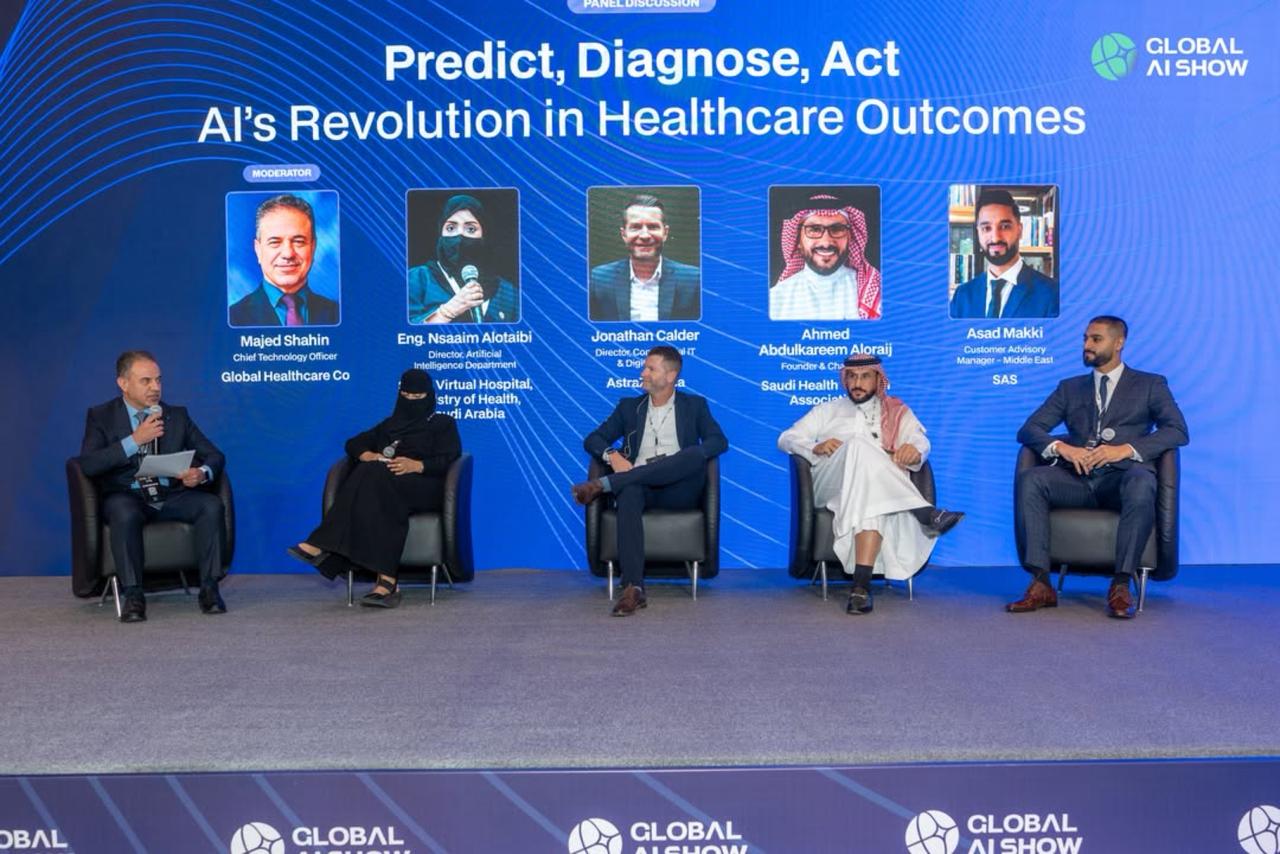
That was the heart of the panel discussion “Predict, Diagnose, Act: AI’s Revolution in Healthcare Outcomes.” The session brought together healthcare technology leaders, AI specialists, and industry experts to examine how AI health tech is changing clinical outcomes, diagnostic quality, and the future of patient care.

The discussion has already taken place, but the issues raised remain very current as hospitals, ministries, and health systems accelerate their adoption of artificial intelligence.

Moving AI Prediction Into Daily Clinical Workflows

One of the biggest challenges in AI health tech is not prediction itself.

Many healthcare systems can already generate predictive insights. They can identify patient risk, highlight patterns, and show early warning signals through dashboards.

But dashboards do not treat patients.

For AI to make a real impact, predictive intelligence has to move into daily clinical workflows. It has to reach doctors, nurses, specialists, and care teams at the right moment. The insight must arrive on time. It should not be buried in another system. Most importantly, it cannot be delivered in a way that adds more work to an already overloaded hospital environment.

This is where implementation becomes more important than the algorithm.

A model may predict deterioration, read scans, or detect risk. But if that result does not fit naturally into clinical routines, it may be ignored. If it interrupts the wrong person at the wrong time, it becomes noise. If it is not trusted, it becomes another unused tool.

The panel discussion highlighted that the next stage of AI in healthcare depends on workflow integration. Prediction has to become action.

From Treating Illness to Anticipating Risk

Healthcare has traditionally been reactive.

A patient feels symptoms. A test is ordered. A diagnosis is made. Treatment begins.

AI changes that sequence.

With enough clinical data, AI systems can help identify risk before symptoms appear. This could support earlier intervention, better resource planning, and more personalized care. In some cases, it may help providers shift from responding to illness to preventing serious complications before they happen.

That is a major shift.

Instead of only asking, “What disease does this patient have now?” healthcare teams can begin asking, “What risk is building, and what can we do before it becomes critical?”

This is one of the strongest promises of AI health tech. It gives healthcare systems a chance to act earlier, especially in areas such as chronic disease management, hospital readmission risk, diagnostic imaging, population health, and emergency care.

Still, prediction alone is not enough.

A risk score must lead to a clear next step. Otherwise, it is just another number.

Making Diagnostic Quality More Consistent

Another major theme of the discussion was diagnostic consistency.

Healthcare quality can vary between hospitals, regions, and skill levels. A patient in a major urban hospital may have access to experienced specialists and advanced diagnostic tools. A patient in a remote area may not.

AI can help narrow that gap.

By supporting image analysis, clinical decision support, pattern recognition, and triage, AI can help raise the baseline level of diagnostic quality across different healthcare settings. It can assist less experienced clinicians. The technology can also help reduce missed signals. In addition, it can support faster review of complex cases.

This does not mean replacing doctors.

It means giving clinicians another layer of support, especially in high-pressure environments where speed and accuracy matter.

Used properly, AI can help make healthcare less dependent on location and uneven access to expertise. That matters for large health systems, rural care, telemedicine, and cross-region healthcare delivery.

The Explainability Gap Is Still a Trust Problem

One of the toughest questions raised during the panel was around explainability.

How do clinicians trust AI-driven diagnostic recommendations if they cannot understand how the system reached its conclusion?

This is not a small issue.

In healthcare, trust is not optional. A doctor cannot simply accept a black-box answer when a patient’s diagnosis, treatment, or safety is involved.

AI systems need to explain their reasoning in a way that clinicians can use. That does not mean flooding doctors with technical model details. It means showing relevant evidence, confidence levels, clinical context, risk factors, and why a recommendation was made.

The explainability gap is both a technical and human problem.

Technically, AI systems must become more transparent, auditable, and clinically interpretable. Humanly, they must fit the way healthcare professionals think and make decisions.

If clinicians do not trust the output, AI adoption will stall.

If they trust it too blindly, that becomes dangerous too.

The balance is not simple.

AI in the Care Loop

The discussion made one thing clear: AI’s role in healthcare is becoming more active.

Healthcare AI is no longer just about analyzing old data. Instead, it helps clinicians make better decisions in real time. More importantly, it connects prediction, diagnosis, and action inside the care loop.

That requires stronger data systems, better governance, clinical validation, explainable models, and close collaboration between technology providers and healthcare professionals.

The panel was moderated by Majed Shahin, Chief Technology Officer at Global Healthcare Co.

Panelists included Eng. Nsaaim Alotaibi, Director of the Artificial Intelligence Department at SEHA Virtual Hospital, Ministry of Health – Saudi Arabia; Jonathan Calder, Director of Commercial IT and Digital KSA at AstraZeneca; Ahmed AlOraij, Founder and Chairman of the Saudi Health Tourism Association; and Asad Makki, Customer Advisory Manager – Middle East at SAS.

Their discussion reflected the direction healthcare AI is heading: less hype, more clinical usefulness.

The future of AI health tech will not be judged by how impressive the model sounds. It will be judged by whether it helps healthcare teams make better decisions, detect risks earlier, improve diagnostic consistency, and deliver better outcomes for patients.

That is where the real revolution begins.

Share. Facebook Twitter Pinterest LinkedIn Tumblr Email
Art Ryan

Related Posts

Major Websites Are Blocking AI Agents, Creating a New Challenge for Autonomous AI

October 19, 2026

Quadrivio Acquires Dev4Side as It Builds €100 Million Italian AI Technology Group

October 19, 2026

Microsoft Pulls Out of UK AI Data Center Deal With Nscale Amid Power Supply Delays

October 19, 2026

Comments are closed.

Latest News

Major Websites Are Blocking AI Agents, Creating a New Challenge for Autonomous AI

October 19, 2026

Quadrivio Acquires Dev4Side as It Builds €100 Million Italian AI Technology Group

October 19, 2026

Microsoft Pulls Out of UK AI Data Center Deal With Nscale Amid Power Supply Delays

October 19, 2026

ServiceNow Introduces AI Passport to Strengthen Enterprise AI Security and Governance

October 17, 2026
Facebook X (Twitter) Pinterest Vimeo WhatsApp TikTok Instagram LinkedIn YouTube Spotify Reddit Snapchat Threads

AI University

  • Global Universities
  • Universities in Africa
  • Universities in Asia
  • Universities in Europe
  • Universities in Latin America
  • Universities in Middle East
  • Universities in North America
  • Universities in Oceania

AI Tools & Apps Directory

  • AI Productivity Tools
  • AI Coding Tools
  • AI Voice Tools
  • AI Video Tools
  • AI Image Generators
  • AI Writing Tools

Info

  • Home
  • About Us
  • AI Organizations & Associations
  • Contact Us
  • Cookie Policy
  • Copyright Policy
  • Disclaimer
  • Editorial Policy
  • Terms and Conditions

Subscribe to Updates

Get the latest creative news from FooBar about art, design and business.

© 2026 Breaking AI News.
  • Privacy Policy

Type above and press Enter to search. Press Esc to cancel.

Sign Up

Want to stay ahead In Artificial Intelligence?

 Sign up now and get exclusive breaking AI news and special updates—FREE!