


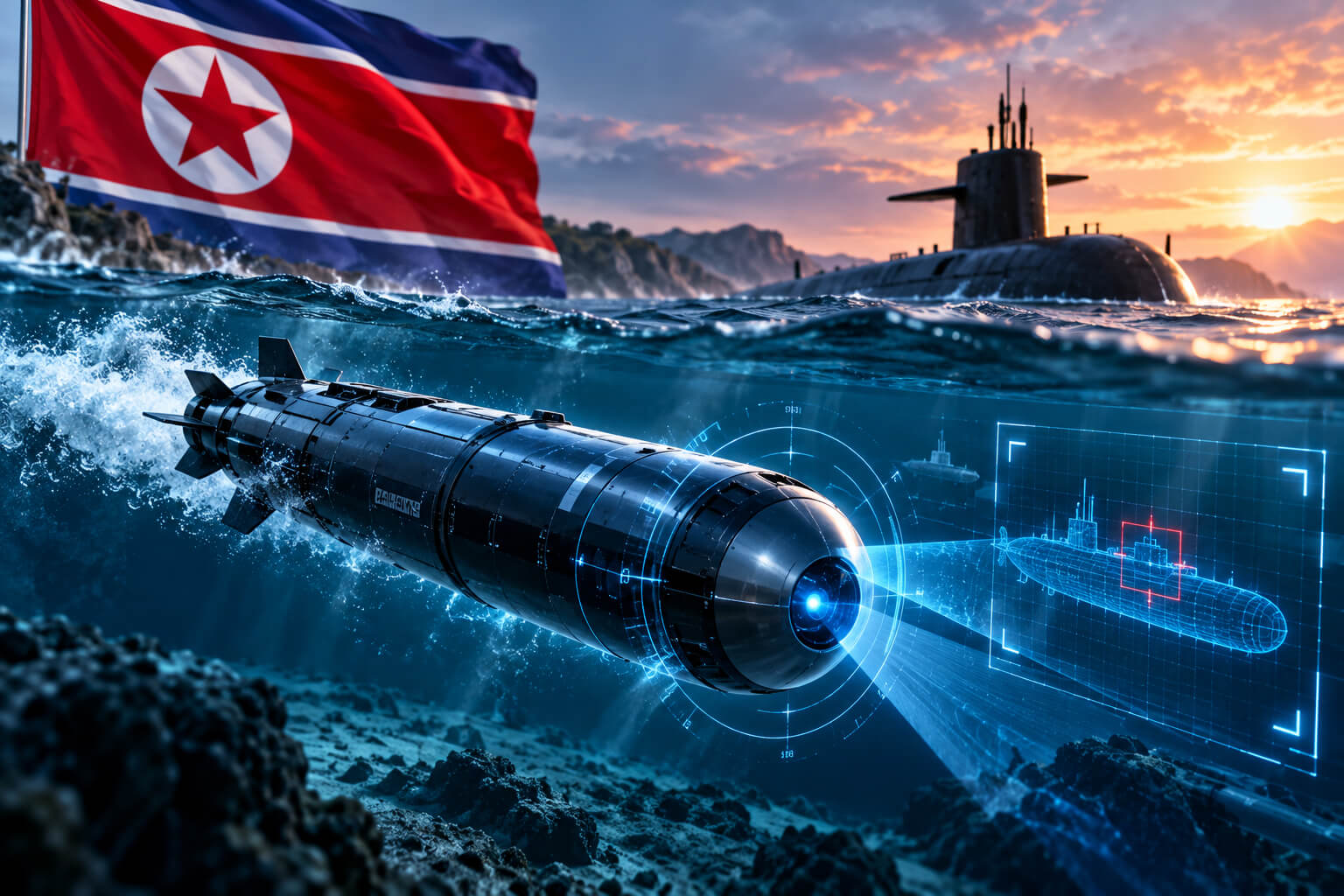
North Korea has reportedly tested a new torpedo equipped with artificial intelligence, signalling another step in the country’s efforts to develop more advanced underwater weapons.
According to the Korean Central News Agency (KCNA), the test involved the Zam-2.0 precision-guided torpedo, a weapon designed to improve underwater targeting and navigation through AI-assisted technology.
The announcement comes as Pyongyang continues investing in military modernisation, including submarine-launched missiles, underwater weapons and advanced propulsion systems. While North Korean state media described the test as successful, independent verification of the torpedo’s performance remains limited.
The development also raises questions about how artificial intelligence could change naval warfare, particularly as military forces explore technologies that can process sensor information and respond to changing conditions with less direct human intervention.
North Korea Integrates AI Into Underwater Target Detection
Artificial intelligence is becoming an increasingly important part of military technology, and North Korea appears determined to incorporate it into its naval weapons. The Zam-2.0 reportedly uses AI to support underwater target detection and guidance, potentially helping the torpedo analyse information collected by its sensors while travelling toward a target.
Traditional torpedoes already rely on automated navigation and acoustic detection systems. AI could introduce more sophisticated methods of interpreting underwater signals, distinguishing targets from surrounding noise and adjusting guidance in difficult operating conditions.
However, North Korea has not disclosed how its AI targeting system works or whether the torpedo can make independent engagement decisions. The distinction matters because AI-assisted navigation does not necessarily mean a weapon can autonomously select and attack targets.
For now, the reported capabilities remain claims made by North Korean state media rather than independently verified technological achievements.
Years of Propulsion Testing Support North Korea’s Torpedo Development
The Zam-2.0 project reportedly builds on several years of research into underwater propulsion. KCNA said North Korean engineers conducted more than 180 tests over five years while developing the propulsion technology used in the new weapon.
The latest demonstration reportedly assessed propulsion performance alongside the torpedo’s guidance capabilities. North Korea presented the results as evidence of progress in developing faster and more accurate underwater weapons.
Speed plays a significant role in torpedo warfare. A weapon travelling at higher velocity can shorten the time available for a targeted vessel to identify the threat, manoeuvre or deploy defensive countermeasures. Improved propulsion could therefore become an important advantage when combined with advanced targeting systems.
Still, Pyongyang has not published independently verifiable figures for the Zam-2.0’s maximum speed, operating range or targeting accuracy. Without those details, it remains difficult to determine how the weapon compares with existing torpedo systems used by other navies.
North Korea Expands Its Naval Weapons Programme
The reported AI-powered torpedo test forms part of North Korea’s broader effort to strengthen its naval capabilities. Pyongyang has continued developing submarine-launched missiles, underwater weapons and platforms intended to expand its military options beyond land-based systems.
North Korean authorities have repeatedly emphasised the importance of modernising their navy, particularly as regional military competition intensifies. Advanced torpedoes could support that objective by giving submarines and other naval platforms additional ways to engage maritime targets.
The integration of artificial intelligence may also reflect a growing interest in technologies that help weapons operate in environments where communication with human operators is difficult. Underwater conditions create particular challenges because radio communications are limited and acoustic sensors must contend with background noise and changing ocean conditions.
Whether the Zam-2.0 can reliably address those problems remains uncertain. Its reported development nevertheless suggests that North Korea sees AI-assisted underwater systems as part of its future military strategy.
South Korea and North Korea Push Ahead With Advanced Missile Technology
Military competition on the Korean Peninsula is no longer focused solely on conventional missiles and artillery. Both North and South Korea are developing weapons that rely on greater speed, improved manoeuvrability and increasingly sophisticated guidance systems.
South Korean President Lee Jae Myung recently oversaw the country’s first test-firing of a domestically developed hypersonic missile. The weapon uses a hypersonic glide vehicle that can change direction during flight, potentially making interception more difficult.
North Korea has pursued similar capabilities. Leader Kim Jong Un recently supervised a test involving an intermediate-range hypersonic missile, adding to Pyongyang’s growing portfolio of advanced weapons.
The Zam-2.0 torpedo introduces another dimension to this competition. While hypersonic missiles focus on high-speed aerial threats, AI-assisted underwater weapons could create additional challenges for naval defence systems. The technologies operate differently, but both reflect efforts to make military weapons faster, more responsive and harder to counter.
AI-Powered Torpedoes Raise Questions About Autonomous Weapons
The reported use of artificial intelligence in North Korea’s latest torpedo raises broader concerns about the growing role of AI in military operations. Defence organisations increasingly explore machine learning for surveillance, threat identification, navigation and decision support, but incorporating these technologies into weapons creates additional technical and ethical challenges.
Underwater environments are especially demanding for automated systems. Ocean noise, changing water temperatures and limited communication can interfere with sensor performance. AI may help process complicated acoustic information, but unreliable data or incorrect classifications could still produce dangerous outcomes.
Another concern involves human control. A torpedo that uses AI to improve target detection is not necessarily an autonomous weapon capable of making independent attack decisions. North Korea has not provided enough technical information to establish where the Zam-2.0 falls on that spectrum.
The distinction matters because systems that independently identify and engage targets raise questions about accountability, civilian protection and compliance with international humanitarian law. Those concerns become more pressing as countries incorporate AI into increasingly capable military platforms.
What North Korea’s AI Torpedo Test Means for Future Naval Warfare
North Korea’s latest weapons announcement suggests that artificial intelligence is becoming part of the country’s broader military modernisation strategy. The Zam-2.0 combines reported AI-assisted targeting with propulsion technology that Pyongyang says has undergone years of testing.
The announcement is significant, but it does not establish that North Korea has developed a fully autonomous underwater weapon. The country has not released enough information to independently assess the torpedo’s accuracy, reliability or operational effectiveness.
What stands out is the direction of development. AI is no longer being discussed only as a tool for military intelligence or battlefield surveillance. Countries are also exploring how the technology can support the guidance and operation of weapons themselves.
For North Korea, the Zam-2.0 represents another claimed technological advance in its naval programme. For the wider defence industry, it illustrates how artificial intelligence could reshape underwater warfare while creating new questions about safety, oversight and the future of autonomous military systems.
Sources
- Reuters – North Korea tests new AI-equipped torpedo, KCNA says — October 16–17, 2026.
- Yonhap News Agency – North Korea conducts underwater test of new precision-guided torpedo using AI — October 17, 2026.
- NK News – North Korea tests new high-precision AI-equipped torpedo — October 17, 2026.
- The Korea Times – North Korea conducts underwater test of new precision-guided torpedo using AI — October 17, 2026.
