


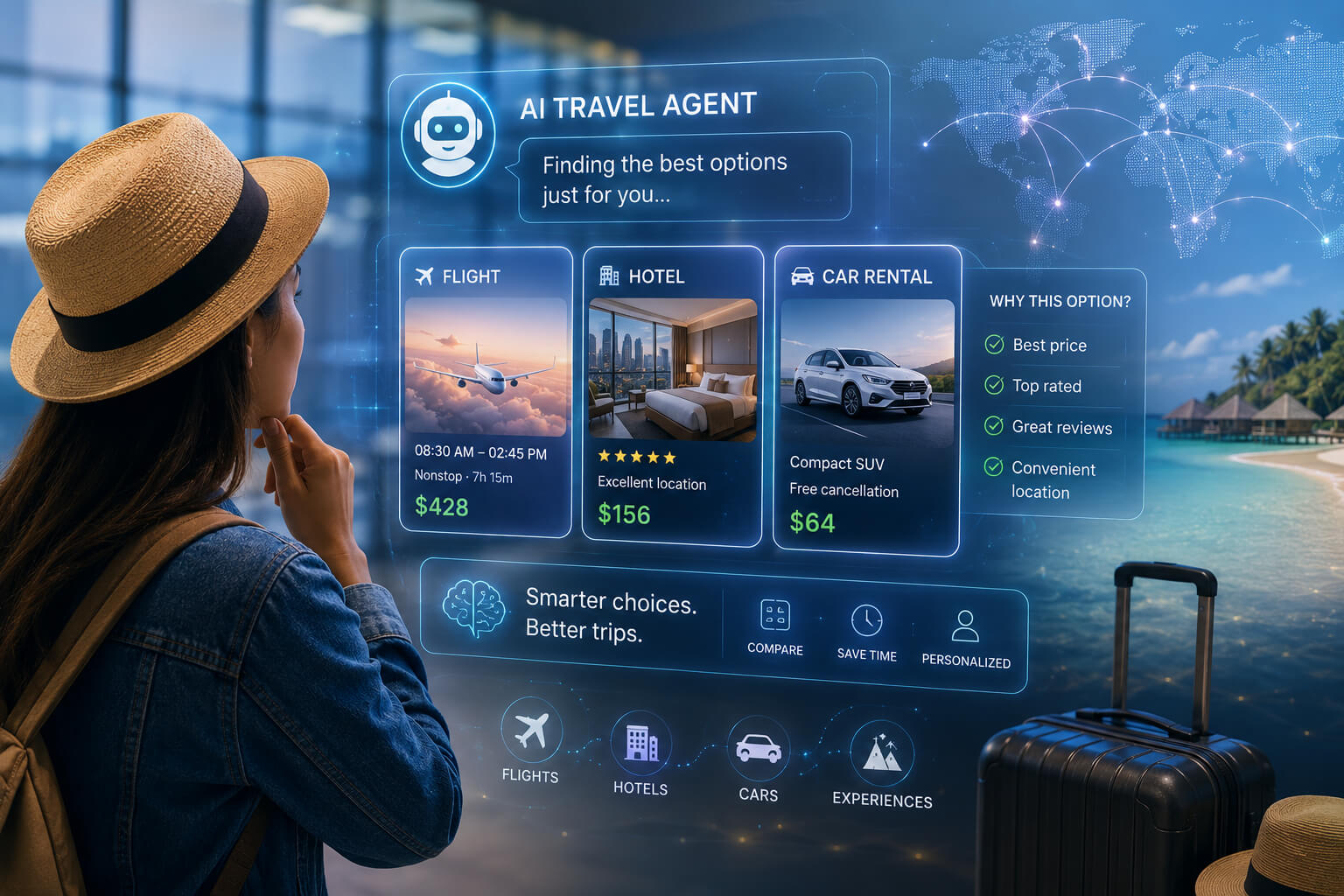
Artificial intelligence is quickly changing how travelers search, compare and book trips. A new Accenture Consumer Pulse Research report shows that AI travel agents are no longer being viewed only as planning tools. Instead, travelers are becoming more comfortable allowing AI agents to influence decisions, compare brands and even make booking choices within set limits.
The findings point to a major shift for airlines, hotels and travel platforms. Brand loyalty, once built through points, repeat stays and familiar experiences, may become more fragile as travelers rely on AI systems to find the best value, relevance and convenience at the moment of booking.
According to the research, 36% of loyal travelers would allow an AI agent to switch them away from their preferred hotel or airline brand if another option better matched their needs. This suggests that travel brands may soon need to compete not only for human attention, but also for visibility inside AI-powered recommendation systems.
AI Travel Agents Are Moving Beyond Simple Trip Planning
For many travelers, AI has already become a useful tool for inspiration, itinerary planning and destination research. However, the next phase is more advanced. AI travel agents are beginning to act as decision-making assistants that can evaluate options, apply traveler preferences and narrow choices across hotels, airlines and other travel services.
Accenture’s latest research found that 87% of travelers are open to collaborating with an AI-powered travel agent to find the best option. This reflects growing confidence in AI’s ability to simplify travel planning, especially in a market where consumers often face too many choices, changing prices and complex loyalty programs.
The report also found that nearly three in ten travelers would allow an AI agent to make the final booking decision before payment, as long as the agent follows defined boundaries such as budget, destination, schedule and personal preferences. Although fully autonomous booking remains in its early stages, 7% of travelers said they would allow an AI agent to shop autonomously, make booking decisions and complete purchases on their behalf.
This does not mean travelers are giving up control completely. Instead, many are choosing a balanced approach. They want AI to reduce the effort involved in comparing options while still allowing them to set the rules.
Travel Loyalty Faces a New AI Challenge
The biggest impact may be felt in brand loyalty. Travel companies have traditionally worked hard to keep customers inside loyalty ecosystems through rewards, member rates, upgrades and personalized offers. However, AI agents could change how travelers evaluate those benefits.
If an AI agent finds a hotel, flight or package that offers a better match, loyal customers may become more willing to switch. This makes loyalty more conditional. Travelers may still value trusted brands, but they may also expect those brands to prove their value every time a booking decision is made.
For airlines and hotels, this creates a new challenge. It is no longer enough to maintain a recognizable brand or offer a standard loyalty program. Travel companies need to ensure that their offers, availability, pricing, policies and personalized benefits are easy for AI systems to understand, compare and recommend.
In this new environment, the winning brand may be the one that provides the clearest value at the moment of intent.
AI Could Influence Most Travel Spending
The research also shows that AI’s role in travel commerce is likely to grow quickly. Accenture found that 71% of travelers expect at least half of their hotel or airline spending to be influenced by AI over the next 12 months.
This could reshape the customer journey from the beginning. Instead of starting with a search engine, online travel agency or brand website, travelers may increasingly begin with a personal AI assistant. The AI agent could ask about preferences, compare loyalty benefits, assess prices, review policies and recommend the most suitable option.
For travel brands, this means digital visibility must evolve. Search engine optimization may no longer be the only priority. Companies may also need to prepare for “agent optimization,” where AI systems can easily access accurate product data, real-time inventory, clear pricing and relevant offers.
Hotels and airlines that fail to adapt may risk being excluded from AI-driven recommendations, even if they have strong brand recognition among human customers.
Why Human Experience Still Matters
Despite the rise of AI travel agents, the research also shows that emotional connection still matters. Accenture found that 44% of travelers want to stay involved in at least one part of the journey because they enjoy browsing or feel connected to a travel brand.
This is an important reminder for the travel industry. AI may help travelers make faster and smarter decisions, but it does not remove the value of human experience. Service quality, trust, hospitality, comfort and memorable moments will remain important factors in long-term loyalty.
The future of travel loyalty may depend on how well brands combine both sides: machine-readable value for AI agents and emotionally meaningful experiences for human travelers.
Travel Brands Need to Become AI-Ready
The shift toward AI-assisted travel booking creates a clear message for the industry. Travel companies need to make their products easier for AI agents to discover, evaluate and book.
This may include improving structured data, strengthening direct booking systems, integrating with AI platforms, updating personalization tools and making loyalty benefits easier to compare. Brands also need to ensure that their offers are transparent and relevant, because AI agents will likely prioritize options that can be verified quickly and matched accurately to consumer needs.
One example highlighted in the report is Ascott, a Singapore-based hospitality company that is developing agent-ready infrastructure. The company is working to connect its inventory, personalization and booking capabilities with AI platforms so travelers can discover and book through the AI assistants they choose.
This approach could become more common as travel brands recognize that AI agents may become a major gateway to future bookings.
Conclusion
AI travel agents are beginning to reshape the relationship between travelers and brands. Accenture’s research suggests that travelers are increasingly willing to let AI influence spending, compare options and even switch them away from preferred hotel or airline brands.
For travel companies, the message is clear. Loyalty can no longer be assumed. Brands must show up where AI agents are making decisions, present their value clearly and continue building the human experiences that create trust.
As AI becomes more involved in travel planning and booking, the brands that succeed will be those that can satisfy both the traveler and the intelligent systems acting on their behalf.
