


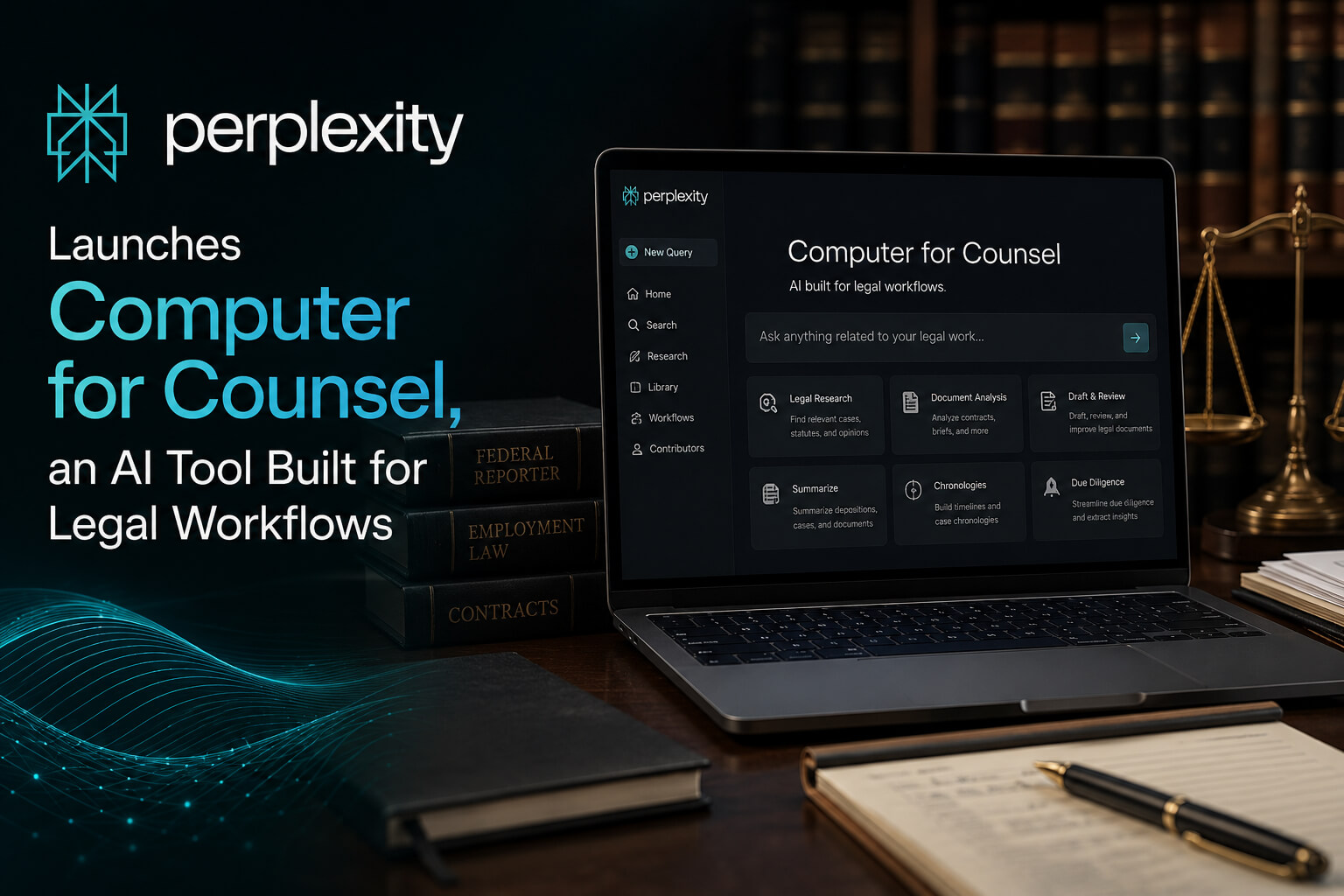
Perplexity is expanding deeper into professional AI tools with the launch of Computer for Counsel, a legal-focused version of its agentic AI platform. This version is designed to help lawyers move beyond simple chatbot-style research.
The new platform is built for legal teams that need more than quick answers. Instead of only summarizing information or responding to legal research prompts, Computer for Counsel is designed to handle multi-step workflows. These include contract review, legal research, document preparation, regulatory monitoring, and matter management.
The launch signals a broader shift in the legal technology market. In particular, AI companies are moving from general-purpose assistants toward workflow-based systems that can connect with the tools professionals already use.
What Is Perplexity Computer for Counsel?
Perplexity Computer for Counsel is a legal AI platform built on Perplexity’s broader “Computer” system. The idea behind the product is to give lawyers an AI agent that can plan, coordinate, and complete legal tasks. This happens across multiple connected tools.
Rather than relying on a single AI model to answer every request, the system uses a multi-agent approach. A legal task can be broken into smaller parts. Different AI agents or models handle research, drafting, document analysis, citation review, or workflow coordination.
For lawyers, this means the platform is not only meant to provide information. It is designed to help produce completed work outputs that can then be reviewed, edited, and approved by legal professionals.
How Perplexity Computer for Counsel Works
Computer for Counsel operates as an AI workflow engine. When a user gives it a task, the system can divide that task into smaller steps. In addition, it can gather the required information, use connected legal and business tools, and combine the results into a more complete final output.
For example, a legal team could use the platform to:
Review a third-party NDA for risk areas
Research case law and produce a citation-backed summary
Monitor regulatory changes across jurisdictions
Search internal legal documents and past work product
Prepare clean contract drafts for review
Organize matter-related information across different systems
The system runs tasks in a cloud-based environment and can connect with legal research databases, document tools, contract platforms, and matter-management systems. Therefore, this makes it more workflow-oriented than a traditional AI chatbot.
Legal Tools and Integrations
Perplexity is positioning Computer for Counsel as a connected AI layer for legal teams. The platform is expected to work with tools used in legal research, document management, contracts, and business operations.
Reported integrations and connectors include platforms such as Box, Carta, Clio, DeepJudge, DocuSign, Ironclad, LegalZoom, Midpage, and NetDocuments.
These integrations are important because lawyers often work across many different systems. A typical legal workflow may involve research databases, document repositories, contract lifecycle management tools, internal knowledge bases, and approval systems. Computer for Counsel aims to bring these tasks into a single AI-assisted workflow.
Why This Matters for Lawyers
Legal work is highly document-heavy and research-intensive. Lawyers often spend significant time gathering information, comparing sources, checking citations, reviewing contracts, and routing documents through approval processes.
AI tools have already entered the legal market, but many still function mainly as assistants for drafting or research. Perplexity’s Computer for Counsel points toward a more agentic model. With this, AI can coordinate several parts of a workflow at once.
This could help legal teams save time on repetitive tasks. At the same time, it keeps lawyers focused on judgment, strategy, negotiation, and final review.
However, legal AI also comes with major responsibilities. Accuracy, confidentiality, citation quality, data security, and professional accountability are especially important in law. Any AI-generated legal output still needs human review before it can be used in real matters.
Examples of Computer for Counsel Use Cases
Perplexity Computer for Counsel could be useful across several areas of legal practice. These include commercial law, litigation, employment law, intellectual property, regulatory compliance, and general corporate legal work.
One possible use case is NDA intake. The AI system could review a third-party NDA, identify missing clauses or risky language, suggest edits, and prepare a clean version. Then it could route the document for signature.
Another use case is regulatory monitoring. Legal teams could ask the system to track privacy, advertising, or technology rules across different states or jurisdictions. Then the system can generate updates with supporting legal sources.
A third use case is case research. Instead of only returning a list of cases, the system could summarize relevant decisions and highlight unresolved legal questions. It could also check citations and prepare a research memo for attorney review.
Perplexity’s Bigger Push Into AI Agents
The launch of Computer for Counsel fits into Perplexity’s broader strategy of turning AI from a search-and-answer tool into an action-oriented agent. The company has been expanding its agentic AI products. These new products help users complete tasks rather than simply receive information.
For the legal sector, this approach could make Perplexity a more direct competitor to established legal technology companies. It would also compete with AI-powered legal research platforms.
The timing is also notable. Law firms and in-house legal departments are increasingly testing AI tools. However, adoption depends heavily on trust, security, accuracy, and whether the tools fit into existing workflows.
The Bottom Line
Perplexity Computer for Counsel shows how quickly AI tools are evolving in the legal industry. The product is designed to help lawyers research, draft, review, and manage legal work through connected AI workflows.
Its success will depend on whether legal teams trust the platform’s accuracy, data handling, citations, and ability. In addition, it must integrate smoothly with existing systems.
For now, the launch marks another sign that AI in law is moving beyond simple chatbots. The next phase is likely to focus on AI agents that can support full professional workflows while keeping human experts in control.
