


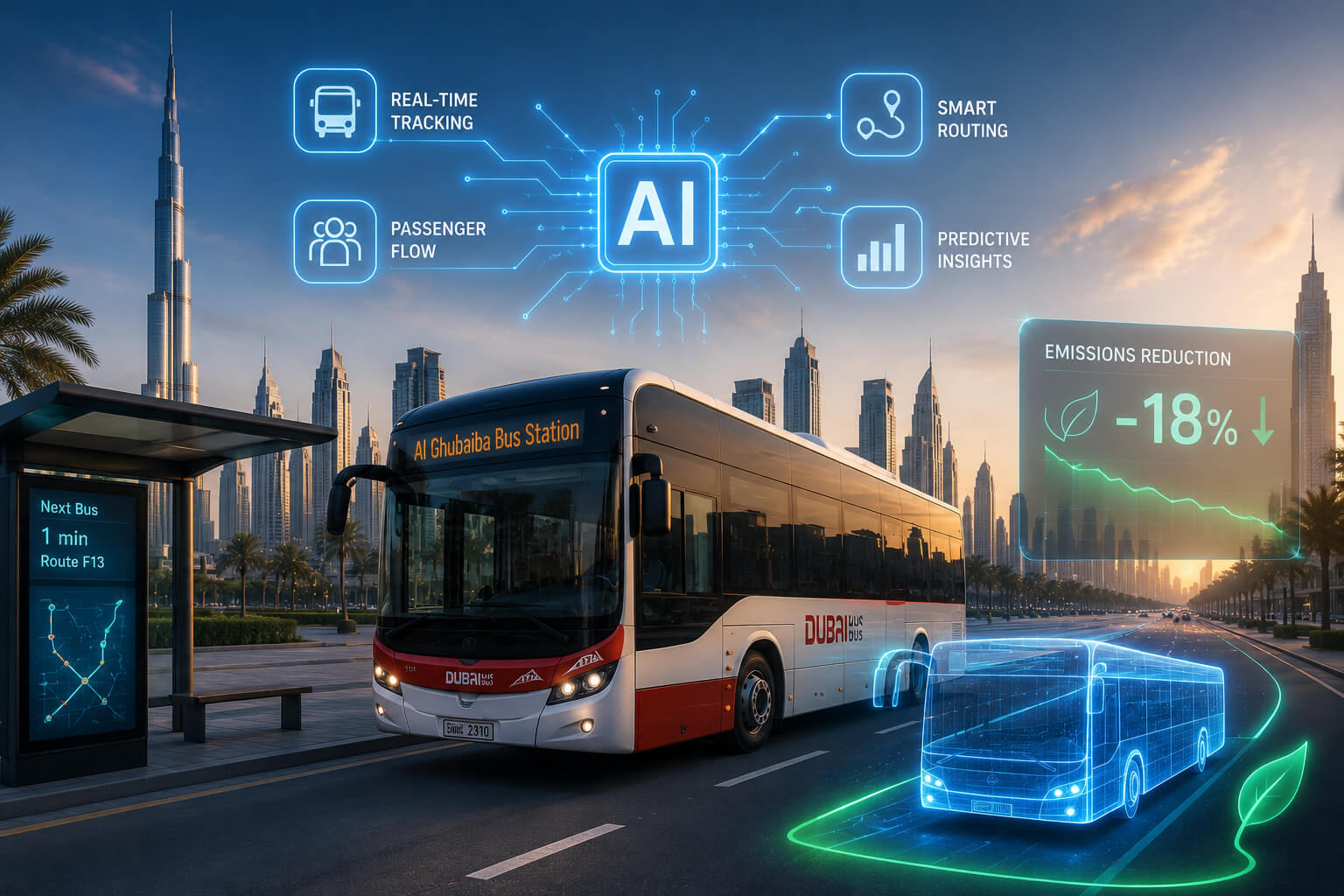
Dubai’s drive to make public transport smarter continues with the introduction of AI-powered dashboards at the Roads and Transport Authority’s Bus Operations Control Centre.
The system is intended to assist transport operators to: manage bus services in real time; improve schedule reliability; reduce emissions; and respond more quickly to service disruptions. Built on the Dataiku platform and developed with the RTA’s in-house Artificial Intelligence Centre, the AI system is now integrated into daily bus network operations across Dubai.
The project forms part of Dubai RTA’s wider digital transformation and AI Strategy 2030. This strategy aims to make mobility smarter, more efficient, and more sustainable.
AI Dashboards Help Reduce Early Bus Departures by Over 68%
One of the most significant results from the deployment is a major improvement in bus punctuality. The report says that early departures of buses are down by more than 68% since the introduction of the AI dashboards.
This matters, as early departures are as disruptive as late buses. If a bus leaves before the scheduled time, passengers may miss their ride, even when they arrive on time. With AI-driven monitoring and prediction tools, Dubai’s transport operators can better enforce schedule discipline and improve the passenger experience.
This results in greater visibility of live operations for control room teams. As a result, this enables them to identify service issues sooner and make faster decisions.
Predictive Analytics Help Avoid Service Disruptions
The AI-powered bus management system also has predictive analytics that can predict possible trip cancellations before they occur.
Instead of responding when something breaks, operators can now proactively forecast the service gaps and respond accordingly. This shift from reactive management to proactive operations is one of the biggest benefits of using AI in public transportation.
These dashboards allow teams to track routes, identify anomalies and manage resources better, making real-time decisions.
Faster Response in Metro Disruptions
The AI bus management system in Dubai is also meant to help passengers during metro disruptions.
In the event of sudden metro problems the platform can help in quickly deploying buses to minimize the impact on commuters. This way buses can be rerouted or added more quickly to maintain mobility in the transport network.
The RTA can streamline the response process by automating some aspects of the decision-making process. Additionally, it improves coordination between different modes of public transport, thus reducing delays.
AI cuts over 13,000 tonnes of CO₂ emissions
The AI dashboards are also delivering environmental benefits beyond punctuality and operations.
The system has helped reduce over 13,000 tonnes of CO2 emissions, by better managing bus parking and reducing unnecessary engine idling. These gains show how AI can support both operational efficiency and sustainability goals.
“Reducing emissions through better transport management is a big achievement for a city committed to smart mobility and environmental performance.
Smarter Bus Routing and Short Turning Operations
The AI platform also enables for short-turning operations, where buses can turn around mid-route when there are disruptions or changes in demand.
This leads to a more resilient network without necessarily adding more vehicles. Thus, operators can more effectively re-route during service disruptions or changes in peak demand, keeping the bus network moving.
This flexibility is particularly important in large, fast-growing cities where demand from passengers can change rapidly.
Automated alerts enhance communication with passengers
The system also has automated alerts.
These alerts help improve communication with passengers during disruptions, schedule changes or operational issues. The system helps reduce the burden on staff and expedites information delivery, helping passengers get faster, more accurate updates.
Reliable communication is an important part of public transport, particularly when unexpected delays or changes in route are involved.
Artificial Intelligence Strategy 2030 of Dubai for Smart Mobility
The AI bus management initiative is a part of Dubai RTA’s broader Artificial Intelligence Strategy 2030.
The strategy includes 81 projects and initiatives in smart mobility, intelligent traffic, customer happiness, future-readiness, cognitive licensing and asset excellence.
Since 2017, Dubai’s RTA has launched more than 40 AI use cases, from predictive bus maintenance to passenger sentiment analysis. It has dozens more AI projects in the pipeline.
The aim is to use AI not just as a technology upgrade, but as a foundation for better public services, more efficient transport and lower operating costs.
Why it Matters
Dubai’s deployment of AI in real-time bus management demonstrates how artificial intelligence can bring tangible benefits to public transportation.
The reduction in early departures, lower emissions, faster disruption response and better passenger communication all add up to a smarter, more efficient mobility system.
For other cities considering AI in public transport, Dubai’s experience offers a pragmatic case of how smart dashboards, predictive analytics and real-time control tools can improve the daily running of the system at scale.
As AI reshapes urban mobility, Dubai is positioning itself as one of the forefront cities in deploying the technology to solve real-world transport challenges.
Summary
Dubai RTA’s AI-enabled bus management system is helping to transform public transport operations in the city. The authority has improved punctuality, reduced emissions and enhanced its ability to respond to disruptions by leveraging real-time dashboards, predictive analytics, automated alerts and sustainability tools.
The deployment underscores the expanding role of AI in smart city infrastructure and demonstrates how artificial intelligence can provide real benefits to operators and passengers alike.
