


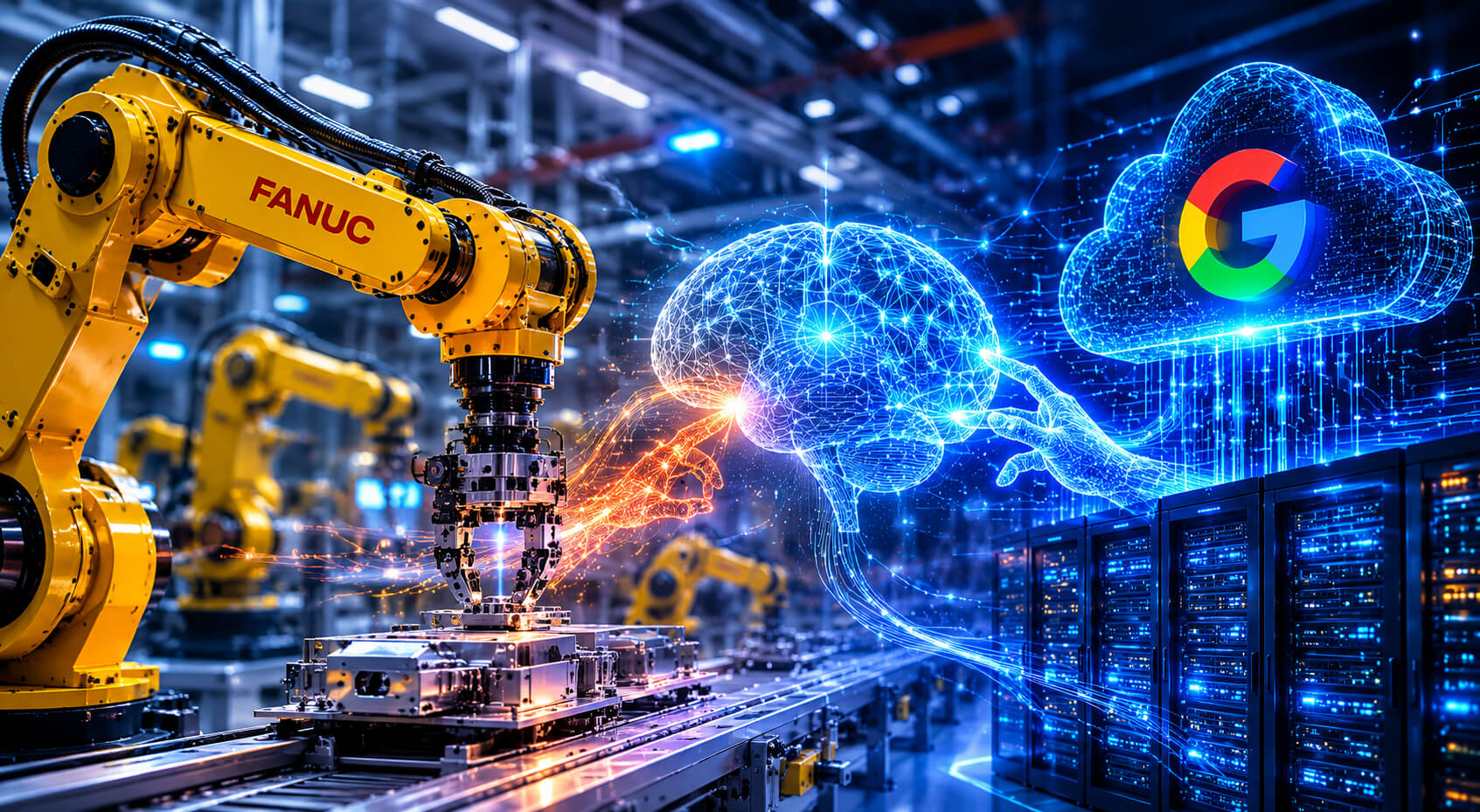
FANUC, the world’s biggest industrial robot manufacturer, has revealed a strategic alliance with Google to accelerate the development of Physical AI for manufacturing and factory automation. The alliance will marry FANUC’s advanced industrial robots with Google’s advanced AI technologies. These include Gemini Enterprise and robotics software from Intrinsic.
The collaboration marks a major advance for the growing Physical AI movement. This movement is a branch of artificial intelligence that builds intelligent machines embedded in robots. These robots can sense their environment, make decisions and do physical work on their own in real-world industrial settings.
What is Physical AI?
Physical AI is the combination of cognitive intelligence with physical robotic systems. Physical AI systems are unlike traditional industrial robots that follow fixed programmed instructions. They can understand human commands, identify objects, adapt to changing environments, and perform tasks independently.
FANUC said recent advances in large language models (LLMs) and AI are enabling robots to interact with the real world more intelligently than ever before.
The company’s new AI-enabled robot systems aim to bring natural language interaction and adaptive automation directly into manufacturing environments.
Google Gemini AI to Power FANUC Robots
As part of the partnership, FANUC is integrating Google Cloud technologies, including Gemini Enterprise, into its industrial robotics ecosystem. The system will enable AI agents to understand human instructions, identify objects and autonomously control multiple robots.
At its upcoming New Product Open House Show, FANUC will demonstrate a next generation Physical AI robot system powered by Gemini AI. The demo will combine collaborative robots and traditional industrial robots. They will work together as a single robotic cell with simple natural language commands.
This development has the potential to significantly simplify robotic automation in factories. It could do so by decreasing reliance on complex programming and manual robot setup.
Intrinsic Flowstate and ROS Integration
Another major part of the collaboration involves Intrinsic, Google’s robotics AI division. FANUC robots will fully support Intrinsic’s enterprise robotics platform and development environment called Flowstate.
Flowstate is compatible with ROS (Robot Operating System), an industry-standard open robotics platform widely used in AI and robotics research. FANUC supports ROS with open-source drivers making it easier to integrate with modern AI development frameworks.
“ROS compatibility, Python support, and AI-powered automation tools come together for a more open ecosystem to build intelligent robotic systems.
FANUC Already Delivered Over 1,000 Physical AI Robots
FANUC announced that customer demand for Physical AI robotics has grown rapidly since the company launched its Physical AI systems at the International Robot Exhibition last year.
More than 1,000 robots for Physical AI applications have been shipped by the company. It also says demand continues to accelerate globally.
This underscores a growing industry interest in intelligent robotics for adaptive manufacturing, predictive automation and AI-led operations.
Physical AI can change manufacturing
Industry analysts say the FANUC-Google partnership could be a game changer for the future of industrial automation. The partnership brings together FANUC’s vast installed base of robotics and Google’s cutting-edge AI infrastructure. As a result, it gives both companies a strong foothold in the emerging Physical AI market.
Experts predict AI-powered robotics will be better at:
- Autonomous factory operation
- Real-time machine learning for industrial tasks
- Predictive maintenance
- Human-robot collaboration
- Smart manufacturing efficiency
The Physical AI market is also expected to grow rapidly in the coming years. This is because manufacturers are increasingly implementing AI-enhanced robotics systems.
Google DeepMind Robotics Research Joins FANUC
Also, FANUC announced that it will join Google DeepMind’s Gemini Robotics Trusted Tester Program. This program aims to accelerate foundational AI models for robotics.
The partnership could speed up the development of general-purpose AI robots. These robots will be able to do more complex real-world tasks in the manufacturing, logistics and industrial automation sectors.
Final thoughts
The collaboration between FANUC and Google is a major step forward for Physical AI and intelligent robotics. By combining industrial-quality robotic hardware with generative AI capabilities such as Gemini Enterprise, the companies are laying the foundation for more intelligent, responsive factory automation.
With AI leaping from software to physical systems, partnerships like this may shape the future of manufacturing and industrial robotics globally.
For more Breaking AI news visit: https://breakingai.news
