


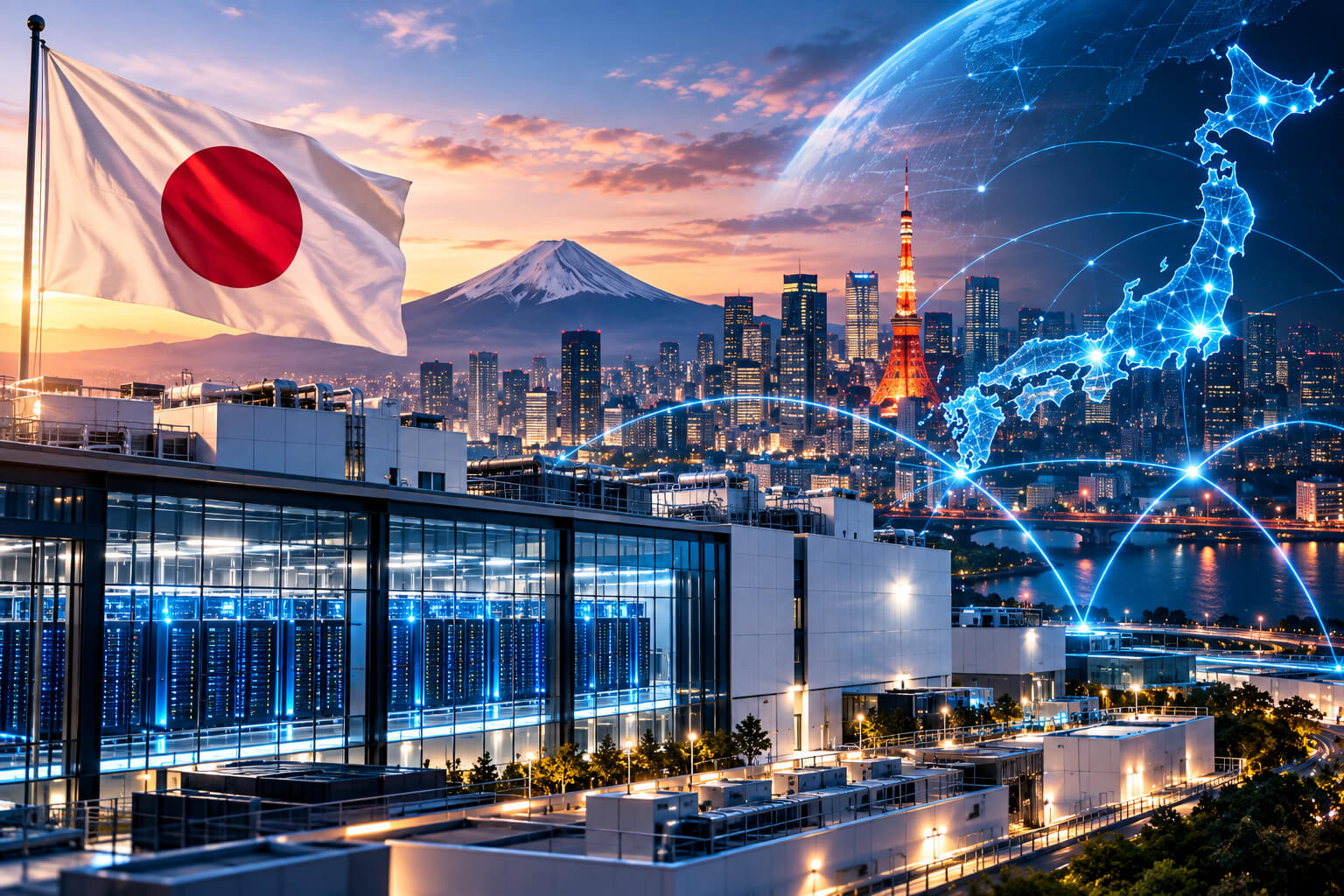
Apollo Global Management is preparing to back a major artificial intelligence infrastructure development in Japan, putting private capital behind the country’s push to expand domestic computing capacity.
The project, valued at more than $15 billion, is planned for Chiba Prefecture, near Tokyo. Infrastructure developer RHAELM Holdings, Jera and Dell Technologies are involved, while Apollo is expected to participate as a strategic investment and financing partner.
The development reaches beyond a conventional data center project. It brings together computing hardware, energy, construction and long-term financing at a time when electricity and access to large-scale compute are becoming critical pieces of the global AI race.
More Than $15 Billion Planned for AI Infrastructure
More than $15 billion in capital could eventually flow into the development, covering the physical and technological infrastructure needed to support a large AI computing campus. The sheer size of the investment reflects how expensive the foundations of modern AI have become.
The planned facility could require as much as 400 megawatts of electricity, with Jera playing an important role on the energy side of the project. Operations are reportedly targeted to begin around 2028, although large infrastructure developments of this scale remain subject to construction, financing and deployment timelines.
That 400MW figure is significant. Training and operating increasingly powerful AI systems requires dense clusters of processors, cooling equipment and networking infrastructure. All of that consumes enormous amounts of electricity. Securing sufficient power has therefore become almost as important as obtaining the advanced chips themselves.
Jera, Dell and RHAELM Bring Different Pieces of the AI Stack
The companies involved bring very different capabilities to the table. RHAELM is tied to the infrastructure development, Jera provides deep experience in Japan’s energy sector, and Dell Technologies brings computing infrastructure expertise. Apollo adds the financing capacity needed to turn an ambitious infrastructure proposal into a project capable of operating at serious scale.
The ambitions may also extend well beyond the initial Chiba facility. According to the Financial Times, the partners are considering the development of several gigawatts of AI data center and power infrastructure over the coming years.
That changes the scale of the story. Instead of viewing Chiba as an isolated data center, the project could become an early piece of a much broader network designed around the rapidly increasing computing requirements of artificial intelligence.
Japan Wants More AI Computing Capacity at Home
Japan has been pushing to strengthen its position across artificial intelligence, semiconductors and other strategically important technologies. Building domestic AI infrastructure is becoming part of that effort because companies cannot expand advanced AI systems without access to sufficient computing power.
The country already has major strengths in electronics, robotics, manufacturing and industrial technology. The current AI boom presents a different challenge. Large models and industrial AI applications need vast computing clusters, reliable electricity, high-speed networking and specialized facilities capable of operating those systems continuously.
More infrastructure inside Japan could give domestic businesses easier access to AI computing resources while reducing dependence on capacity located overseas. It could also make the country more attractive to companies deciding where to deploy increasingly compute-intensive AI services.
Apollo Is Moving Deeper Into the AI Infrastructure Boom
Apollo’s involvement in Japan fits a broader investment strategy rather than appearing as a one-off move. The asset manager has increasingly focused on the enormous physical infrastructure requirements emerging around artificial intelligence.
Apollo has participated in initiatives aimed at financing AI computing infrastructure alongside major technology and investment companies. It has also worked on financing structures designed to support large-scale deployments involving data centers, processors and related infrastructure.
The investment opportunity is expanding because AI companies cannot scale through software alone. Servers need facilities. Facilities need electricity. Electricity needs generation and grid capacity. Nearly every layer requires billions of dollars in capital before a model ever processes a user’s request.
Apollo appears to see an opportunity in financing that less-visible side of the AI industry.
Power Is Becoming Part of the AI Story
Jera’s involvement highlights one of the biggest changes taking place in the AI infrastructure market. Electricity has moved from a background consideration to a central part of planning new computing facilities.
A facility consuming hundreds of megawatts cannot simply connect to the grid like an ordinary commercial building. Developers need to think about generation capacity, transmission, cooling, backup systems and the long-term reliability of the electricity supply before filling a site with AI servers.
This is why energy companies are becoming increasingly relevant to the AI sector. The competition to build bigger models is creating a parallel competition for the electricity needed to run them. Projects that combine computing infrastructure with dependable power arrangements may have an advantage as demand continues to rise.
Japan Joins a Bigger AI Infrastructure Race
Japan is not building in isolation. Technology companies, governments, infrastructure developers and institutional investors around the world are pouring money into data centers, semiconductors, networking equipment and electricity generation.
The Chiba development gives Japan another potential foothold in that race. Its location near Tokyo could also place significant computing capacity close to one of Asia’s largest economic and corporate centers.
Still, the distinction between an announced investment and operating AI infrastructure matters. The project is targeting operations around 2028, meaning substantial construction, financing, equipment deployment and energy work still has to happen before that capacity becomes available.
Even so, the direction of travel is becoming difficult to ignore. The AI race is no longer only about which company builds the smartest model. It is increasingly about which markets can supply the chips, data centers, networks, electricity and capital required to keep those models running.
Apollo’s planned investment in Japan puts another $15 billion marker on that shift.
Sources
The Japan Times — Apollo to expand Japan AI investments
https://www.japantimes.co.jp/business/2026/10/02/companies/apollo-japan-ai/
Financial Times — Japan AI infrastructure and data center investment
https://www.ft.com/content/ec55a734-243b-43a2-93ea-8652d6b99309
Apollo Global Management — AI infrastructure investment and financing
https://www.apollo.com/insights-news/pressreleases/2026/08/nvidia-partners-with-apollo
