


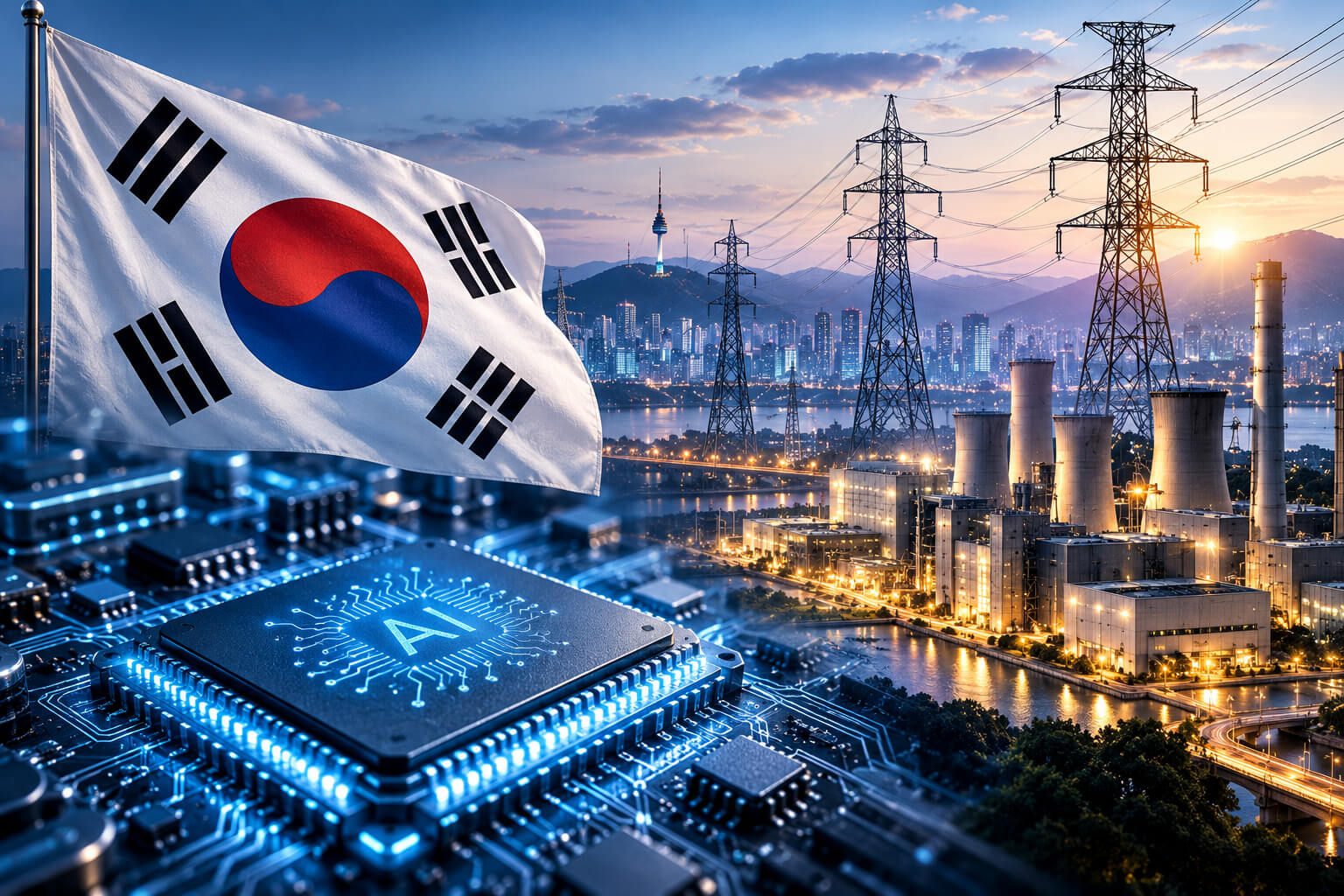
South Korea is preparing a major restructuring of its state-owned electricity sector as artificial intelligence, data centers and semiconductor manufacturing place more pressure on the country’s power infrastructure. The government plans to combine five power generation companies under Korea Electric Power Corporation, or KEPCO, into one larger entity. The move reflects how closely electricity supply is becoming tied to South Korea’s ambitions in AI, semiconductors and advanced manufacturing.
The proposed company is expected to operate under the tentative name Korea Power Generation and could officially launch in October 2027 once the required legislation and integration process are completed. While the restructuring has several goals, including improving efficiency and accelerating renewable energy investment, rising electricity demand from AI infrastructure and chip production is becoming an increasingly important part of the conversation.
Five Power Companies Will Become One
The restructuring will bring together Korea South-East Power, Korea Midland Power, Korea Western Power, Korea Southern Power and Korea East-West Power. These companies currently operate as separate subsidiaries under KEPCO, but the government believes managing them as one organization could reduce duplication and make large-scale investment easier to coordinate.
Together, the five companies control roughly 53 gigawatts of generation capacity. That would give the proposed merged company considerable scale and potentially place it among the world’s largest electricity generators. The consolidation also marks a shift away from the structure introduced in 2001, when South Korea separated KEPCO’s generation activities into multiple companies in an effort to improve competition and operational efficiency.
AI and Semiconductor Growth Are Changing the Electricity Equation
The merger is not being driven by AI alone, but the rapid growth of AI infrastructure is making South Korea’s power requirements harder to ignore. Semiconductor factories already consume large amounts of electricity, and AI data centers are adding another layer of demand. South Korea is home to Samsung Electronics and SK hynix, two companies that play major roles in the global memory chip market and the fast-growing high-bandwidth memory segment used in AI computing systems.
As those companies expand production and as more data centers come online, electricity availability becomes a strategic issue rather than simply an operating concern. The government is increasingly looking at energy infrastructure as part of its wider technology policy. Building more fabs and data centers will only work if the grid can supply enough electricity to support them.
Korea’s AI Buildout Is Becoming a Grid Project
South Korea’s AI strategy increasingly depends on the physical infrastructure behind computing. Data centers need stable and continuous electricity, while semiconductor manufacturing requires large amounts of power for fabrication, cooling and other processes. That means the success of new AI and semiconductor projects will depend not only on investment in chips and servers, but also on substations, transmission lines and generation capacity.
Recent estimates cited in Korean reporting suggest that planned semiconductor projects could add around 20.6 gigawatts of electricity demand, while regional AI data centers could require another 7.9 gigawatts. Those figures show the scale of the challenge. Without enough power infrastructure, even well-funded projects can face delays or limits on how quickly they can operate.
One Utility Could Carry More Investment Weight
Operating five separate power generation companies creates administrative overlap and divides investment planning across different organizations. By combining them, the government expects to create a stronger entity that can manage capital, staff and infrastructure projects more efficiently. The goal is not only to simplify operations, but also to improve the country’s ability to finance large energy projects.
A larger public utility may also be better positioned to support renewable energy expansion and major grid upgrades. South Korea needs significant investment in generation, transmission and storage as it reduces reliance on coal and prepares for higher demand from strategic industries. Bringing the five companies under one structure could make those investment decisions easier to coordinate.
The Semiconductor Industry Raises the Stakes
South Korea’s semiconductor industry is one of the country’s most important economic assets, which makes reliable power supply a national priority. Samsung Electronics and SK hynix are central to the production of memory chips used in smartphones, servers and AI systems. Demand for high-bandwidth memory has increased sharply as companies build larger AI models and more powerful data center infrastructure.
That growth is putting more pressure on South Korea to secure enough electricity for future semiconductor clusters. A new chip factory may involve billions of dollars in investment, but it still cannot operate without sufficient grid capacity. The same applies to AI data centers. Power availability is quickly becoming one of the factors that could determine how fast South Korea can expand its technology sector.
Renewable Energy Is Also Part of the Plan
The planned merger is also designed to support South Korea’s transition toward cleaner energy. The government wants the combined company to play a larger role in renewable energy development while gradually reducing dependence on coal-fired generation. This could include projects in offshore wind, solar power and other large-scale clean energy initiatives.
Combining the companies may give the government a better way to direct funding and personnel toward these projects. Instead of having five separate organizations pursuing overlapping strategies, one larger utility could coordinate investment around national energy priorities. That may become more important as South Korea tries to meet rising electricity demand without relying entirely on traditional fossil fuel generation.
KEPCO Is Looking for New Ways to Fund Grid Expansion
KEPCO is also exploring new financing methods as the cost of expanding the electricity network continues to rise. One proposal involves asking Samsung Electronics and SK hynix to prepay a combined 25 trillion won in electricity bills over several years. The money could then help finance transmission infrastructure needed for semiconductor clusters.
The proposal shows how closely the energy and technology sectors are becoming connected. Instead of waiting for traditional grid investment to catch up, KEPCO is looking at ways to involve major electricity users directly in infrastructure funding. For chipmakers, paying earlier could help reduce the risk of delays caused by insufficient transmission capacity.
October 2027 Is the Target
South Korea is targeting October 2027 for the launch of the merged power company, but several issues still need to be resolved before the transition is complete. The government will need to address staffing, wages, management structures, contracts and asset integration across all five companies.
Merging large public utilities is rarely simple, especially when they operate critical infrastructure. The government will have to complete the restructuring without disrupting electricity supply or ongoing investment projects. That makes implementation just as important as the merger itself.
Why This Matters for the AI Industry
The South Korean plan highlights a wider shift in the AI industry. Artificial intelligence is no longer only a story about software, chips and cloud computing. It is increasingly a story about energy infrastructure. Countries that want to build large AI ecosystems need enough electricity generation, transmission and grid capacity to support them.
South Korea is facing this challenge earlier than many countries because it already has a large semiconductor industry and wants to expand its role in AI. That combination is driving unusually high demand for electricity. The proposed utility merger is one way the government is trying to prepare the power system for what comes next.
South Korea’s AI ambitions will depend on whether its electricity infrastructure can keep pace with its technology investments. Merging the five power companies will not solve every grid problem, but it could give the country a more coordinated structure for managing energy demand, supporting semiconductor growth and preparing for the next phase of AI expansion.
Sources
Nikkei Asia – South Korea to combine 5 utilities to prepare for AI, chip power demand
https://asia.nikkei.com/politics/south-korea-to-combine-5-utilities-to-prepare-for-ai-chip-power-demand
Republic of Korea Government – Power utility restructuring announcement
https://admin.korea.kr/briefing/pressReleaseView.do?newsId=156780268
