


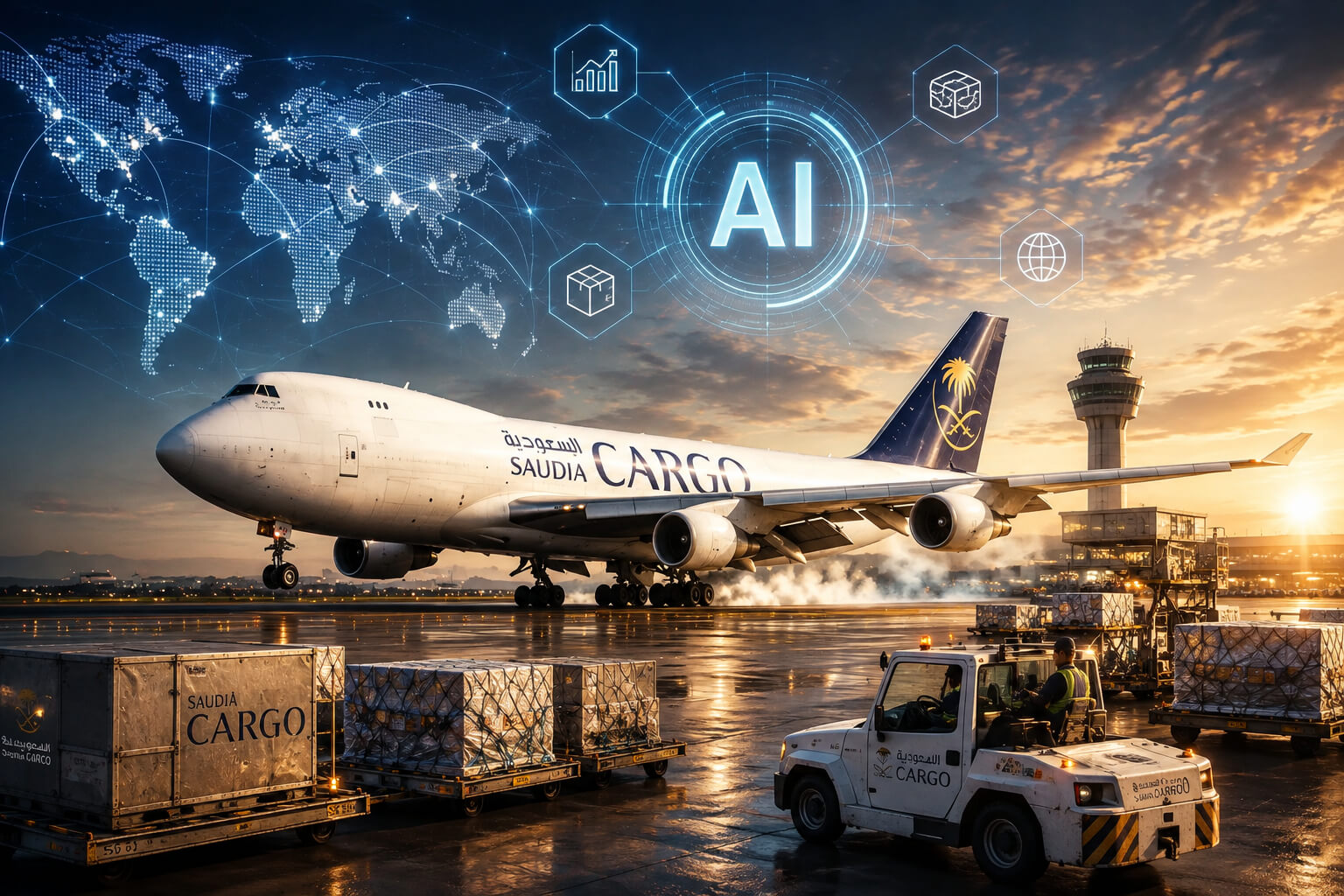
Saudi Arabia’s air cargo sector is moving deeper into artificial intelligence.
Saudia Cargo is expanding its use of AI while preparing to double its freighter fleet. The strategy supports Saudi Arabia’s wider push to become a major logistics hub connecting Asia, Europe, and Africa by 2030.
AI is no longer being treated as an extra layer inside the company. It is now embedded across several operational processes. Saudia Cargo is using algorithms to forecast demand, manage capacity, and improve load planning.
The company is also using sensors for temperature-sensitive shipments. Automation tools are helping teams handle cargo more efficiently and reduce operational delays.
AI Is Becoming Part of Saudia Cargo’s Core Operations
Artificial intelligence is now integrated into Saudia Cargo’s daily operations. The company uses algorithms to predict demand and manage cargo capacity. AI also helps optimize cargo weight and aircraft load distribution. These tools can improve efficiency across planning and operations. Temperature sensors are also used for sensitive shipments. This is particularly important for pharmaceuticals, food, and other products that require strict cold-chain control.
Smart Logistics Is Reshaping Global Air Freight
Saudia Cargo’s AI strategy reflects a wider shift across the air freight industry. Airlines and logistics companies are increasingly using automation and predictive systems. These tools can improve route planning, cargo handling, and inventory decisions. AI can also help operators react faster when demand changes. According to IATA-related industry reports, smarter cargo management can reduce operating costs. It can also improve delivery accuracy across complex supply chains.
LEAP 2026 Opens the Door to New Technology Partnerships
Saudia Cargo used LEAP 2026 as a platform to explore new technology partnerships. The company is particularly interested in artificial intelligence and cloud computing. Hisham Mallakah, Vice President of Shared Services, said the event allows the company to study new technologies. It also gives teams access to industry experts and possible partners. Those relationships could support more flexible logistics systems as market conditions change.
Saudia Cargo Is Preparing to Double Its Freighter Fleet
The company is planning to add four Boeing 777-200F aircraft. That would double the size of its dedicated cargo fleet over the next several years. The aircraft are widely used for long-distance freight operations. They can carry heavy cargo while operating over long routes. Saudia Cargo expects the new aircraft to improve capacity and expand access to profitable markets. The fleet upgrade also supports rising demand for express freight and e-commerce shipments.
Boeing 777 Freighters Could Improve Efficiency and Range
The Boeing 777-200F is designed for long-haul cargo operations. It offers a range of roughly 9,200 kilometers at full payload. That makes it suitable for heavy and temperature-sensitive cargo. Saudia Cargo expects the aircraft to reduce the need for intermediate stops. Fuel efficiency is another factor. Lower fuel use can reduce costs while also cutting emissions across long-distance freight routes.
High-Value and Temperature-Sensitive Cargo Is Driving Demand
Global demand for specialized air freight continues to rise. Pharmaceuticals, semiconductors, and perishable products require fast and reliable transportation. Many also depend on strict temperature controls. Saudia Cargo is positioning its fleet around these higher-value categories. The company sees growth opportunities in pharmaceuticals and fresh goods. It is also targeting express freight tied to global e-commerce.
Asia Is Becoming a Major Growth Market
Saudia Cargo sees strong growth potential across East and Southeast Asia. China remains an important market because of its role in global manufacturing and e-commerce. Vietnam and Indonesia are also becoming more significant. Rising online retail activity is increasing demand for fast cross-border delivery. Saudia Cargo wants to capture more of that traffic. Its expanded fleet could help connect Asian markets with Europe, the Middle East, and North America.
The Riyadh-Melbourne Route Connects New Supply Chains
Saudia Cargo has also launched a direct route between Riyadh and Melbourne. The service connects Saudi Arabia with an important Australian export market. Australia supplies meat, dairy products, fresh produce, and pharmaceuticals to international markets. A direct route can shorten transport times. It can also reduce the risk of losses involving perishable cargo. The service could also support Saudi exports moving toward Australia and the wider Oceania region.
Australia Offers Strong Potential for Perishable Cargo
Australia is a major producer of agricultural and food products. Many of those shipments depend on reliable cold-chain logistics. Direct air links can reduce handling points and delays. That is particularly important for meat, dairy products, and pharmaceuticals. Saudia Cargo can use the Melbourne connection to move these products faster toward the Middle East and Europe. The route also strengthens Riyadh’s role as a logistics transfer point.
Africa Is Another Target for Expansion
Saudia Cargo is also looking toward African markets. The goal is to strengthen Saudi Arabia’s position as a corridor between Asia and Africa. Better air connections could support trade across both regions. The company is also exploring opportunities in Central and Eastern Europe. These markets could become more important as Saudi Arabia expands its logistics network. New freighters will give the company more flexibility to serve those routes.
AI Could Help Saudia Cargo Manage a Larger Network
Fleet expansion creates additional operational complexity. More aircraft mean more routes, cargo, scheduling decisions, and capacity planning. AI could help Saudia Cargo manage that complexity. Predictive systems can help match available space with changing demand. Algorithms can also support load planning and route decisions. As the network expands, these systems may become even more important to day-to-day operations.
Saudi Arabia Wants to Reach 4.5 Million Tonnes of Air Cargo
Saudia Cargo’s expansion supports Saudi Arabia’s National Transport and Logistics Strategy. The kingdom wants annual air cargo capacity to reach 4.5 million tonnes by 2030. That target forms part of a broader economic transformation. Saudi Arabia is investing heavily in aviation, infrastructure, and digital technology. Logistics is expected to become a major part of economic diversification. Air cargo will play an important role in connecting Saudi businesses with global markets.
Technology Is Becoming Central to Saudi Arabia’s Logistics Ambitions
Saudi Arabia’s logistics strategy is not only about adding aircraft or building infrastructure. Technology is becoming a central part of the plan. AI can help companies operate faster and use assets more efficiently. Cloud systems can improve coordination across international networks. Automation can also reduce manual processes.
Saudia Cargo Is Building for a More Automated Air Freight Market
Saudia Cargo is combining aircraft expansion with deeper AI adoption. That combination could shape how the company competes over the next several years. Bigger fleets create more capacity, but technology determines how efficiently that capacity is used. AI is already helping with demand forecasting and cargo planning. More advanced systems could follow.
The direction is fairly clear. Saudi Arabia wants logistics to become one of the engines of its post-oil economy. Saudia Cargo is becoming one of the companies carrying that strategy into practice.
Sources
Asharq Al-Awsat — Saudia Cargo Expands AI Operations and Fleet
https://english.aawsat.com/
Saudia Cargo — Official Website
https://www.saudiacargo.com/
