


Close Menu
    • Home
    • Events
    • Videos
      • Machine Can Think Summit 2026
      • Step Dubai Conference 2026
    • Technology & Innovation
    • Business & Marketing
    • Trends & Insights
    • Industry Applications
    • Tutorials & Guides
    What's Hot
    Business & Marketing

    Dubai Holding Partners With Microsoft to Accelerate AI Adoption

    By Art RyanMay 19, 20260

    Dubai Holding announced on Tuesday a strategic partnership with Microsoft to accelerate adoption of Artificial…

    Dubai GDRFA Unveils AI-Powered System to Transform Services

    May 19, 2026

    UAE Rolls Out Massive Agentic AI Training for 80,000 Employees

    May 19, 2026

    NextEra Dominion $67B Merger Shows AI Power Demand

    May 19, 2026
    Facebook X (Twitter) Instagram
    Facebook X (Twitter) Instagram
    Breaking AI News
    Tuesday, May 19
    • Home
    • Events
    • Videos
      • Machine Can Think Summit 2026
      • Step Dubai Conference 2026
    • Technology & Innovation

      Dubai Holding Partners With Microsoft to Accelerate AI Adoption

      May 19, 2026

      Dubai GDRFA Unveils AI-Powered System to Transform Services

      May 19, 2026

      UAE Rolls Out Massive Agentic AI Training for 80,000 Employees

      May 19, 2026

      NextEra Dominion $67B Merger Shows AI Power Demand

      May 19, 2026

      Arizona Rolls Out AI Medicaid Fraud Screening Before Payments

      May 19, 2026
    • Business & Marketing

      Dubai Holding Partners With Microsoft to Accelerate AI Adoption

      May 19, 2026

      Dust Raises $40M Series B to Scale AI Enterprise Workspaces

      May 19, 2026

      Baidu Beats Estimates on Agentic AI Strategy

      May 19, 2026

      HMRC Signs £175 Million AI Transformation Deal With Quantexa

      May 18, 2026

      OpenAI Acquires Weights.gg to Broaden Its Voice AI Presence

      May 18, 2026
    • Trends & Insights

      NextEra Dominion $67B Merger Shows AI Power Demand

      May 19, 2026

      Baidu Beats Estimates on Agentic AI Strategy

      May 19, 2026

      Ghana AI Healthcare Programme for Quality Healthcare Access

      May 18, 2026

      Israel National AI Strategy Drives AI Talent and Startup Innovation

      May 18, 2026

      Malta Unveils ChatGPT Plus Initiative to Accelerate AI Growth

      May 17, 2026
    • Industry Applications

      Dubai Holding Partners With Microsoft to Accelerate AI Adoption

      May 19, 2026

      Dubai GDRFA Unveils AI-Powered System to Transform Services

      May 19, 2026

      UAE Rolls Out Massive Agentic AI Training for 80,000 Employees

      May 19, 2026

      NextEra Dominion $67B Merger Shows AI Power Demand

      May 19, 2026

      Arizona Rolls Out AI Medicaid Fraud Screening Before Payments

      May 19, 2026
    • Tutorials & Guides

      How AI Is Revolutionizing the Future of Travel 2026 with Wellness and Sustainability

      April 19, 2026

      University of Wollongong in Dubai AI initiative boosts future-ready education

      March 31, 2026

      Microsoft AI upgrades Copilot Cowork unveiled for early access users

      March 31, 2026

      Starcloud $11 billion valuation signals AI space race surge

      March 31, 2026

      Flexible AI Factories Power the Future of Energy Grids

      March 30, 2026
    Breaking AI News
    Home » Oxford Study Says AI Safety Should Build on Existing Global Standards
    Technology & Innovation

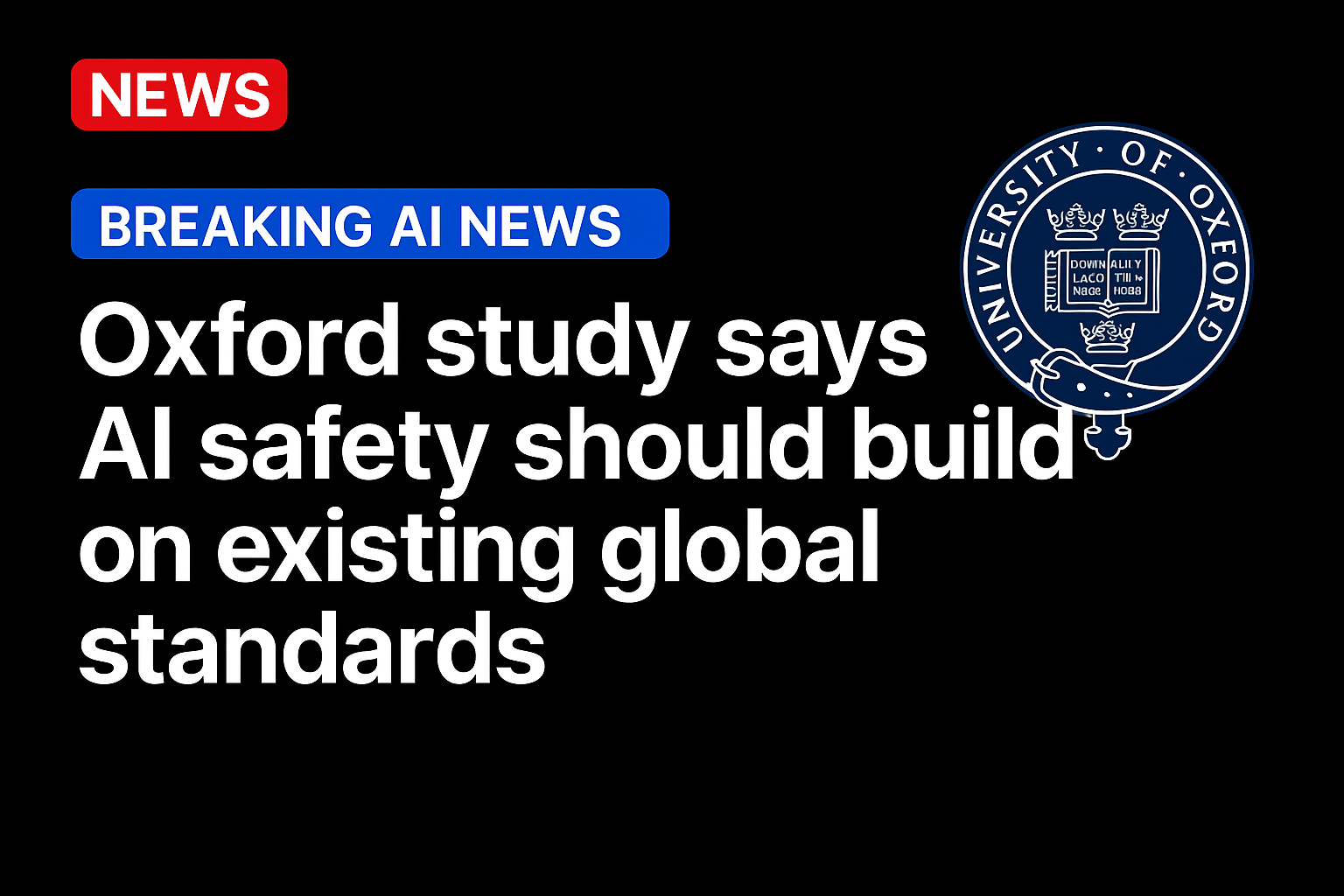
    Oxford Study Says AI Safety Should Build on Existing Global Standards

    Art RyanBy Art RyanNovember 7, 2025No Comments4 Mins Read
    Facebook Twitter Pinterest LinkedIn Tumblr Email
    Share
    Facebook Twitter LinkedIn Pinterest Email
    AI safety concept

    The Oxford Martin AI Governance Initiative has released new research that challenges the idea that artificial intelligence requires an entirely new regulatory architecture. Instead, the study argues that global institutions can build on the safety and risk standards that already govern complex industries such as aviation, energy and finance.

    The paper examines how the emerging “frontier AI safety frameworks” being developed by major labs align with, and diverge from, established international standards such as ISO 31000 and ISO/IEC 23894. It concludes that the most effective approach is not to replace these standards but to adapt and extend them.

    “The question is not whether AI should be regulated,” the authors write. “It is how existing systems can evolve to govern technologies that move faster than any regulation ever has.”

    Bridging Two Worlds

    The Oxford analysis maps two distinct approaches that have grown in parallel. Frontier AI safety frameworks, or FSFs, are internal policies created by developers such as OpenAI, Anthropic and Google DeepMind to manage risks tied to models. These frameworks include mechanisms for model evaluation, incident reporting and capability thresholds, benchmarks that indicate when a system becomes capable enough to warrant additional scrutiny.

    Such frameworks are nimble, but they vary widely in scope and consistency. Most were built for single organizations rather than as cross-industry standards.

    International safety standards, by contrast, have decades of history in highly regulated fields. They focus on continuous improvement, role definition, traceability and governance. Their strength lies in structure, but they were not designed for fast-moving, self-learning technologies that can evolve between audit cycles.

    The Oxford study suggests that each approach solves for what the other lacks. Frontier frameworks provide speed and practical insight. Established standards bring discipline and comparability. A governance model that combines the two, the researchers argue, would be better equipped to balance innovation with accountability.

    Building a Shared Language for Risk

    Oxford’s research proposes integrating those thresholds into the structured loops already familiar to compliance teams: identify, analyze, evaluate and treat. When a model crosses a specific threshold, for instance, by showing unexpected reasoning ability or multi-domain behavior that event should automatically trigger a formal review, documentation and mitigation plan.

    This procedural rigor, the study argues, would make frontier-AI oversight more transparent to regulators, insurers and other stakeholders. It would also clarify how organizations define risk and determine when intervention is necessary.

    The concept aligns with “Safety Cases: A Scalable Approach to Frontier AI Safety,” which describes a safety case as “a structured argument, supported by evidence, that a system is safe enough in a given operational context.” Both analyses emphasize evidence-based assurance and external validation over self-certification.

    Creating a “shared language of risk,” Oxford’s researchers write, is central to scaling AI governance. Without that alignment, governments and developers will continue to talk past each other, using different criteria for the same problems.

    Putting Into Practice

    The study frames this convergence as a practical evolution rather than a philosophical one. The goal is to make artificial intelligence governance operational, measurable and compatible with existing institutions. It argues that safety frameworks should not rely solely on company self-regulation but should be auditable through processes already recognized by international standards bodies.

    That perspective represents a shift in tone from the more alarmist narratives that have surrounded frontier models. Instead of focusing on existential risks, Oxford’s researchers point to the tools that already exist to handle high-impact technologies from risk registers to third-party audits and certification programs.

    The Oxford study fits into a wider movement toward codifying AI governance through standards rather than ad hoc rules. The EU AI Act will rely on harmonized standards to operationalize compliance for high-risk systems, turning abstract legal requirements into auditable technical practices. In the United States, the NIST AI Risk Management Framew

    Source: https://www.pymnts.com/
    Share. Facebook Twitter Pinterest LinkedIn Tumblr Email
    Art Ryan

    Related Posts

    Dubai Holding Partners With Microsoft to Accelerate AI Adoption

    May 19, 2026

    Dubai GDRFA Unveils AI-Powered System to Transform Services

    May 19, 2026

    UAE Rolls Out Massive Agentic AI Training for 80,000 Employees

    May 19, 2026

    Comments are closed.

    Latest News

    Dubai Holding Partners With Microsoft to Accelerate AI Adoption

    May 19, 2026

    Dubai GDRFA Unveils AI-Powered System to Transform Services

    May 19, 2026

    UAE Rolls Out Massive Agentic AI Training for 80,000 Employees

    May 19, 2026

    NextEra Dominion $67B Merger Shows AI Power Demand

    May 19, 2026
    Facebook X (Twitter) Pinterest Vimeo WhatsApp TikTok Instagram LinkedIn YouTube Spotify Reddit Snapchat Threads

    AI University

    • Global Universities
    • Universities in Africa
    • Universities in Asia
    • Universities in Europe
    • Universities in Latin America
    • Universities in Middle East
    • Universities in North America
    • Universities in Oceania

    AI Tools & Apps Directory

    • AI Productivity Tools
    • AI Coding Tools
    • AI Voice Tools
    • AI Video Tools
    • AI Image Generators
    • AI Writing Tools

    Info

    • Home
    • About Us
    • AI Organizations & Associations
    • Contact Us
    • Cookie Policy
    • Copyright Policy
    • Disclaimer
    • Editorial Policy
    • Terms and Conditions

    Subscribe to Updates

    Get the latest creative news from FooBar about art, design and business.

    © 2026 Breaking AI News.
    • Privacy Policy

    Type above and press Enter to search. Press Esc to cancel.

    Sign Up

    Want to stay ahead In Artificial Intelligence?

     Sign up now and get exclusive breaking AI news and special updates—FREE!