


Close Menu
    • Home
    • Events
      • Upcoming Events
      • Videos
        • Machine Can Think Summit 2026
        • Step Dubai Conference 2026
    • Technology & Innovation
    • Business & Marketing
    • Trends & Insights
    • Industry Applications
    • Tutorials & Guides
    What's Hot
    Industry Applications

    AI Drug Development Johnson & Johnson Impact on Healthcare

    By Art RyanApril 28, 20260

    Johnson & Johnson (J&J) has unveiled new information about the future of AI in healthcare,…

    Qualcomm OpenAI AI Smartphone Processors Partnership News

    April 28, 2026

    Google AI Campus South Korea and Its Development Plans

    April 28, 2026

    Accenture Copilot Rollout Enhances Employee Productivity

    April 28, 2026
    Facebook X (Twitter) Instagram
    Facebook X (Twitter) Instagram
    Breaking AI News
    Wednesday, April 29
    • Home
    • Events
      • Upcoming Events
      • Videos
        • Machine Can Think Summit 2026
        • Step Dubai Conference 2026
    • Technology & Innovation

      AI Drug Development Johnson & Johnson Impact on Healthcare

      April 28, 2026

      Qualcomm OpenAI AI Smartphone Processors Partnership News

      April 28, 2026

      Google AI Campus South Korea and Its Development Plans

      April 28, 2026

      New AI-Based Solution Launched by Box to Revolutionize Enterprise Workflows

      April 28, 2026

      Meta AWS Graviton AI Partnership: Revolutionizing Infrastructure

      April 28, 2026
    • Business & Marketing

      UK AI Startup Ineffable Secures $1.1B in Europe’s Largest Seed Round

      April 28, 2026

      Meta Manus AI Acquisition Blocked Over Strategic Concerns

      April 28, 2026

      Microsoft Ceases Revenue Split With OpenAI in Landmark AI Partnership Move

      April 28, 2026

      ZainTECH Named a Leader in IDC MarketScape: Gulf Countries AI Professional Services

      April 28, 2026

      AI Job Cuts Forecast: Shocking Prediction That 50% of UK Executives Expect Workforce Reduction

      April 20, 2026
    • Trends & Insights

      Google AI Campus South Korea and Its Development Plans

      April 28, 2026

      Meta Manus AI Acquisition Blocked Over Strategic Concerns

      April 28, 2026

      Emirati Inventor AI UAE: Bridging Culture and Technology

      April 28, 2026

      Cursor’s $50 Billion Ambition: Explosive AI Coding Demand Fuels Massive Growth

      April 19, 2026

      Dubai AI-powered government will change your daily life in the UAE

      April 3, 2026
    • Industry Applications

      AI Drug Development Johnson & Johnson Impact on Healthcare

      April 28, 2026

      Accenture Copilot Rollout Enhances Employee Productivity

      April 28, 2026

      HomeLight AI Real Estate Closings Transforming the Market

      April 27, 2026

      UiPath & Databricks Partner to Transform Enterprise Operations through Automation and Data Intelligence

      April 27, 2026

      Visit Oman Launches Revolutionary AI Digital Hub and Global Collaboration to Transform Tourism Industry

      April 27, 2026
    • Tutorials & Guides

      How AI Is Revolutionizing the Future of Travel 2026 with Wellness and Sustainability

      April 19, 2026

      University of Wollongong in Dubai AI initiative boosts future-ready education

      March 31, 2026

      Microsoft AI upgrades Copilot Cowork unveiled for early access users

      March 31, 2026

      Starcloud $11 billion valuation signals AI space race surge

      March 31, 2026

      Flexible AI Factories Power the Future of Energy Grids

      March 30, 2026
    Breaking AI News
    Home » Finer-CAM Revolutionizes AI Visual Explainability
    Technology & Innovation

    Finer-CAM Revolutionizes AI Visual Explainability

    Art RyanBy Art RyanMarch 9, 2025No Comments3 Mins Read
    Facebook Twitter Pinterest LinkedIn Tumblr Email
    Share
    Facebook Twitter LinkedIn Pinterest Email

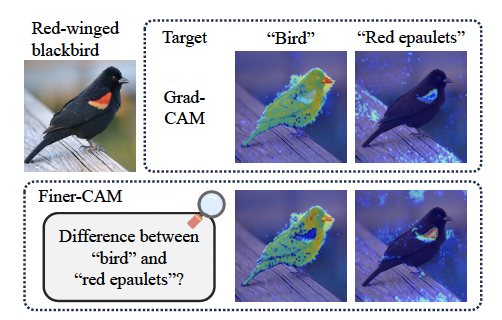
    Researchers at The Ohio State University have introduced Finer-CAM, an innovative method that significantly improves the precision and interpretability of image explanations in fine-grained classification tasks. This advanced technique addresses key limitations of existing Class Activation Map (CAM) methods by explicitly highlighting subtle yet critical differences between visually similar categories.

    Current Challenge with Traditional CAM

    Conventional CAM methods typically illustrate general regions influencing a neural network’s predictions but frequently fail to distinguish fine details necessary for differentiating closely related classes. This limitation poses significant challenges in fields requiring precise differentiation, such as species identification, automotive model recognition, and aircraft type differentiation.

    Finer-CAM: Methodological Breakthrough

    The central innovation of Finer-CAM lies in its comparative explanation strategy. Unlike traditional CAM methods that focus solely on features predictive of a single class, Finer-CAM explicitly contrasts the target class with visually similar classes. By calculating gradients based on the difference in prediction logits between the target class and its similar counterparts, it reveals unique image features, enhancing the clarity and accuracy of visual explanations.

    Finer-CAM Pipeline
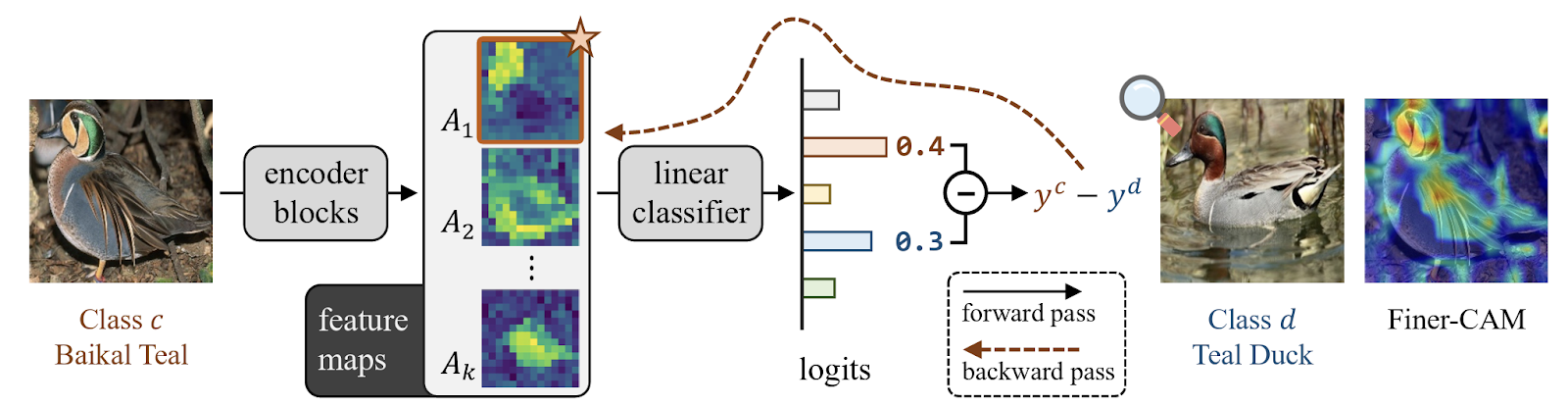
    The methodological pipeline of Finer-CAM involves three main stages:

    1. Feature Extraction:
      • An input image first passes through neural network encoder blocks, generating intermediate feature maps.
      • A subsequent linear classifier uses these feature maps to produce prediction logits, which quantify the confidence of predictions for various classes.
    2. Gradient Calculation (Logit Difference):
      • Standard CAM methods calculate gradients for a single class.
      • Finer-CAM computes gradients based on the difference between the prediction logits of the target class and a visually similar class.
      • This comparison identifies the subtle visual features specifically discriminative to the target class by suppressing commonly shared features.
    3. Activation Highlighting:
      • The gradients calculated from the logit difference are used to produce enhanced class activation maps that emphasize discriminative visual details crucial for distinguishing between similar categories.
    Experimental Validation

    B.1. Model Accuracy

    Researchers evaluated Finer-CAM across two popular neural network backbones, CLIP and DINOv2. Experiments demonstrated that DINOv2 generally produces higher-quality visual embeddings, achieving superior classification accuracy compared to CLIP across all tested datasets.

    B.2. Results on FishVista and Aircraft

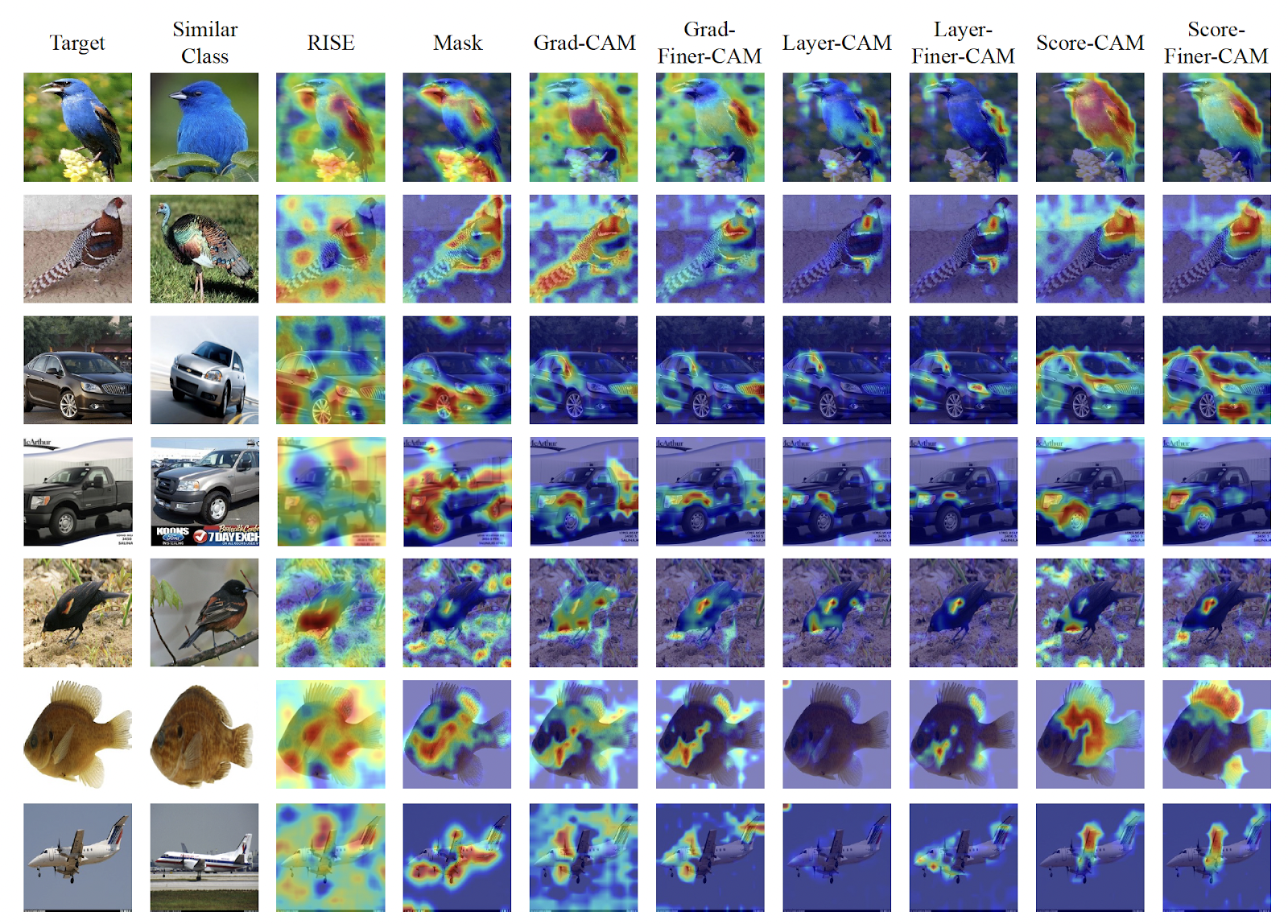
    Quantitative evaluations on the FishVista and Aircraft datasets further demonstrate Finer-CAM’s effectiveness. Compared to baseline CAM methods (Grad-CAM, Layer-CAM, Score-CAM), Finer-CAM consistently delivered improved performance metrics, notably in relative confidence drop and localization accuracy, underscoring its ability to highlight discriminative details crucial for fine-grained classification.

    B.3. Results on DINOv2

    Additional evaluations using DINOv2 as the backbone showed that Finer-CAM consistently outperformed baseline methods. These results indicate that Finer-CAM’s comparative method effectively enhances localization performance and interpretability. Due to DINOv2’s high accuracy, more pixels need to be masked to significantly impact predictions, resulting in larger deletion AUC values and occasionally smaller relative confidence drops compared to CLIP.

    Visual and Quantitative Advantages

    • Highly Precise Localization: Clearly pinpoints discriminative visual features, such as specific coloration patterns in birds, detailed structural elements in cars, and subtle design variations in aircraft.
    • Reduction of Background Noise: Significantly reduces irrelevant background activations, increasing the relevance of explanations.
    • Quantitative Excellence: Outperforms traditional CAM approaches (Grad-CAM, Layer-CAM, Score-CAM) in metrics including relative confidence drop and localization accuracy.
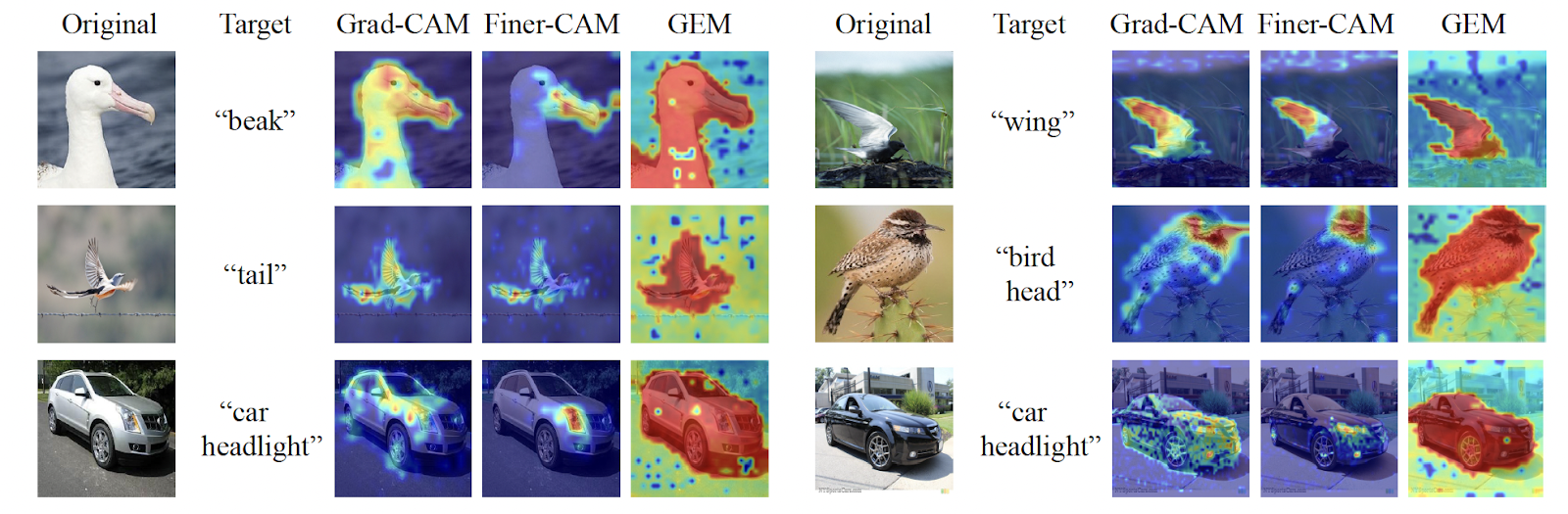
    Extendable to multi-modal zero-shot learning scenarios

    Finer-CAM is extendable to multi-modal zero-shot learning scenarios. By intelligently comparing textual and visual features, it accurately localizes visual concepts within images, significantly expanding its applicability and interpretability.
    Researchers have made Finer-CAM’s source code and colab demo available.

    Source: https://www.marktechpost.com/

    Share. Facebook Twitter Pinterest LinkedIn Tumblr Email
    Art Ryan

    Related Posts

    AI Drug Development Johnson & Johnson Impact on Healthcare

    April 28, 2026

    Qualcomm OpenAI AI Smartphone Processors Partnership News

    April 28, 2026

    Google AI Campus South Korea and Its Development Plans

    April 28, 2026

    Comments are closed.

    Latest News

    AI Drug Development Johnson & Johnson Impact on Healthcare

    April 28, 2026

    Qualcomm OpenAI AI Smartphone Processors Partnership News

    April 28, 2026

    Google AI Campus South Korea and Its Development Plans

    April 28, 2026

    Accenture Copilot Rollout Enhances Employee Productivity

    April 28, 2026
    Facebook X (Twitter) Pinterest Vimeo WhatsApp TikTok Instagram

    AI University

    • Global Universities
    • Universities in Africa
    • Universities in Asia
    • Universities in Europe
    • Universities in Latin America
    • Universities in Middle East
    • Universities in North America
    • Universities in Oceania

    AI Tools & Apps Directory

    • AI Productivity Tools
    • AI Coding Tools
    • AI Voice Tools
    • AI Video Tools
    • AI Image Generators
    • AI Writing Tools

    Info

    • Home
    • About Us
    • AI Organizations & Associations
    • Contact Us

    Subscribe to Updates

    Get the latest creative news from FooBar about art, design and business.

    © 2026 Breaking AI News.
    • Privacy Policy

    Type above and press Enter to search. Press Esc to cancel.