


Amazon Web Services is putting a firm date on one of its biggest infrastructure projects in Saudi Arabia.
AWS says its first cloud infrastructure region in the Kingdom is on track to launch in December 2026. The project forms part of more than $5.3 billion in planned Saudi cloud investment.
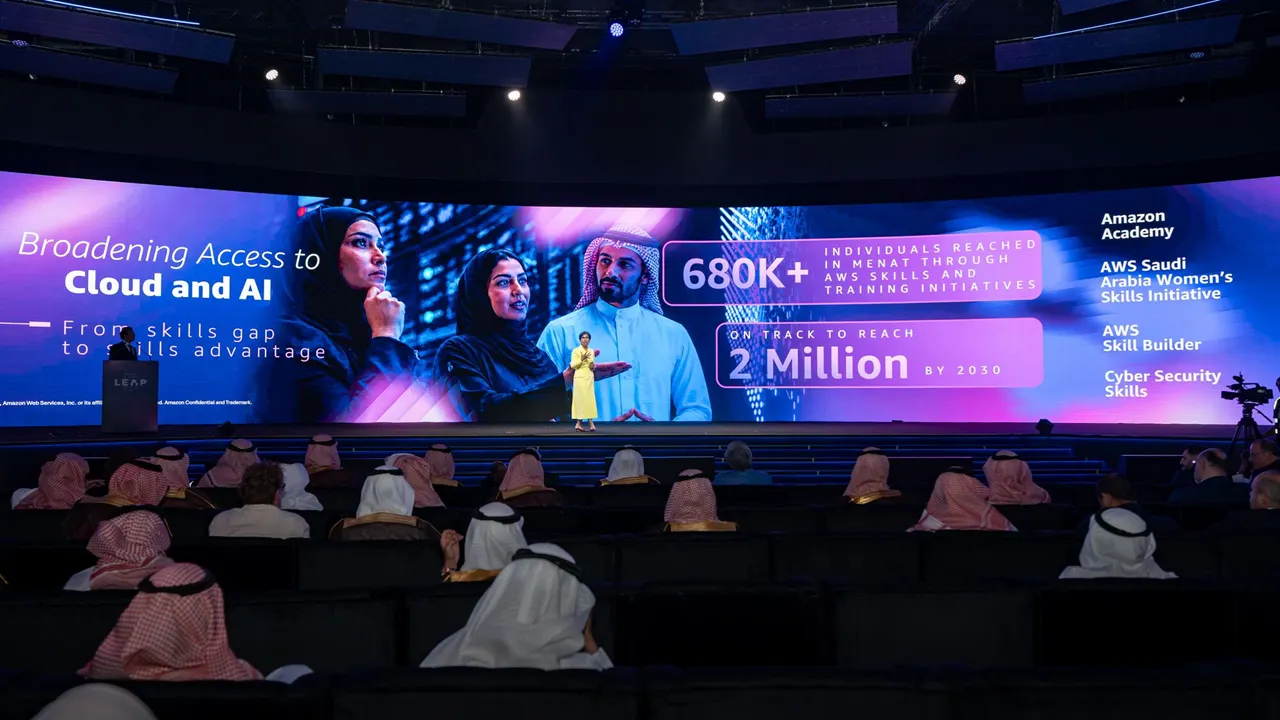
The announcement came during LEAP 2026 in Riyadh. AWS also expanded its partnership with Saudi AI company HUMAIN. Together, they plan to provide up to 50 megawatts of capacity in the Kingdom’s first AI Zone by 2028.
The combination is significant. Saudi Arabia is not simply adding another cloud region. It is building local infrastructure for training, deploying, and running increasingly demanding AI systems.
AWS Saudi Cloud Region Arrives in December 2026
AWS first announced plans for its Saudi infrastructure region in March 2024. Now there is a clearer timeline. The company expects the region to begin operating in December 2026. It will launch with three Availability Zones. Developers and businesses will be able to run applications from data centers inside Saudi Arabia. The new location will also expand AWS to 40 cloud regions worldwide.
More Than $5.3 Billion Is Going Into Saudi Cloud Infrastructure
The Saudi region represents more than $5.3 billion, or SAR19.88 billion, in planned AWS investment. That money goes beyond building data centers. AWS wants to create a larger local cloud ecosystem around the infrastructure. Saudi businesses will gain more options for keeping workloads and customer content inside the Kingdom. Lower latency should also help applications serving local users.
AWS and HUMAIN Are Expanding Their AI Partnership
The cloud region is only one piece of AWS’s Saudi strategy. AWS has also expanded its relationship with HUMAIN, the AI company owned by Saudi Arabia’s Public Investment Fund. AWS is HUMAIN’s preferred AI partner. The companies are working together on infrastructure, models, software, and AI services. Their partnership is closely tied to Saudi Arabia’s wider push to build domestic computing capacity.
Saudi Arabia’s First AI Zone Will Get Up to 50MW of Capacity
AWS and HUMAIN plan to make up to 50 megawatts available inside Saudi Arabia’s first AI Zone by 2028. That capacity will support demanding AI workloads. The infrastructure will include AWS Trainium chips and NVIDIA AI hardware. Customers will be able to use the systems for both AI training and inference. It gives Saudi organizations more computing power without relying entirely on infrastructure outside the country.
Trainium and NVIDIA Hardware Will Power AI Workloads
The hardware mix is worth watching. AWS is bringing its own Trainium accelerators into the project alongside NVIDIA infrastructure. Trainium was developed specifically for machine learning workloads. NVIDIA remains a dominant supplier of hardware for generative AI. Using both gives the Saudi AI Zone access to different computing options. Those resources will be aimed at large-scale model training and inference.
HUMAIN’s ALLAM Model Is Coming to Amazon Bedrock
The partnership also extends into generative AI software. HUMAIN’s ALLAM Arabic large language model will become available through Amazon Bedrock. That gives Bedrock customers access to Arabic-language AI capabilities through AWS’s managed platform. It also gives HUMAIN another route for distributing its model. Arabic AI is becoming an increasingly important part of Saudi Arabia’s technology strategy.
HUMAIN Fabric Is Heading to AWS Marketplace
HUMAIN is also bringing its Fabric platform to AWS Marketplace. HUMAIN Fabric provides AI-native data infrastructure and forms part of the HUMAIN ONE platform. Making it available through AWS could make deployment easier for enterprise customers. It also pushes the partnership beyond physical computing capacity. AWS and HUMAIN are building connections across hardware, cloud services, data infrastructure, and AI models.
Local Infrastructure Could Help With Data Sovereignty
Keeping cloud infrastructure inside Saudi Arabia has practical advantages. Some organizations need stronger control over where their data is stored and processed. That can be especially important in government and regulated industries. AWS says its regions are designed with digital sovereignty controls in mind. Local infrastructure also reduces the need to send workloads to overseas data centers.
Saudi Companies Are Already Building on AWS
AWS already works with several major organizations in Saudi Arabia. Middle East AI News highlighted stc Group, ZainTECH, Abdul Latif Jameel, Almosafer, and Red Bull Mobile among its customers and partners. The local region gives these organizations another option for running workloads closer to users. It could also lower barriers for Saudi startups that need cloud and AI infrastructure without building their own data centers.
AWS Is Putting Training Alongside Infrastructure
AWS is pairing its infrastructure investment with skills programs. Amazon Academy plans to provide free digital training to more than 100,000 Saudi citizens. Another program aims to train up to 10,000 women. That matters because data centers alone cannot create an AI ecosystem. Saudi Arabia will also need engineers, developers, cloud specialists, and AI professionals who can use the computing capacity being built.
AI Could Add $130 Billion to Saudi Arabia’s Economy
The economic expectations around AI in Saudi Arabia are huge. An IDC report commissioned by AWS estimates AI could contribute $130 billion to the Saudi economy by 2030. More local computing capacity could support that growth. Government agencies and businesses would gain easier access to advanced cloud services. Startups could also build AI products without depending as heavily on infrastructure hosted abroad.
Saudi Arabia Is Building the Infrastructure Behind Its AI Ambitions
Saudi Arabia has spent heavily on AI companies, data centers, semiconductors, and digital infrastructure. The AWS region adds another piece to that stack. Its December launch gives businesses local cloud capacity. The HUMAIN partnership adds specialized AI computing on top.
That distinction matters. AI strategies eventually run into a physical constraint: computing power. Models need chips, electricity, networking, storage, and data centers. Saudi Arabia is increasingly investing in all of them.
The AWS Saudi cloud region is therefore bigger than another regional expansion for Amazon. It gives the Kingdom more of the infrastructure needed to run AI locally. And with the AI Zone still expanding toward 2028, December looks more like the starting point than the finish line.
Sources
Middle East AI News — AWS confirms December 2026 launch for Saudi cloud region
https://www.middleeastainews.com/p/aws-confirms-december-2026-launch
Amazon — AWS to launch first cloud region in Saudi Arabia by 2026
https://www.aboutamazon.com/news/aws/aws-cloud-region-saudi-arabia
