

Close Menu
    • Home
    • Events
    • Videos
      • Machine Can Think Summit 2026
      • Step Dubai Conference 2026
    • Technology & Innovation
    • Business & Marketing
    • Trends & Insights
    • Industry Applications
    • Tutorials & Guides
    What's Hot
    AI Travel Technology News

    Webjet AI Travel App Launches for Smarter Flight and Hotel Search

    By Art RyanMay 12, 20260

    Australian online travel company Webjet is taking a deep dive into AI-powered travel with the…

    Dubai AI-Powered Smart Bus Station: A New Era in Transport

    May 12, 2026

    Tesla Vision AI May Deploy Airbags Before Crashes

    May 12, 2026

    AI-Powered Hackers Targeting Zero-Day Exploits 2026

    May 12, 2026
    Facebook X (Twitter) Instagram
    Facebook X (Twitter) Instagram
    Breaking AI News
    Wednesday, May 13
    • Home
    • Events
    • Videos
      • Machine Can Think Summit 2026
      • Step Dubai Conference 2026
    • Technology & Innovation

      Webjet AI Travel App Launches for Smarter Flight and Hotel Search

      May 12, 2026

      Dubai AI-Powered Smart Bus Station: A New Era in Transport

      May 12, 2026

      Tesla Vision AI May Deploy Airbags Before Crashes

      May 12, 2026

      eviivo and DirectBooker Bring Hotels to ChatGPT and Claude

      May 11, 2026

      AI-Powered Robodog Guides Transform Travel in Singapore

      May 11, 2026
    • Business & Marketing

      QNA Upgrades AI News Service to Multi-Lingual Services

      May 11, 2026

      Big Tech Burns Cash on $725B AI Infrastructure Race

      May 11, 2026

      Alibaba to Bring Qwen AI to Taobao for Smarter Online Shopping

      May 10, 2026

      UAE Among World’s Top AI Powerhouses in 2026

      May 9, 2026

      RingCentral AI Receptionist Integration with Major Platforms

      May 9, 2026
    • Trends & Insights

      AI-Powered Hackers Targeting Zero-Day Exploits 2026

      May 12, 2026

      QNA Upgrades AI News Service to Multi-Lingual Services

      May 11, 2026

      AI Travel Trends Transform Experiential Tourism

      May 11, 2026

      Dubai Launches AI Government Scholarships for Future Leaders

      May 10, 2026

      China AI Boom Could Shape the Future of Artificial Intelligence

      May 10, 2026
    • Industry Applications

      Dubai AI-Powered Smart Bus Station: A New Era in Transport

      May 12, 2026

      Tesla Vision AI May Deploy Airbags Before Crashes

      May 12, 2026

      AI App Detect Drunk Drivers Using Speech Analysis

      May 11, 2026

      ASEAN Leaders Call for Stronger Regional Health Cooperation

      May 10, 2026

      Airbnb AI Assistant Now Resolves One-Third of Support Inquiries

      May 9, 2026
    • Tutorials & Guides

      How AI Is Revolutionizing the Future of Travel 2026 with Wellness and Sustainability

      April 19, 2026

      University of Wollongong in Dubai AI initiative boosts future-ready education

      March 31, 2026

      Microsoft AI upgrades Copilot Cowork unveiled for early access users

      March 31, 2026

      Starcloud $11 billion valuation signals AI space race surge

      March 31, 2026

      Flexible AI Factories Power the Future of Energy Grids

      March 30, 2026
    Breaking AI News
    Home » Autonomous AI agent can support clinical decisions in oncology
    Technology & Innovation

    Autonomous AI agent can support clinical decisions in oncology

    Art RyanBy Art RyanJune 8, 2025No Comments4 Mins Read
    Facebook Twitter Pinterest LinkedIn Tumblr Email
    Share
    Facebook Twitter LinkedIn Pinterest Email

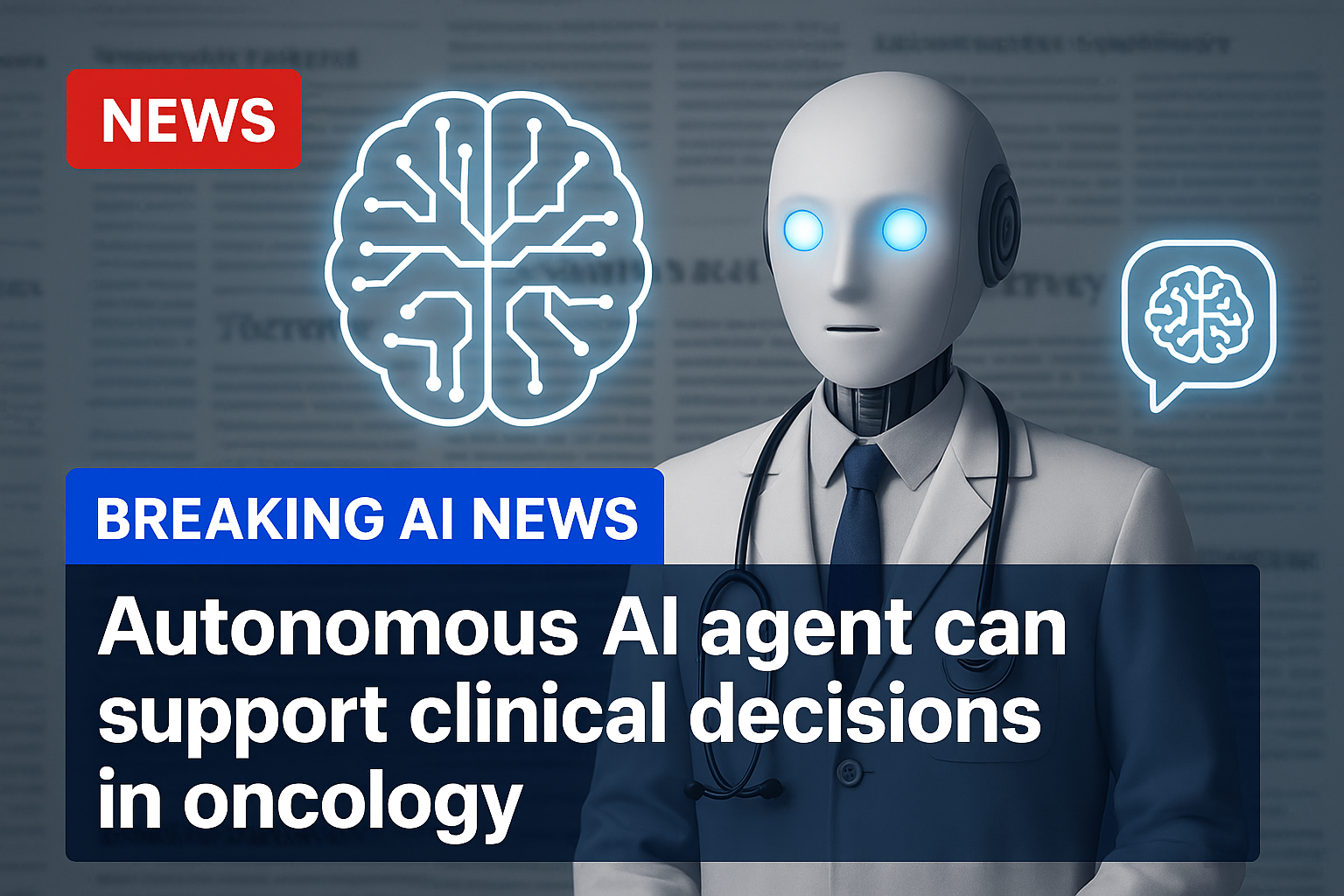
    Researchers at the Else Kröner Fresenius Center (EKFZ) for Digital Health at TUD Dresden University of Technology, in collaboration with partners from Germany, the U.K. and U.S., have developed and validated an autonomous artificial intelligence (AI) agent capable of supporting clinical decision-making in oncology.

    In the future, AI agents could assist health care professionals in navigating complex medical data and supporting informed, personalized treatment decisions for cancer patients. The research is published in the journal Nature Cancer.

    Clinical decision-making in oncology is challenging and requires the analysis of various data types—from medical imaging and genetic information to patient records and treatment guidelines. To effectively support medical practice, AI models must be capable of processing multimodal data and have reasoning and problem-solving capabilities that resemble those of humans.

    To build an autonomous AI agent for precision medicine, the researchers enhanced the large language model GPT-4 with several digital tools—including radiology report generation from MRI and CT scans, medical image analysis, prediction of genetic alterations directly from histopathology slides, and search functions across platforms such as PubMed, Google and OncoKB.

    To ensure that decisions were grounded in current medical knowledge, the model was given access to about 6,800 documents compiled from official oncology guidelines and clinical resources.

    Autonomous AI agents successfully tested on realistic, simulated patient cases

    The AI agent was evaluated on 20 real-world, simulated patient cases using a two-step process: First, the system selected appropriate tools, then it retrieved relevant medical information to guide its reasoning. The outputs were reviewed by human medical experts for accuracy, completeness, and correct citation of sources.

    The AI agent reached correct clinical conclusions in 91% of cases and accurately cited relevant oncology guidelines in more than 75% of its responses. Importantly, the use of specialized tools and medical information retrieval significantly improved the model’s performance. As a result, so-called “hallucinations”—seemingly plausible but incorrect statements—were significantly reduced. This improvement is particularly important in the sensitive area of health care.

    “AI tools are designed to support medical professionals, freeing up valuable time for patient care,” says Dyke Ferber, first author of the publication. “They could help in daily decision-making processes and support doctors to stay updated on the latest treatment recommendations, contributing to the identification of optimal personalized care for cancer patients.”

    Potential future support in everyday clinical practice

    The study serves as proof of principle that AI agents can be designed to support oncologists in everyday clinical practice. Despite the promising results, the researchers acknowledge current limitations of their study. The system was only tested on a small number of simulated cases and requires further validation. Future work will focus on integrating conversational capabilities with human feedback—so-called “human-in-the-loop” interactions—and ensuring data privacy through deployment on local servers.

    “To fully leverage the potential of AI agents in the future, it will be crucial to integrate them smoothly into routine clinical practice with minimal disruption,” says Prof. Jakob N. Kather, Professor of Clinical Artificial Intelligence at EKFZ for Digital Health at TU Dresden, and oncologist at Dresden University Hospital Carl Gustav Carus. “Challenges such as interoperability with existing systems, compliance with data privacy laws, the need for regulatory approval processes as medical devices, and ensuring accountability still need to be addressed.”

    Long-term, the research team envisions that similar AI agents could be adapted for use in other medical fields—provided they are equipped with appropriate tools and data. “For successful implementation of medical AI agents, medical professionals need to be well educated on how to effectively collaborate with these systems while maintaining full authority over final clinical decision-making”, Prof. Kather adds. “These agents are designed to support clinicians, but by no means to replace them.”

    Overall, the study highlights the considerable potential of large language models when combined with precision oncology and search tools, establishing a solid foundation for the future use of AI-driven, personalized support systems in clinical practice.

    Source: https://medicalxpress.com/

    Share. Facebook Twitter Pinterest LinkedIn Tumblr Email
    Art Ryan

    Related Posts

    Webjet AI Travel App Launches for Smarter Flight and Hotel Search

    May 12, 2026

    Dubai AI-Powered Smart Bus Station: A New Era in Transport

    May 12, 2026

    Tesla Vision AI May Deploy Airbags Before Crashes

    May 12, 2026

    Comments are closed.

    Latest News

    Webjet AI Travel App Launches for Smarter Flight and Hotel Search

    May 12, 2026

    Dubai AI-Powered Smart Bus Station: A New Era in Transport

    May 12, 2026

    Tesla Vision AI May Deploy Airbags Before Crashes

    May 12, 2026

    AI-Powered Hackers Targeting Zero-Day Exploits 2026

    May 12, 2026
    Facebook X (Twitter) Pinterest Vimeo WhatsApp TikTok Instagram LinkedIn YouTube Spotify Reddit Snapchat Threads

    AI University

    • Global Universities
    • Universities in Africa
    • Universities in Asia
    • Universities in Europe
    • Universities in Latin America
    • Universities in Middle East
    • Universities in North America
    • Universities in Oceania

    AI Tools & Apps Directory

    • AI Productivity Tools
    • AI Coding Tools
    • AI Voice Tools
    • AI Video Tools
    • AI Image Generators
    • AI Writing Tools

    Info

    • Home
    • About Us
    • AI Organizations & Associations
    • Contact Us
    • Cookie Policy
    • Copyright Policy
    • Disclaimer
    • Editorial Policy
    • Terms and Conditions

    Subscribe to Updates

    Get the latest creative news from FooBar about art, design and business.

    © 2026 Breaking AI News.
    • Privacy Policy

    Type above and press Enter to search. Press Esc to cancel.

    Sign Up

    Want to stay ahead In Artificial Intelligence?

     Sign up now and get exclusive breaking AI news and special updates—FREE!