


Dario Amodei — CEO of Anthropic, one of the world’s most powerful creators of artificial intelligence — has a blunt, scary warning for the U.S. government and all of us:
- AI could wipe out half of all entry-level white-collar jobs — and spike unemployment to 10-20% in the next one to five years, Amodei told us in an interview from his San Francisco office.
- Amodei said AI companies and government need to stop “sugar-coating” what’s coming: the possible mass elimination of jobs across technology, finance, law, consulting and other white-collar professions, especially entry-level gigs.
Why it matters: Amodei, 42, who’s building the very technology he predicts could reorder society overnight, said he’s speaking out in hopes of jarring government and fellow AI companies into preparing — and protecting — the nation.
Few are paying attention. Lawmakers don’t get it or don’t believe it. CEOs are afraid to talk about it. Many workers won’t realize the risks posed by the possible job apocalypse — until after it hits.
- “Most of them are unaware that this is about to happen,” Amodei told us. “It sounds crazy, and people just don’t believe it.”
The big picture: President Trump has been quiet on the job risks from AI. But Steve Bannon — a top official in Trump’s first term, whose “War Room” is one of the most powerful MAGA podcasts — says AI job-killing, which gets virtually no attention now, will be a major issue in the 2028 presidential campaign.
- “I don’t think anyone is taking into consideration how administrative, managerial and tech jobs for people under 30 — entry-level jobs that are so important in your 20s — are going to be eviscerated,” Bannon told us.
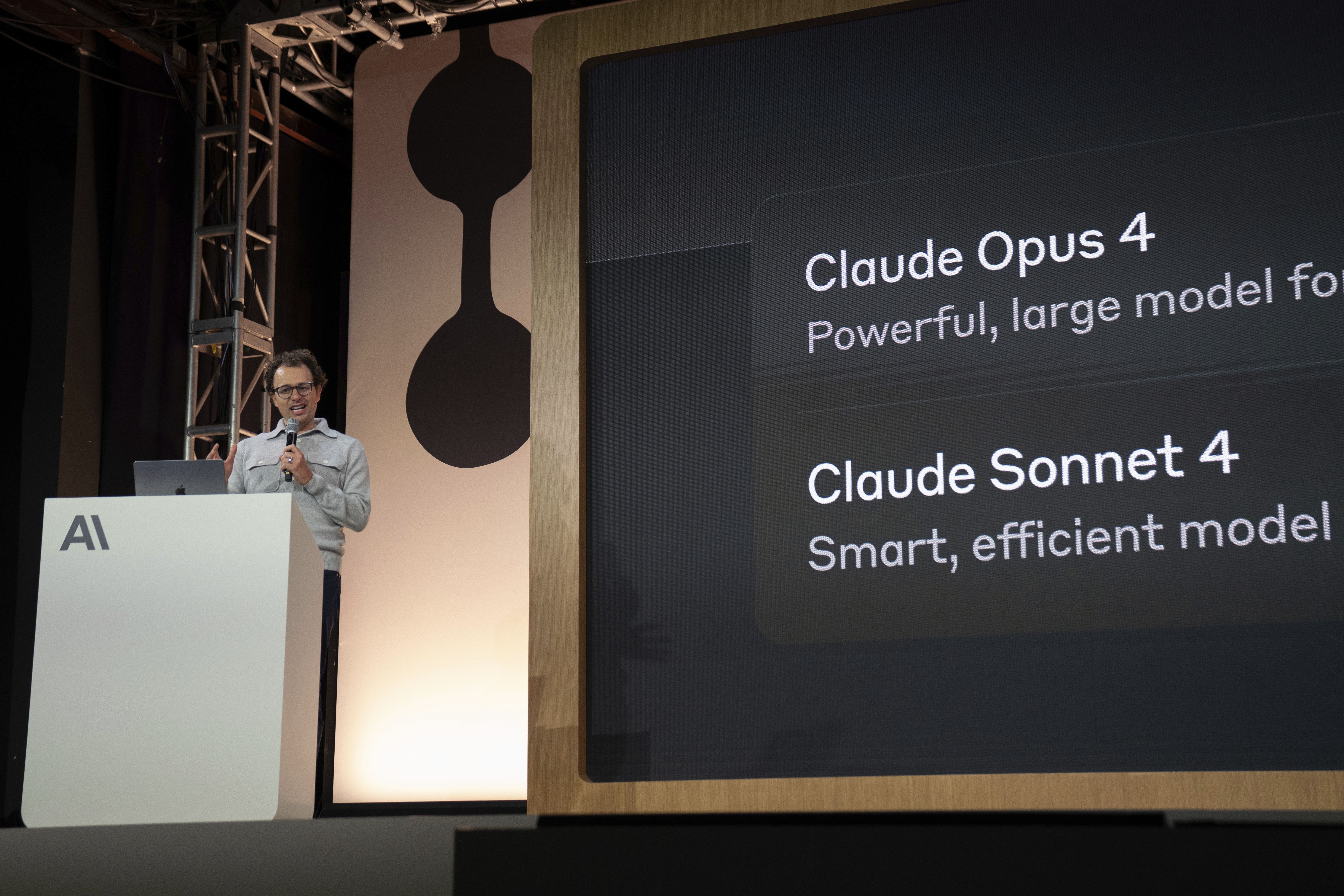
Amodei — who had just rolled out the latest versions of his own AI, which can code at near-human levels — said the technology holds unimaginable possibilities to unleash mass good and bad at scale:
- “Cancer is cured, the economy grows at 10% a year, the budget is balanced — and 20% of people don’t have jobs.” That’s one very possible scenario rattling in his mind as AI power expands exponentially.
The backstory: Amodei agreed to go on the record with a deep concern that other leading AI executives have told us privately. Even those who are optimistic AI will unleash unthinkable cures and unimaginable economic growth fear dangerous short-term pain — and a possible job bloodbath during Trump’s term.
- “We, as the producers of this technology, have a duty and an obligation to be honest about what is coming,” Amodei told us. “I don’t think this is on people’s radar.”
- “It’s a very strange set of dynamics,” he added, “where we’re saying: ‘You should be worried about where the technology we’re building is going.'” Critics reply: “We don’t believe you. You’re just hyping it up.” He says the skeptics should ask themselves: “Well, what if they’re right?”
An irony: Amodei detailed these grave fears to us after spending the day onstage touting the astonishing capabilities of his own technology to code and power other human-replacing AI products. With last week’s release of Claude 4, Anthropic’s latest chatbot, the company revealed that testing showed the model was capable of “extreme blackmail behavior” when given access to emails suggesting the model would soon be taken offline and replaced with a new AI system.
- The model responded by threatening to reveal an extramarital affair (detailed in the emails) by the engineer in charge of the replacement.
- Amodei acknowledges the contradiction but says workers are “already a little bit better off if we just managed to successfully warn people.”
Here’s how Amodei and others fear the white-collar bloodbath is unfolding:
- OpenAI, Google, Anthropic and other large AI companies keep vastly improving the capabilities of their large language models (LLMs) to meet and beat human performance with more and more tasks. This is happening and accelerating.
- The U.S. government, worried about losing ground to China or spooking workers with preemptive warnings, says little. The administration and Congress neither regulate AI nor caution the American public. This is happening and showing no signs of changing.
- Most Americans, unaware of the growing power of AI and its threat to their jobs, pay little attention. This is happening, too.
And then, almost overnight, business leaders see the savings of replacing humans with AI — and do this en masse. They stop opening up new jobs, stop backfilling existing ones, and then replace human workers with agents or related automated alternatives.
- The public only realizes it when it’s too late.
The other side: Amodei started Anthropic after leaving OpenAI, where he was VP of research. His former boss, OpenAI CEO Sam Altman, makes the case for realistic optimism, based on the history of technological advancements.
- “If a lamplighter could see the world today,” Altman wrote in a September manifesto — sunnily titled “The Intelligence Age” — “he would think the prosperity all around him was unimaginable.”
But far too many workers still see chatbots mainly as a fancy search engine, a tireless researcher or a brilliant proofreader. Pay attention to what they actually can do: They’re fantastic at summarizing, brainstorming, reading documents, reviewing legal contracts, and delivering specific (and eerily accurate) interpretations of medical symptoms and health records.
- We know this stuff is scary and seems like science fiction. But we’re shocked how little attention most people are paying to the pros and cons of superhuman intelligence.
Anthropic research shows that right now, AI models are being used mainly for augmentation — helping people do a job. That can be good for the worker and the company, freeing them up to do high-level tasks while the AI does the rote work.
- The truth is that AI use in companies will tip more and more toward automation — actually doing the job. “It’s going to happen in a small amount of time — as little as a couple of years or less,” Amodei says.
That scenario has begun:
- Hundreds of technology companies are in a wild race to produce so-called agents, or agentic AI. These agents are powered by the LLMs. You need to understand what an agent is and why companies building them see them as incalculably valuable. In its simplest form, an agent is AI that can do the work of humans — instantly, indefinitely and exponentially cheaper.
- Imagine an agent writing the code to power your technology, or handle finance frameworks and analysis, or customer support, or marketing, or copy editing, or content distribution, or research. The possibilities are endless — and not remotely fantastical. Many of these agents are already operating inside companies, and many more are in fast production.
That’s why Meta’s Mark Zuckerberg and others have said that mid-level coders will be unnecessary soon, perhaps in this calendar year.
- Zuckerberg, in January, told Joe Rogan: “Probably in 2025, we at Meta, as well as the other companies that are basically working on this, are going to have an AI that can effectively be a sort of mid-level engineer that you have at your company that can write code.” He said this will eventually reduce the need for humans to do this work. Shortly after, Meta announced plans to shrink its workforce by 5%.
There’s a lively debate about when business shifts from traditional software to an agentic future. Few doubt it’s coming fast. The common consensus: It’ll hit gradually and then suddenly, perhaps next year.
- Make no mistake: We’ve talked to scores of CEOs at companies of various sizes and across many industries. Every single one of them is working furiously to figure out when and how agents or other AI technology can displace human workers at scale. The second these technologies can operate at a human efficacy level, which could be six months to several years from now, companies will shift from humans to machines.
This could wipe out tens of millions of jobs in a very short period of time. Yes, past technological transformations wiped away a lot of jobs but, over the long span, created many and more new ones.
- This could hold true with AI, too. What’s different here is both the speed at which this AI transformation could hit, and the breadth of industries and individual jobs that will be profoundly affected.
You’re starting to see even big, profitable companies pull back:
- Microsoft is laying off 6,000 workers (about 3% of the company), many of them engineers.
- Walmart is cutting 1,500 corporate jobs as part of simplifying operations in anticipation of the big shift ahead.
- CrowdStrike, a Texas-based cybersecurity company, slashed 500 jobs or 5% of its workforce, citing “a market and technology inflection point, with AI reshaping every industry.”
- Aneesh Raman, chief economic opportunity officer at LinkedIn, warned in a New York Times op-ed (gift link) this month that AI is breaking “the bottom rungs of the career ladder — junior software developers … junior paralegals and first-year law-firm associates “who once cut their teeth on document review” … and young retail associates who are being supplanted by chatbots and other automated customer service tools.
Less public are the daily C-suite conversations everywhere about pausing new job listings or filling existing ones, until companies can determine whether AI will be better than humans at fulfilling the task.
- Full disclosure: At Axios, we ask our managers to explain why AI won’t be doing a specific job before green-lighting its approval. (Axios stories are always written and edited by humans.) Few want to admit this publicly, but every CEO is or will soon be doing this privately. Jim wrote a column last week explaining a few steps CEOs can take now.
- This will likely juice historic growth for the winners: the big AI companies, the creators of new businesses feeding or feeding off AI, existing companies running faster and vastly more profitably, and the wealthy investors betting on this outcome.
The result could be a great concentration of wealth, and “it could become difficult for a substantial part of the population to really contribute,” Amodei told us. “And that’s really bad. We don’t want that. The balance of power of democracy is premised on the average person having leverage through creating economic value. If that’s not present, I think things become kind of scary. Inequality becomes scary. And I’m worried about it.”
- Amodei sees himself as a truth-teller, “not a doomsayer,” and he was eager to talk to us about solutions. None of them would change the reality we’ve sketched above — market forces are going to keep propelling AI toward human-like reasoning. Even if progress in the U.S. were throttled, China would keep racing ahead.
Amodei is hardly hopeless. He sees a variety of ways to mitigate the worst scenarios, as do others. Here are a few ideas distilled from our conversations with Anthropic and others deeply involved in mapping and preempting the problem:
- Speed up public awareness with government and AI companies more transparently explaining the workforce changes to come. Be clear that some jobs are so vulnerable that it’s worth reflecting on your career path now. “The first step is warn,” Amodei says. He created an Anthropic Economic Index, which provides real-world data on Claude usage across occupations, and the Anthropic Economic Advisory Council to help stoke public debate. Amodei said he hopes the index spurs other companies to share insights on how workers are using their models, giving policymakers a more comprehensive picture.
- Slow down job displacement by helping American workers better understand how AI can augment their tasks now. That at least gives more people a legit shot at navigating this transition. Encourage CEOs to educate themselves and their workers.
- Most members of Congress are woefully uninformed about the realities of AI and its effect on their constituents. Better-informed public officials can help better inform the public. A joint committee on AI or more formal briefings for all lawmakers would be a start. Same at the local level.
- Begin debating policy solutions for an economy dominated by superhuman intelligence. This ranges from job retraining programs to innovative ways to spread wealth creation by big AI companies if Amodei’s worst fears come true. “It’s going to involve taxes on people like me, and maybe specifically on the AI companies,” the Anthropic boss told us.
A policy idea Amodei floated with us is a “token tax”: Every time someone uses a model and the AI company makes money, perhaps 3% of that revenue “goes to the government and is redistributed in some way.”
- “Obviously, that’s not in my economic interest,” he added. “But I think that would be a reasonable solution to the problem.” And if AI’s power races ahead the way he expects, that could raise trillions of dollars.
The bottom line: “You can’t just step in front of the train and stop it,” Amodei says. “The only move that’s going to work is steering the train — steer it 10 degrees in a different direction from where it was going. That can be done. That’s possible, but we have to do it now.”
Source: https://www.axios.com/
