

Close Menu
    • Home
    • Events
      • Upcoming Events
      • Videos
        • Machine Can Think Summit 2026
        • Step Dubai Conference 2026
    • Technology & Innovation
    • Business & Marketing
    • Trends & Insights
    • Industry Applications
    • Tutorials & Guides
    What's Hot
    Industry Applications

    AI Drug Development Johnson & Johnson Impact on Healthcare

    By Art RyanApril 28, 20260

    Johnson & Johnson (J&J) has unveiled new information about the future of AI in healthcare,…

    Qualcomm OpenAI AI Smartphone Processors Partnership News

    April 28, 2026

    Google AI Campus South Korea and Its Development Plans

    April 28, 2026

    Accenture Copilot Rollout Enhances Employee Productivity

    April 28, 2026
    Facebook X (Twitter) Instagram
    Facebook X (Twitter) Instagram
    Breaking AI News
    Wednesday, April 29
    • Home
    • Events
      • Upcoming Events
      • Videos
        • Machine Can Think Summit 2026
        • Step Dubai Conference 2026
    • Technology & Innovation

      AI Drug Development Johnson & Johnson Impact on Healthcare

      April 28, 2026

      Qualcomm OpenAI AI Smartphone Processors Partnership News

      April 28, 2026

      Google AI Campus South Korea and Its Development Plans

      April 28, 2026

      New AI-Based Solution Launched by Box to Revolutionize Enterprise Workflows

      April 28, 2026

      Meta AWS Graviton AI Partnership: Revolutionizing Infrastructure

      April 28, 2026
    • Business & Marketing

      UK AI Startup Ineffable Secures $1.1B in Europe’s Largest Seed Round

      April 28, 2026

      Meta Manus AI Acquisition Blocked Over Strategic Concerns

      April 28, 2026

      Microsoft Ceases Revenue Split With OpenAI in Landmark AI Partnership Move

      April 28, 2026

      ZainTECH Named a Leader in IDC MarketScape: Gulf Countries AI Professional Services

      April 28, 2026

      AI Job Cuts Forecast: Shocking Prediction That 50% of UK Executives Expect Workforce Reduction

      April 20, 2026
    • Trends & Insights

      Google AI Campus South Korea and Its Development Plans

      April 28, 2026

      Meta Manus AI Acquisition Blocked Over Strategic Concerns

      April 28, 2026

      Emirati Inventor AI UAE: Bridging Culture and Technology

      April 28, 2026

      Cursor’s $50 Billion Ambition: Explosive AI Coding Demand Fuels Massive Growth

      April 19, 2026

      Dubai AI-powered government will change your daily life in the UAE

      April 3, 2026
    • Industry Applications

      AI Drug Development Johnson & Johnson Impact on Healthcare

      April 28, 2026

      Accenture Copilot Rollout Enhances Employee Productivity

      April 28, 2026

      HomeLight AI Real Estate Closings Transforming the Market

      April 27, 2026

      UiPath & Databricks Partner to Transform Enterprise Operations through Automation and Data Intelligence

      April 27, 2026

      Visit Oman Launches Revolutionary AI Digital Hub and Global Collaboration to Transform Tourism Industry

      April 27, 2026
    • Tutorials & Guides

      How AI Is Revolutionizing the Future of Travel 2026 with Wellness and Sustainability

      April 19, 2026

      University of Wollongong in Dubai AI initiative boosts future-ready education

      March 31, 2026

      Microsoft AI upgrades Copilot Cowork unveiled for early access users

      March 31, 2026

      Starcloud $11 billion valuation signals AI space race surge

      March 31, 2026

      Flexible AI Factories Power the Future of Energy Grids

      March 30, 2026
    Breaking AI News
    Home » AI Revives Autonomous Microstores as Inventory Agents Cut Costs
    Technology & Innovation

    AI Revives Autonomous Microstores as Inventory Agents Cut Costs

    Art RyanBy Art RyanNovember 21, 2025No Comments4 Mins Read
    Facebook Twitter Pinterest LinkedIn Tumblr Email
    Share
    Facebook Twitter LinkedIn Pinterest Email

    Autonomous microstores are returning to the retail market as artificial intelligence (AI) solves the accuracy and cost issues that stalled the first generation. New systems use stronger computer vision, lightweight agentic inventory models and simpler robotics to track items, forecast demand and run without dense sensor grids or continuous human oversight.

    Retailers are moving from small pilots to practical deployments as evidence grows that the model can operate reliably at lower cost.

    The first wave of microstores depended on pressure shelves and large sensor arrays that required constant calibration and often produced inconsistent reads. AI is changing that. Today’s vision models handle low light, tight aisles and cluttered shelves with much greater stability.

    A study from University of Michigan shows how modern vision architectures reduce occlusion errors and cut reliance on expensive multi-sensor hardware. These improvements eliminate much of the fragility that made early autonomous stores difficult to scale.

    AI Makes Microstores Operationally Viable

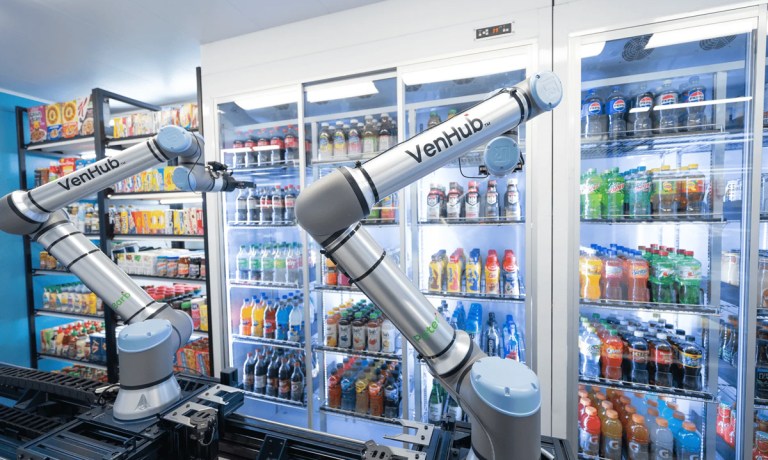
    An example of the new model is VenHub’s rollout in Los Angeles. The company opened a 24/7 smart store at Los Angeles Union Station as part of its transit-hub deployment. The autonomous store runs on vision-driven checkout, robotic picking and real-time inventory agents. The store manages SKU counts, customer interactions and demand forecasting using a compact AI stack designed for unattended operation.

    Underlying technologies are also maturing. Modern vision systems track items and customer movement without pressure shelves or heavy sensor grids. The move toward software-driven perception lowers installation costs and increases reliability.

    Inventory automation is strengthening the model further, and this layer is becoming one of the most important differentiators between legacy autonomous retail formats and the second-generation systems now entering the market.

    For example, Brain Corp’s robotic shelf-intelligence platform, ShelfOptix, captures shelf data, detects misplaced goods and updates inventory in real time. It also detects shelf gaps, tracks planogram deviations, and records count discrepancies as they happen rather than after the fact. Continuous monitoring is critical for unattended formats, which depend on clean data to avoid stock errors and unexpected downtime.

    PYMNTS Intelligence has tracked the same shift across unattended retail. The latest analysis shows that AI and connected devices are giving operators real-time visibility into transactions, shelf conditions and store performance.

    The research also finds that consumers are moving toward frictionless formats as cashless payments become standard in self-service environments. Retailers are using these systems to reduce manual oversight, identify issues earlier and stabilize small-footprint locations that operate without staff. The findings point to a broader acceleration of autonomous retail as technology replaces labor-intensive monitoring.

    A Second Wave Driven by Costs, Reliability and Proof of Deployment

    Labor cost pressure and changing consumer behavior are major drivers in this second wave. Retailers want small, high-availability formats that do not expand headcount. Microstores meet that need with compact footprints and predictable operating costs. AI agents manage replenishment, forecast demand and enforce planograms, which reduces manual workload.

    Reliability is also improving. Earlier microstores often failed when sensors misread items or checkout systems broke down. A PYMNTS Tracker shows how modern AI-IoT systems detect anomalies early and support remote fixes. Field deployments such as VenHub’s demonstrate extended periods of unattended operation, something the first-generation formats could not achieve.

    Costs have shifted in favor of adoption. Modern microstores use fewer sensors, rely on smaller models running on compact hardware and use robotics with fewer moving parts. These improvements shorten installation cycles and reduce maintenance demands.

    Retailers are also widening their use of smart-commerce orchestration tools that coordinate sensors, cameras and store-management systems in real time. Recent PYMNTS coverage shows that self-serve retail is benefiting from platforms that integrate item tracking, temperature sensors, motion alerts and automated merchandising rules into a single command layer.

    Source: https://www.pymnts.com/
    Share. Facebook Twitter Pinterest LinkedIn Tumblr Email
    Art Ryan

    Related Posts

    AI Drug Development Johnson & Johnson Impact on Healthcare

    April 28, 2026

    Qualcomm OpenAI AI Smartphone Processors Partnership News

    April 28, 2026

    Google AI Campus South Korea and Its Development Plans

    April 28, 2026

    Comments are closed.

    Latest News

    AI Drug Development Johnson & Johnson Impact on Healthcare

    April 28, 2026

    Qualcomm OpenAI AI Smartphone Processors Partnership News

    April 28, 2026

    Google AI Campus South Korea and Its Development Plans

    April 28, 2026

    Accenture Copilot Rollout Enhances Employee Productivity

    April 28, 2026
    Facebook X (Twitter) Pinterest Vimeo WhatsApp TikTok Instagram LinkedIn YouTube Spotify Reddit Snapchat Threads

    AI University

    • Global Universities
    • Universities in Africa
    • Universities in Asia
    • Universities in Europe
    • Universities in Latin America
    • Universities in Middle East
    • Universities in North America
    • Universities in Oceania

    AI Tools & Apps Directory

    • AI Productivity Tools
    • AI Coding Tools
    • AI Voice Tools
    • AI Video Tools
    • AI Image Generators
    • AI Writing Tools

    Info

    • Home
    • About Us
    • AI Organizations & Associations
    • Contact Us

    Subscribe to Updates

    Get the latest creative news from FooBar about art, design and business.

    © 2026 Breaking AI News.
    • Privacy Policy

    Type above and press Enter to search. Press Esc to cancel.