


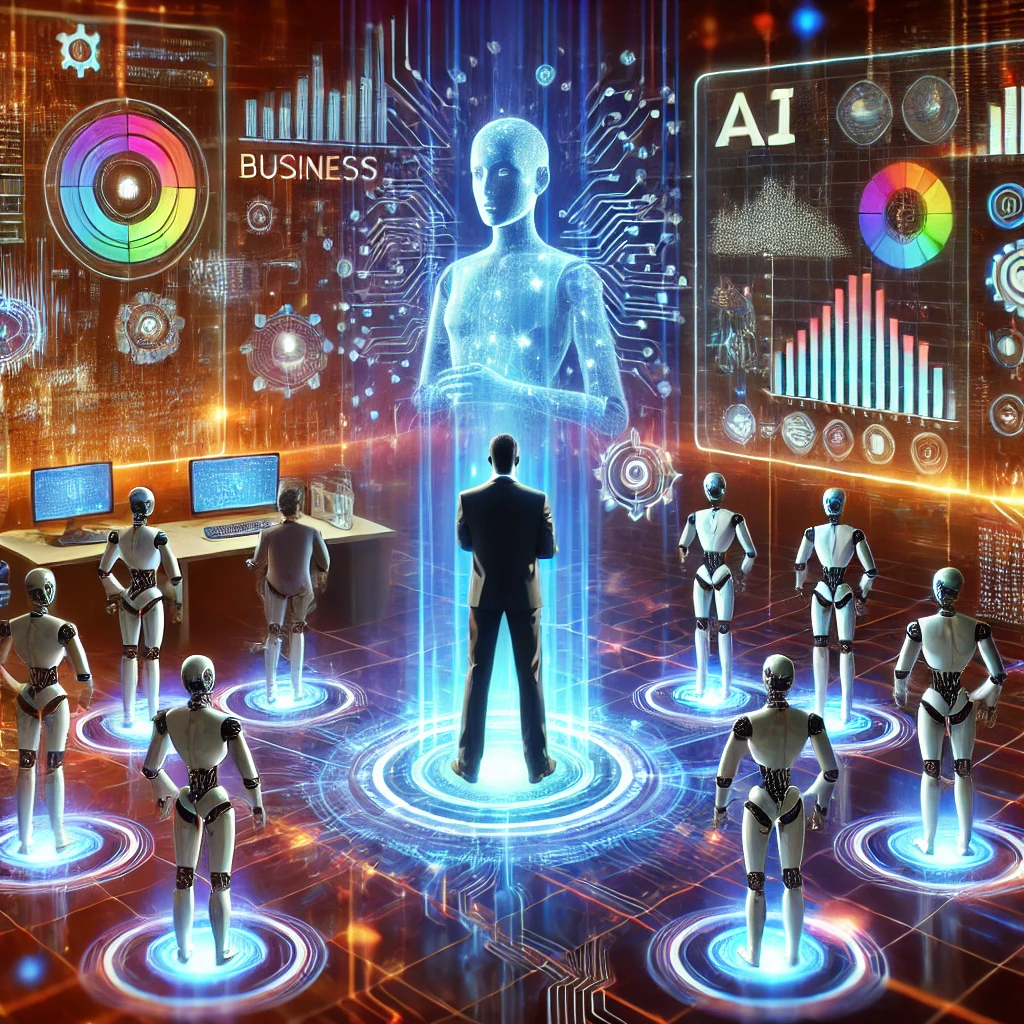
Thanks to the advent of cloud computing and distributed digital infrastructure, the one-person micro-enterprise is far from a novel concept. Cheap on-demand compute, remote collaboration, payment processing APIs, social media, and e-commerce marketplaces have all made it easier to “go it alone” as an entrepreneur.
But what about scaling that one-person business into something meatier — an enterprise of unicorn proportions?
Historically, this would have been an unfathomably tough task, due to the skills and resources required, not only to scale a product but also to grow and maintain a sufficiently bountiful customer base. But AI agents could unshackle the would-be solo-preneurs of the world.
AI agents are all about embedding human workflows into software, freeing the human to do more in less time. Agents can be assigned tasks, and they can make decisions with varying degrees of autonomy. Multiple AI agents could even collaborate on complementary tasks, paving the way for getting some real work done entirely autonomously.
In an interview last year with Reddit co-founder Alexis Ohanian, OpenAI’s Sam Altman predicted this exact scenario.
“In my little group chat with my tech CEO friends, there’s this betting pool for the first year that there is a one-person billion-dollar company,” Altman said. “Which would have been unimaginable without AI — and now [it] will happen.”
In a discussion at the World Economic Forum’s annual meeting in Davos last week, a panel of entrepreneurs and investors also discussed the prospect of the single-person billion-dollar enterprise — and, more importantly, what this might mean for the future of employment.
In humans we trust
Recent history reveals a slew of svelte billion-dollar companies. Microsoft doled out $2.5 billion for Minecraft maker Mojang, which had a reported 40 employees. Facebook acquired WhatsApp for $19 billion when the messaging app maker had just 55 employees. Two years before that, Facebook bought Instagram for $1 billion with just 13 employees in its ranks.
This proves that internet technology has already generated huge companies with minimal headcount. But this isn’t the same as a one-person unicorn.
Kanjun Qiu, CEO of AI research lab Imbue, which is building agents capable of reasoning and coding, reckons that the kind of one-person businesses that AI will most likely help hit the big time are those where the product is largely self-serve.
“I think the places where it’ll be easiest, and first, are ‘bottoms up’ — either consumer or prosumer — products that don’t require large go-to-market teams,” Qiu explained during the panel discussion. “I think go to market is actually one of the places where it’s going to be difficult to automate all of these relationships with other people.”
When it comes to generating sales, it’s not always the better product that wins out; it’s the people behind the product that have done a better job of building trust with customers. So if you need to proactively sell your product, you still might need to staff up.
“That human-to-human trust, I think, is still very necessary and very important,” Qiu added.
Benjamine Liu, CEO of AI drug development company Formation Bio, is bullish on the growing role that AI is having in his company and beyond.
“I think we’re living in one of the most exciting areas to be building companies,” Liu said at Davos. “We have PhD-level intelligence in our pockets, and we’re beginning to see AI systems do the work of entire teams. I think in that world, AI-native companies have a pretty significant advantage.”
However, Liu echoed Qiu’s sentiments: Though the potential for one-person mega-businesses is real, it might not actually make sense from a business or entrepreneurial perspective — and it all comes down to the human condition that values relationships.
“The potential to get there is earlier than people think,” Liu said. “My view is that it’s gonna take a long time, because being an entrepreneur is kind of a lonely journey, and you want a co-founder. Companies are still started by humans. I think you will want some people to share the journey with.”
So the reality is, we might actually end up in a place where companies have always started out: a founding team with complementary skill sets. But rather than scaling through incremental hiring, they maintain that initial slenderness with AI agents plugging the gap.
But even if the fabled one-person unicorn never happens, there’s little question that the oncoming agentic AI freight train will disrupt the workforce in a big way.
“The era of AI employees”
If this still all seems hypothetical, think again. Agentic AI is already entering the workforce in the form of lawyers like Harvey or software engineers such as Cognition’s Devin.
AI sales agents are also booming, with VC-backed companies such as Artisan boasting that it wants to replace the human workforce — as its dystopian billboard ad in San Francisco demonstrates.

Plenty of other companies are also laying the foundation for agentic AI to flourish.
Lattice, an HR and “people management” platform last valued at $3 billion, is going further by giving “digital workers” official employee records, meaning that its customers’ AI agents actually show up in the organizational chart, replete with profile photo and a manager assigned to them.
Sarah Franklin, who joined Lattice as CEO last year, called this transition a “great new age of collaboration,” where humans and AI agents work side by side. And what this means is managing these agents in a similar fashion to humans, to foster transparency and accountability.
“We want to prioritize the success of people as the primary, and when you’re working with AI agents, it’s important to understand what they are assigned to be doing,” Franklin explained at Davos. “It’s not saying that AI is human; it’s more that we need to clearly identify where AI is. As AI speaks on behalf of brands and people, makes decisions on behalf of brands and people, and integrates with other systems, we need to be able to track that.”

But if companies can operate at scale without any significant human workforce, what does this mean for society? People need to earn money; they need purpose — wouldn’t society just implode on itself if people aren’t able to work?
As with previous industrial revolutions, a common refrain around the AI revolution is that new jobs will crop up in the longer term — we just don’t know what they are yet.
“There’s going to be a lot of job creation, too,” Mitchell Green, founder of investment firm Lead Edge Capital, said at Davos. “If you think about when the iPhone came out in 2007 — Uber and Airbnb are now $100 billion companies. [They] could not have existed before this. Where the opportunities can be are the companies that we’re not even thinking about yet — they are going to be these next giant businesses.”
That doesn’t mean there won’t be a whole heap of pain in the short term, though. And as we’re already seeing with Chinese AI sensation DeepSeek, the rate of AI’s advance is significant in terms of cost-to-performance ratio of AI models. And this could be a key differentiator versus previous industrial and technological revolutions: We might not be able to adapt quickly enough.
“I do think there’s a lot to talk about in terms of retraining and upskilling,” Liu said. “But there’s something quite unique about the pace of developments and how quickly these models are getting better, specifically where we’re seeing these AI systems do the work of entire teams.”
“Manager of AIs”
There was a general consensus among the panel that regardless of the rate of change, everyone will have to learn not only to live with AI, but also learn how to use it to thrive in the workplace.
With You.com, for example, companies can access its API to bring real-time web search to any large language model (LLM). While it offers its own suite of agents for specific tasks, companies can also create their own custom agents, choosing their preferred AI model and giving it instructions based on whatever sources of data they need to connect.
“We, as CEOs, are going to be the first generation that manages people and AI,” You.com CEO Richard Socher said at Davos. “But I think the most interesting change here is actually that every individual contributor, every employee, is going to become a manager of AIs. And in that sense, everyone is going to become kind of an entrepreneur.”
So the jury is still very much out on whether we’ll ever see a true one-person unicorn company. However, the principle behind the sentiment has already kind of been proven, as we’ve seen with the insanely high value-to-headcount ratio of WhatsApp, which worked out at $345 million for each employee at the time Facebook bought it.
Even Nvidia, with a market cap of more than $3 trillion, has a relatively slender workforce of fewer than 30,000 employees — that’s the equivalent of around $100 million in value per employee.
With the right type of company, and the right execution, it’s difficult to see how AI won’t nudge these dollar figures north as the headcount heads south. But in all likelihood, it will just come down to whether there is a desire for one person to build alone, with enough entrepreneurial knowledge to embed a strong, defensible business model that someone else can’t just replicate at the drop of a hat.
But whether society will be ready to handle this is an entirely different question.
Published by: Paul Sawers
