


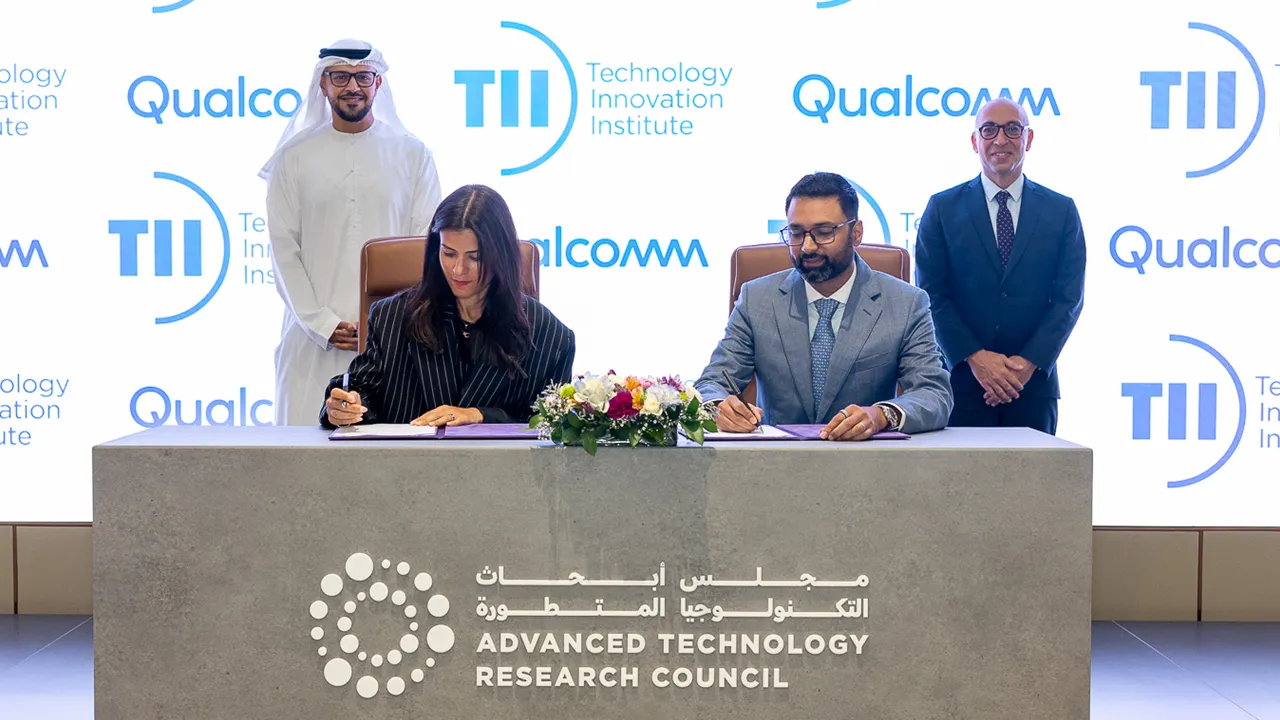
Abu Dhabi’s Technology Innovation Institute, or TII, has become the first institution in the Middle East to receive Qualcomm’s Tech for Good Grant. This recognition comes as part of the TII Qualcomm edge AI grant initiative. The collaboration will focus on bringing AI-powered predictive maintenance directly onboard autonomous aircraft, including cargo drones and future electric vertical take-off and landing aircraft.
The project will combine TII’s SADEED Prognostics and Health Management platform with Qualcomm’s Dragonwing IQ9 edge AI processor. The idea is straightforward but technically demanding: aircraft should be able to detect developing technical problems without having to rely on a constant cloud connection.
For Advanced Air Mobility, that matters. Autonomous aircraft may not always have access to stable connectivity, yet they still need to monitor critical systems in real time and make decisions without delay.
SADEED Brings Predictive Maintenance Directly Onboard
TII developed SADEED to monitor the condition of critical systems and identify early signs of degradation before they become serious failures. The platform uses AI to analyze sensor data, detect unusual patterns and estimate when a component may need attention. Rather than waiting for a scheduled maintenance check or a visible mechanical issue, operators can potentially spot problems much earlier.
The Qualcomm collaboration is designed to move that intelligence closer to the aircraft itself. By adapting SADEED for the Dragonwing IQ9 processor, much of the analysis can happen onboard instead of sending everything back to remote cloud infrastructure. That reduces dependence on connectivity and gives the aircraft a faster way to assess its own condition.
This type of local processing could also improve data control. Aircraft health information can remain closer to the machine while still supporting real-time diagnostics, which may become increasingly important as autonomous aviation systems become more advanced.
Why Edge AI Matters for Cargo Drones and eVTOL Aircraft
Cloud-based AI works well when a system has dependable connectivity, but aircraft cannot always count on that. Cargo drones may travel through remote areas, while future eVTOL aircraft could operate across urban air corridors where network quality changes constantly.
Edge AI addresses that problem by processing information directly on the aircraft. Instead of sending sensor data to a distant server and waiting for a response, the system can analyze what is happening locally and react without delay.
That becomes especially important when the AI is responsible for monitoring safety-critical components. If an aircraft detects signs of overheating, vibration or unusual mechanical behavior, it should not have to depend entirely on an external data connection before deciding that something needs attention.
This is why edge computing is becoming closely tied to Physical AI. Machines that operate in the real world need intelligence that stays with them, particularly when safety and reliability are part of the equation.
TII Moves SADEED Beyond the Research Lab
The Qualcomm grant gives TII a chance to move SADEED closer to a practical operating environment. The AI Diagnostics and Prognostics team at TII’s Propulsion and Space Research Center has spent more than two years developing the technology, and the next challenge is making it work reliably on real hardware.
That step is much harder than demonstrating an AI system under controlled research conditions. Aviation systems must deal with hardware limitations, changing environments, connectivity gaps and strict reliability requirements. A model that performs well in a laboratory still needs to prove that it can function continuously onboard an aircraft.
The Qualcomm collaboration brings SADEED closer to that test. If the platform performs well on edge hardware, it could strengthen the case for using predictive AI as part of future autonomous aviation systems.
Predictive Maintenance Could Change How Aircraft Are Serviced
Aircraft maintenance still depends heavily on fixed inspection schedules and predefined service intervals. Predictive maintenance offers a different approach by looking at the actual condition of the equipment instead of relying only on time-based maintenance.
SADEED is designed around that model. Sensor data can reveal subtle changes in temperature, vibration, pressure or performance long before a component fails. AI can then examine those signals and identify patterns that suggest a developing issue.
This does not mean traditional aircraft maintenance disappears. Scheduled inspections will still matter, especially in tightly regulated aviation environments. What predictive AI can do is give maintenance teams better information about which components may need attention and when.
For operators managing larger drone or eVTOL fleets, that could reduce unexpected downtime and make maintenance planning more precise. Instead of replacing parts too early or discovering failures too late, operators could work with a clearer picture of equipment health.
Abu Dhabi Is Building More Than Air Taxis
The TII and Qualcomm project also fits into Abu Dhabi’s wider Advanced Air Mobility strategy. The emirate has been exploring the infrastructure needed for future air taxis, autonomous aircraft and urban aerial transportation, including digital twins, communication systems and airspace optimization.
Predictive maintenance adds another layer to that infrastructure. Building an aircraft is only one part of the challenge. Operators also need systems that can keep fleets safe, reliable and available over time.
That means future air mobility will depend on more than aircraft design. Navigation systems, communication networks, health monitoring, maintenance platforms and autonomous decision-making will all need to work together.
TII’s work with Qualcomm is useful in that context because it focuses on the part of the system that passengers may never notice. The intelligence monitoring the aircraft in the background could become just as important as the vehicle itself.
Qualcomm Expands Its Edge AI Footprint in the Gulf
The project also reflects Qualcomm’s wider push into edge AI and industrial computing across the Gulf. The company has been moving beyond its traditional smartphone business and positioning platforms such as Dragonwing for connected machines, robotics, industrial IoT and autonomous systems.
Qualcomm has also been building relationships with technology companies and research institutions across the Middle East. Its work with TII follows a broader effort to support edge computing, AI infrastructure and autonomous technologies in the region.
The SADEED project gives that strategy a clear use case. Instead of using AI mainly in cloud data centers, the technology is being placed directly inside a physical machine that needs to keep operating under real-world conditions.
That shift is becoming increasingly important as companies look for ways to reduce latency, improve reliability and keep more processing close to where data is generated.
Physical AI Is Becoming a Bigger Part of Abu Dhabi’s Research Strategy
TII’s work on SADEED also reflects a broader shift toward Physical AI, where artificial intelligence is embedded into machines that interact with the real world. This includes robots, autonomous vehicles, drones and other systems that need to understand their surroundings and respond without constant human control.
Abu Dhabi has already been investing in this area. TII has expanded its work in robotics, advanced AI models and autonomous systems, including collaborations with major technology companies.
The SADEED project brings that idea into aviation. Instead of using AI to generate text, images or recommendations, the system is monitoring physical components and helping a machine understand its own condition.
That is a different type of AI problem. The decisions happen closer to hardware, and reliability becomes more important because the system is tied directly to real-world operations.
TII’s Qualcomm Grant Signals a Shift Toward Real-World Edge AI
Becoming the first Middle Eastern institution to receive Qualcomm’s Tech for Good Grant gives TII a regional milestone, but the more important story is what happens next. SADEED now has an opportunity to move from research and testing toward real onboard deployment.
If the technology works well on aircraft, the same approach could eventually apply to other industries. TII describes SADEED as hardware-agnostic, which means the platform could potentially be adapted for other machines that require continuous condition monitoring.
Industrial equipment, energy systems, transportation networks and autonomous machines all face the same basic problem. Operators want to know that something is beginning to fail before it causes downtime, damage or safety issues.
For Abu Dhabi, the project adds another piece to its wider investment in sovereign AI, autonomous systems and advanced aviation. The aircraft will attract most of the attention, but the AI quietly monitoring their health may turn out to be just as important.
Sources
Technology Innovation Institute — Qualcomm Awards Its First Tech for Good Grant in the Middle East to Abu Dhabi’s TII
https://www.tii.ae/news/qualcomm-awards-its-first-tech-good-grant-middle-east-abu-dhabis-tii
Middle East AI News — Abu Dhabi’s TII wins first regional Qualcomm research grant
https://www.middleeastainews.com/p/abu-dhabis-tii-wins-first-regional
Technology Innovation Institute — Designing the Sky: How TII is Building the Invisible Infrastructure for Air Taxis
https://www.tii.ae/insights/designing-sky-how-tii-building-invisible-infrastructure-air-taxis
Technology Innovation Institute — Abu Dhabi’s TII and NVIDIA Launch Middle East’s First Joint AI & Robotics Research Lab
https://www.tii.ae/news/abu-dhabis-tii-and-nvidia-launch-middle-easts-first-joint-ai-robotics-nvaitc-research-lab
