


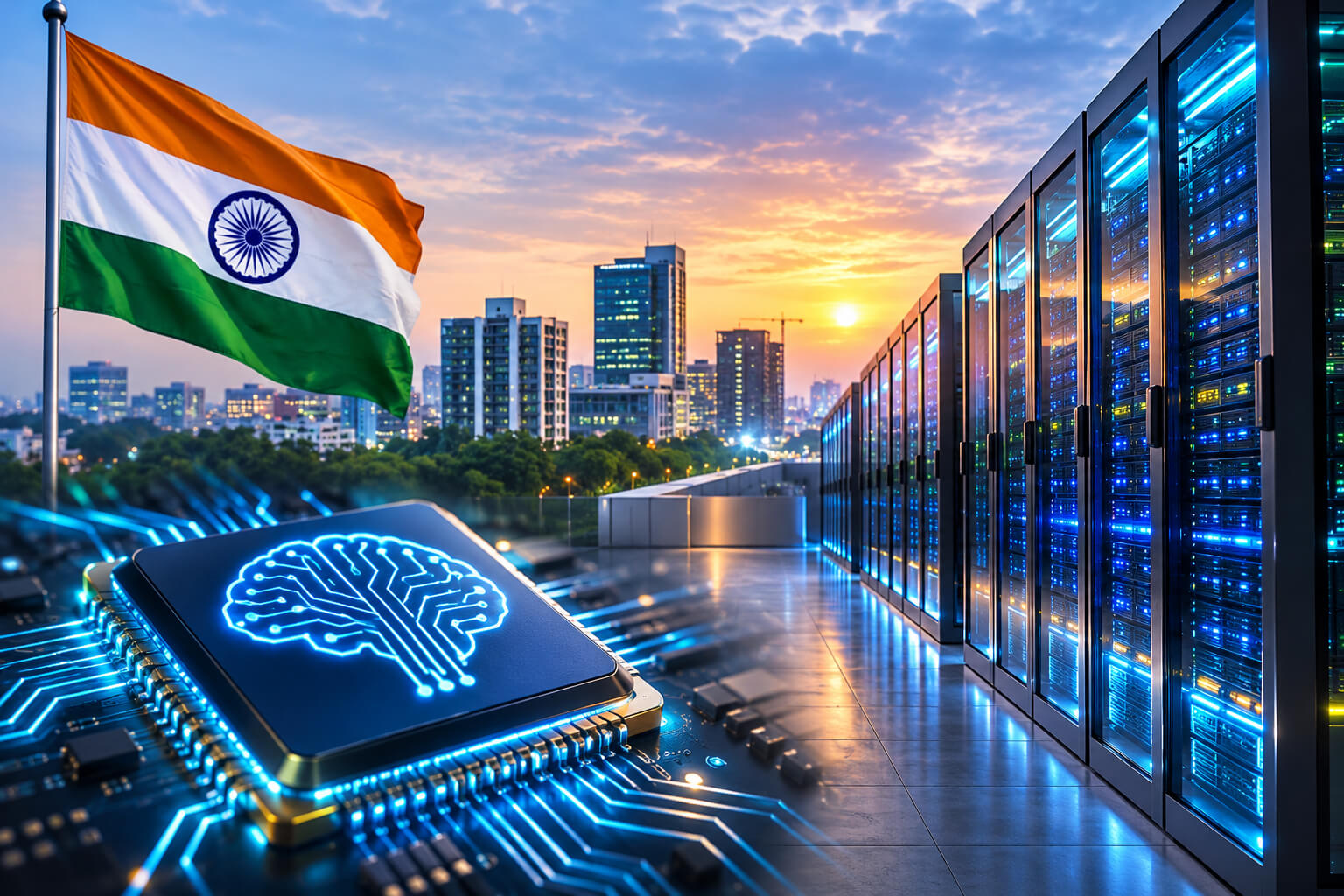
India is becoming an unexpected destination for investors navigating the global artificial intelligence boom. The growing India AI investment landscape is attracting attention as technology-heavy markets remain closely tied to the fortunes of AI companies, while India’s broader stock market offers a different kind of exposure. At the same time, the country is pouring resources into data centers, cloud computing and digital infrastructure.
That contrast is drawing attention.
A November 27 Bloomberg report highlighted how India has provided investors with some distance from the crowded AI trade while simultaneously preparing for a massive expansion in computing infrastructure.
The opportunity is substantial. So are the challenges. India needs more electricity, stronger infrastructure and faster project execution to turn its AI ambitions into a functioning technology ecosystem.
India Becomes an Alternative for Investors Concerned About AI Stocks
Global investors have spent much of the AI boom concentrating on semiconductor manufacturers, cloud computing providers and technology companies developing advanced artificial intelligence models. Their rising valuations have created concerns about how much market performance depends on continued enthusiasm for AI.
India offers a different investment profile. Its stock market includes major banking institutions, consumer businesses, industrial companies and service providers whose performance is not entirely dependent on AI spending.
This distinction has helped position India as an alternative for investors seeking exposure to economic growth without concentrating their portfolios in the same technology companies driving global AI markets.
Yet India is hardly avoiding artificial intelligence. Its growing investment in computing infrastructure suggests that the country wants to benefit from the technology’s expansion without relying exclusively on the companies currently dominating AI-related stock market gains.
India’s Data Center Industry Heads Toward a Major Investment Boom
India’s data center industry is preparing for a dramatic increase in capacity as artificial intelligence applications place greater demands on computing infrastructure.
According to Crisil Ratings, the country’s installed third-party colocation data center capacity could increase fivefold to approximately 7.5 gigawatts by March 2030. The expansion is expected to attract investments exceeding ₹3 trillion over four financial years.
Generative AI is a major reason behind the projected growth. Companies developing and deploying AI applications need powerful computing systems capable of processing enormous amounts of information. Traditional cloud services, enterprise digitalization and rising internet consumption are adding to that demand.
The investment pipeline also has substantial commercial backing. Crisil estimates that nearly half of India’s upcoming data center capacity has already been committed through long-term customer contracts.
That gives developers greater confidence that their facilities will attract paying customers once construction finishes.
Global Technology Companies See India as an AI Infrastructure Opportunity
India’s appeal extends beyond domestic technology businesses. International cloud providers and infrastructure investors increasingly view the country as a location for large-scale computing facilities.
The attraction comes partly from development costs. Crisil estimates that building data centers in India costs approximately 20% less than in several competing Asia-Pacific markets, supported by relatively competitive land, construction and labor expenses.
Lower operating costs could make India especially attractive for companies expanding their cloud computing networks. As AI workloads become more demanding, finding affordable locations for large computing facilities becomes increasingly important.
India also has an established technology services industry and a large digital economy. Those advantages give international companies access to skilled workers, business customers and potential long-term demand.
However, investment announcements do not guarantee completed facilities. Developers still need regulatory approvals, financing, electricity connections and suitable land before projects can begin generating revenue.
Electricity Supply Becomes a Critical Challenge for AI Data Centers
India’s expanding data center industry faces a problem that cannot be solved simply by attracting more investment: electricity.
AI computing facilities consume significant amounts of power. Advanced processors operate continuously, while cooling systems must prevent equipment from overheating. Larger facilities place additional pressure on electricity transmission networks.
Crisil expects approximately three-quarters of India’s upcoming data center capacity to be concentrated in Visakhapatnam, Mumbai and Hyderabad.
By fiscal 2030, the planned data center capacity in these cities could represent electricity demand equivalent to roughly 80%, 60% and 20% of their respective current peak power demand.
Those figures illustrate the scale of the infrastructure challenge. Even where electricity generation capacity is available, transmission networks may not be ready to deliver sufficient power to individual facilities.
Cooling requirements and water availability create further complications. Developers may need to invest in more efficient cooling technology while balancing industrial demand against local environmental concerns.
Without reliable electricity and supporting infrastructure, some of India’s most ambitious data center projects could face delays.
Government Incentives Encourage India’s AI Infrastructure Expansion
India’s government has introduced measures designed to strengthen the country’s position in the global artificial intelligence industry.
The IndiaAI Mission supports domestic AI development, computing access and technology innovation. Meanwhile, government incentives for digital infrastructure aim to attract international investment and encourage companies to establish computing facilities within the country.
The 2026–27 Union Budget introduced a long-term tax incentive for eligible foreign cloud service providers using qualifying India-based data center infrastructure, extending through March 2047.
These policies could make India more competitive as technology companies decide where to establish their next generation of cloud and AI facilities.
Government support also reflects a broader ambition to reduce dependence on overseas computing infrastructure and strengthen India’s role in the international digital economy.
Still, financial incentives cannot eliminate every obstacle. Land acquisition, electricity availability and the lengthy approval processes associated with major infrastructure developments remain important considerations for investors.
India’s AI Growth Could Benefit Industries Beyond Technology
The economic effects of India’s AI infrastructure expansion could extend well beyond software companies and cloud computing providers.
Data center construction requires electrical equipment, cooling systems, backup power infrastructure and specialized engineering services. This creates potential opportunities for industrial manufacturers, construction firms and energy providers.
Renewable energy developers could also benefit as technology companies search for electricity sources capable of supporting their growing computing requirements while meeting environmental commitments.
The scale of spending may attract investors who would not normally consider themselves participants in the artificial intelligence industry.
But the financial risks are considerable. Data centers require large upfront investments, and developers may wait several years before completed facilities begin generating substantial revenue.
Crisil estimates that debt levels could remain elevated during the expansion period because investment typically precedes cash generation by 24 to 36 months.
Developers must therefore balance ambitious construction plans against the financial realities of building expensive infrastructure.
India’s Domestic AI Demand Remains an Important Question
Building more data centers does not automatically guarantee that India will become a leading developer of artificial intelligence technologies.
An October 2026 assessment by Rhodium Group raised concerns about the gap between India’s rapidly expanding computing infrastructure and the demand generated by domestic AI companies.
The report suggested that much of the country’s future computing capacity could serve international cloud platforms and overseas customers rather than Indian businesses.
That raises an important economic question. India may become a major location for AI infrastructure without capturing an equally large share of the value generated by AI models, software and applications.
The country’s established technology services sector offers a possible advantage. Indian IT companies already work with international businesses, giving them opportunities to integrate AI into enterprise operations.
Expanding domestic AI adoption, supporting local developers and encouraging businesses to use advanced computing services could help India generate more value from the infrastructure being built within its borders.
Can India Become a Leading Global AI Infrastructure Hub?
India has several advantages that could support its emergence as a major AI infrastructure market. Competitive construction costs, a growing digital economy, government incentives and international investor interest have created momentum behind the country’s data center expansion.
Yet the next stage will depend less on investment announcements and more on execution.
Electricity networks must expand alongside computing capacity. Developers need to complete projects on schedule, secure customers and maintain financial stability. Domestic businesses must also find practical ways to benefit from the technology being introduced.
India’s position in the global AI economy is becoming increasingly distinctive. Investors can look to its broader stock market as an alternative to concentrated AI technology trades, while infrastructure developers see an opportunity to participate in one of the industry’s largest expansion cycles.
The investment interest is already visible. What matters now is how quickly India can turn that interest into operational infrastructure and sustainable economic growth.
Sources
1. Bloomberg — November 27, 2026
India Became an Investor Haven in AI Trade, Playing Catch-Up in Data Centers
2. Crisil Ratings — November 3, 2026
India’s Data Centre Capacity Set for 5x Surge by 2030
3. Business Standard — November 3, 2026
India’s Data Centre Sector to Draw ₹3 Trillion Investment by FY30
4. Rhodium Group — October 27, 2026
Hyperscaler Heaven? A Reality Check on India’s AI Ambitions
5. Financial Express — November 26, 2026
India vs China in AI Investment: Where Does Asia’s Biggest Opportunity Lie?
