


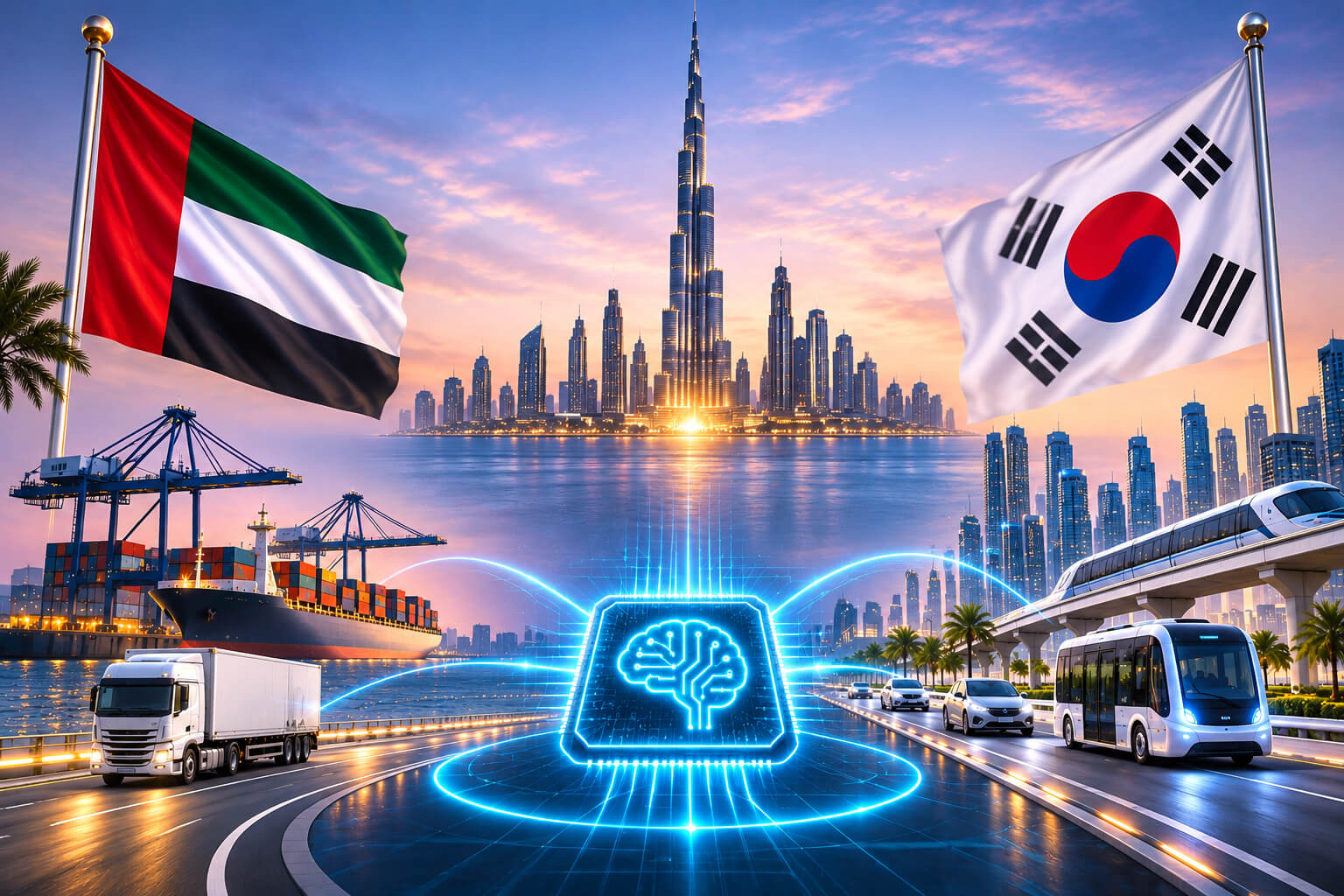
Dubai is exploring closer cooperation with South Korea in artificial intelligence, with logistics and mobility emerging as promising areas for future collaboration. The idea is to bring together technological expertise, research capabilities and experience in international trade to develop smarter transportation systems.
Khalifa Al Qama, Chief of Research at the Dubai Future Foundation, discussed the potential partnership during a press briefing on November 19, 2026. He pointed to the strong trade connections between Dubai and South Korea, suggesting that AI could help both economies improve how goods and people move across international markets.
The proposal comes at a time when governments and businesses are looking beyond AI chatbots and digital assistants. Industries such as logistics, aviation and maritime transportation are increasingly exploring how intelligent systems can improve efficiency, reduce operational challenges and support long-term growth.
Dubai and South Korea See Opportunities in AI-Powered Logistics
Dubai’s position as a global trading hub makes logistics a natural area for AI development. The emirate operates major airports, seaports and transportation networks that connect businesses across Asia, Europe and other international markets.
South Korea brings its own strengths, particularly in advanced manufacturing, automation and digital technology. Combining these capabilities could create opportunities to develop AI solutions that improve supply chain operations and transportation infrastructure.
Al Qama highlighted the importance of trade to both economies, particularly their role in moving goods between eastern and western markets.
AI could help logistics companies analyze shipment data, anticipate disruptions and improve cargo scheduling. Intelligent systems may also support more efficient warehouse operations and transportation planning.
These are potential applications rather than projects already announced under a new Dubai–South Korea agreement. Still, they illustrate why logistics has become an attractive area for technological cooperation.
Smart Airports and Seaports Could Benefit From AI Innovation
Dubai’s experience managing international airports and seaports could provide a practical foundation for cooperation with South Korean technology companies and researchers.
Modern transportation hubs handle enormous amounts of information every day. Cargo movements, flight schedules, shipping operations and infrastructure maintenance all require careful coordination.
Artificial intelligence could help operators process this information more effectively. Predictive analytics, for example, can identify potential equipment problems before they cause major disruptions. Automated scheduling systems can also help optimize the movement of cargo and transportation resources.
South Korea’s experience in industrial technology could complement Dubai’s operational knowledge, potentially creating opportunities to test AI applications in real-world logistics environments.
The UAE and South Korea have already explored cooperation involving physical AI and smart-port technologies, including discussions surrounding Khalifa Port in Abu Dhabi. That broader relationship provides useful context for Dubai’s interest in expanding collaboration.
Researchers and Innovators Could Lead Early AI Projects
Rather than immediately pursuing large-scale commercial agreements, Al Qama suggested that Dubai and South Korea begin with smaller collaborative projects involving scientists, researchers and technology innovators.
The approach would allow teams from both locations to exchange ideas, develop relationships and identify areas where AI could provide practical benefits.
Academic cooperation could play an important role. Al Qama noted that university students from Dubai and South Korea already participate in exchange programs, creating opportunities for collaboration across different research environments.
Small research initiatives could eventually develop into more ambitious projects involving universities, technology startups and established businesses.
Such cooperation would also give researchers an opportunity to understand the transportation challenges faced by both economies before developing solutions intended for wider commercial use.
No specific pilot project, funding commitment or implementation schedule was announced during the briefing.
Dubai Future Week Brings AI and Emerging Technologies Into Focus
The comments were made during Dubai Future Week, a four-day event organized by the Dubai Future Foundation that began on November 18, 2026.
Held under the theme “For the Human of the Future,” the gathering attracted approximately 10,000 participants, including government representatives, business leaders and technology specialists.
The event focused on how emerging technologies could influence industries, societies and economic development in the coming years.
AI was particularly relevant to discussions about the future of transportation and industrial innovation. For cities such as Dubai, the challenge is not simply introducing new technology but identifying where it can improve existing systems.
Logistics offers a compelling opportunity because improvements in cargo handling, transportation coordination and infrastructure management can affect businesses far beyond the technology sector.
The discussions also highlighted the importance of international cooperation as countries explore how AI can address shared economic and operational challenges.
Dubai Strengthens Economic and Technology Ties With South Korea
The proposed AI collaboration comes as Dubai and South Korea expand their broader economic relationship.
On November 18, 2026, Dubai International Chamber announced the opening of a representative office in Seoul to strengthen trade and investment connections between the two markets.
According to the Emirates News Agency, Dubai’s non-oil trade with South Korea exceeded AED 19.5 billion in 2025, representing a 2.3% increase from the previous year.
The number of active South Korean companies registered with Dubai Chamber of Commerce also grew from 130 at the end of 2020 to 330 at the end of 2025.
Technology cooperation has been developing alongside these commercial ties.
In September 2025, Dubai Multi Commodities Centre signed a strategic partnership with South Korea’s National IT Industry Promotion Agency to support cooperation in artificial intelligence, information technology and startup development.
These initiatives demonstrate that the relationship already extends beyond traditional trade, creating potential opportunities for deeper collaboration in AI research and industrial applications.
AI Could Reshape the Future of International Mobility
Artificial intelligence is becoming increasingly relevant to how cities manage transportation networks, infrastructure and the movement of goods.
For Dubai, collaborating with South Korean researchers could provide access to additional technical expertise while supporting the development of intelligent logistics systems.
South Korean technology companies, meanwhile, could benefit from opportunities to explore applications within Dubai’s international transportation ecosystem.
Potential areas of cooperation include predictive logistics, intelligent traffic management, automated cargo processing and data-driven infrastructure planning.
The commercial possibilities are significant, but turning research ideas into operational systems requires investment, technical testing and coordination between public and private organizations.
Dubai’s interest in working with South Korea reflects a broader shift toward applying AI in industries where measurable operational improvements matter.
What Comes Next for the Dubai–South Korea AI Partnership?
The next stage will depend on whether the discussions lead to formal research initiatives, pilot programs or commercial partnerships.
For now, Dubai has expressed a willingness to engage with South Korean researchers and innovators, particularly in logistics and mobility.
Starting with smaller projects could help both sides identify promising applications before committing to larger technology deployments.
The wider economic relationship provides a useful starting point, especially as Dubai continues strengthening its connections with South Korean businesses and technology organizations.
What makes the proposal interesting is its practical direction. Rather than treating artificial intelligence as a standalone industry, Dubai is exploring how it could improve the transportation and trade systems that already support its economy.
Whether that ambition develops into specific projects remains to be seen. But logistics and mobility are clearly emerging as potential areas for the next phase of Dubai–South Korea technology cooperation.
Sources
- Korea JoongAng Daily – Dubai Seeks Korea Partnership on Logistics AI – November 20, 2026.
- Yonhap News Agency – Dubai Eyes Closer Ties With South Korea on AI in Logistics and Mobility – November 20, 2026.
- Emirates News Agency (WAM) – Dubai International Chamber Opens New Representative Office in Seoul – November 18, 2026.
- Seoul Economic Daily – South Korea and UAE Join Forces on AI and Future Technologies – February 8, 2026.
- Dubai Multi Commodities Centre (DMCC) – Strategic Partnership With South Korea’s National IT Industry Promotion Agency – September 11, 2025.
