


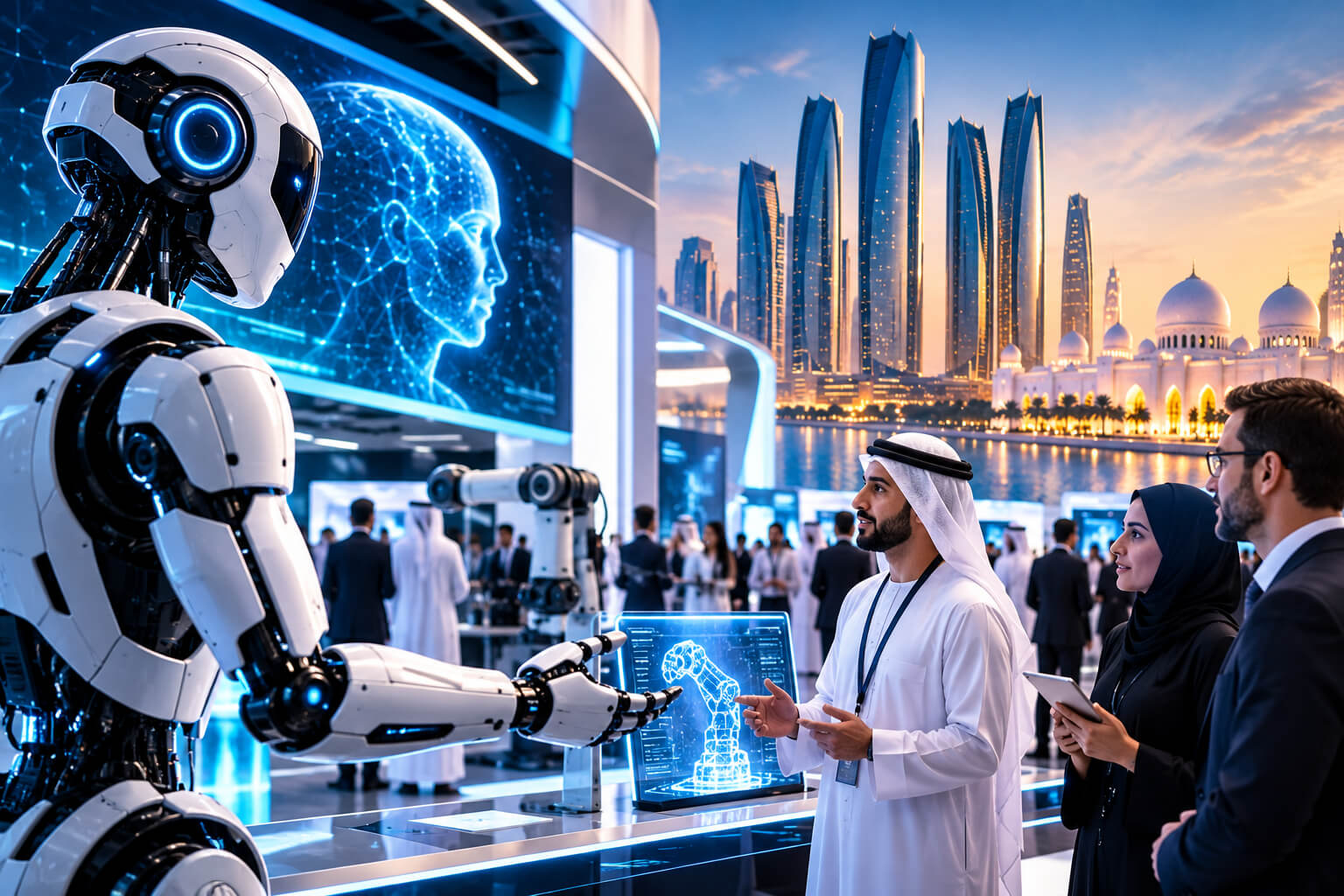
Artificial intelligence is moving beyond software and into the physical world, workplaces and classrooms.
That shift was a major theme at Ai Everything Abu Dhabi 2026, where global technology leaders, policymakers, researchers and businesses discussed the next phase of AI development. Robotics, humanoid machines, workforce training and education all featured heavily as the event looked at what it will take to build an AI economy beyond the current generation of generative AI tools.
The event brought together more than 400 enterprises and startups, 180 speakers and thousands of technology, government and business executives from more than 105 countries, according to the Emirates News Agency (WAM).
Humanoid Robots Are Bringing AI Into the Physical World
The growing interest in humanoid robotics reflects a broader change in the AI industry. Instead of limiting artificial intelligence to chatbots, software platforms and data systems, researchers and companies are working on machines that can perceive their surroundings, learn physical tasks and operate alongside people.
At Ai Everything Abu Dhabi, Marc Raibert, Executive Director of the RAI Institute and founder of Boston Dynamics, discussed the development of a new generation of robots and their potential applications across industry and everyday environments. His comments came as the robotics sector pushes to combine advances in machine learning with increasingly capable physical machines.
Research cited at the event by the Bank of America Institute estimates that annual humanoid robot shipments could rise from around 90,000 units in 2026 to 10 million by 2035.
Raibert also highlighted advances in reinforcement learning and the potential use of large language models to help robots understand instructions and interact more naturally with humans.
That combination is important. A robot that can move effectively is one challenge. A robot that can understand what a person wants, interpret its surroundings and respond appropriately is a much larger one.
Abu Dhabi Is Training the Workforce for an AI-Native Government
AI adoption inside government depends on more than technology. Public institutions also need employees who understand how to use AI responsibly and how to apply it to the work they already perform.
That is becoming a major part of Abu Dhabi’s strategy. Mariam Al Musharrekh, Director General of Government Talent at the Department of Government Enablement, said Abu Dhabi aims to become the world’s first AI-native government by 2027.
The government’s AI training programme has reached 30,000 employees, with a reported completion rate of 95%. Rather than providing identical training to every employee, the programme uses different learning paths based on employees’ roles and responsibilities.
The idea is to move workers away from repetitive administrative tasks and give them more capacity for activities requiring judgement, problem-solving and strategic thinking.
That also changes what governments need from their workforce. Knowing how to operate an AI tool is useful, but understanding its limitations and knowing when human judgement should take over could prove more valuable.
Universities Are Rethinking the Role of Education
AI is also forcing universities to reconsider how they prepare students for work. Students now have access to systems capable of generating explanations, analysing information, writing content and assisting with increasingly complex tasks.
That does not necessarily make traditional education less important. It changes what educators need to emphasise.
Prof. Ebrahim Al Hajri, President of Khalifa University, said the role of instructors will increasingly move from being the sole source of knowledge to becoming an orchestrator of learning.
Khalifa University is placing greater emphasis on graduates who can solve problems, work independently and build businesses. The university also identifies qualities such as ethics, leadership, curiosity, communication, empathy and adaptability as important capabilities for an AI-driven economy.
The change reflects a simple reality: when AI can produce information quickly, students need to become better at questioning that information, applying it and deciding whether it makes sense.
Alef Education Is Putting AI Into Everyday Learning
The education sector is already moving from discussion about AI to practical classroom applications. At Ai Everything Abu Dhabi, Alef Education showcased technologies designed to personalise learning and give teachers more insight into student performance.
The company has developed tools for automated marking and feedback, personalised learning pathways and AI literacy programmes. Its Alef Pathways programme has supported more than 100,000 students, according to Alef Education.
The system uses student performance data to adjust learning content while giving teachers information about progress and areas where students may need additional support.
Alef is also developing an AI curriculum in both English and Arabic. The focus extends beyond teaching students how to use AI tools. It includes helping them understand how AI systems work, assess their outputs and recognise where those systems can produce unreliable results.
That distinction could become increasingly important as AI becomes part of normal school and university life.
Abu Dhabi Wants AI Research to Reach the Market
Research alone does not create an AI economy. Technologies developed inside universities and research institutions need pathways into companies, government programmes and commercial products.
That was another part of the discussion at Ai Everything Abu Dhabi, where Khalifa University Enterprises Company (KUEC) presented AI ventures targeting areas including healthcare, government, industry, sustainability and enterprise.
The initiative reflects a wider effort to connect academic research with commercial opportunities. Researchers can develop new models, technologies and applications, but startups and businesses are often needed to turn those ideas into products that can operate outside the laboratory.
KUEC’s presence at the event put that commercialisation process directly in front of companies, investors and government stakeholders.
For Abu Dhabi, the connection matters because the emirate is not simply trying to attract AI companies. It is also building institutions and programmes that can help generate AI companies locally.
The AI Race Is Becoming a Talent Race
The robotics discussion at Ai Everything Abu Dhabi ultimately pointed to a larger issue: advanced AI requires people who know how to build it, deploy it and manage its consequences.
Humanoid robots require engineers, researchers and AI specialists. AI-native governments require employees who can integrate artificial intelligence into public services. Universities need educators who understand how AI changes learning. Businesses need workers who can use these technologies without blindly relying on them.
That makes talent development just as important as infrastructure.
Abu Dhabi is building its AI strategy across several layers at once, from government training and university research to education technology and robotics. The approach suggests that the next phase of AI competition will not be decided solely by who develops the biggest model.
It will also depend on who has the people capable of turning those systems into useful, reliable applications.
Ai Everything Abu Dhabi 2026 offered a glimpse of that broader shift. AI is moving into factories, classrooms, government offices and eventually more parts of everyday physical life. The technology may be advancing quickly, but the people building and using it will determine how far that progress actually goes.
Sources
- Emirates News Agency (WAM) — Global leaders map next wave of robotics, AI talent
Read the original WAM report - Emirates News Agency (WAM)
WAM Official Website
