


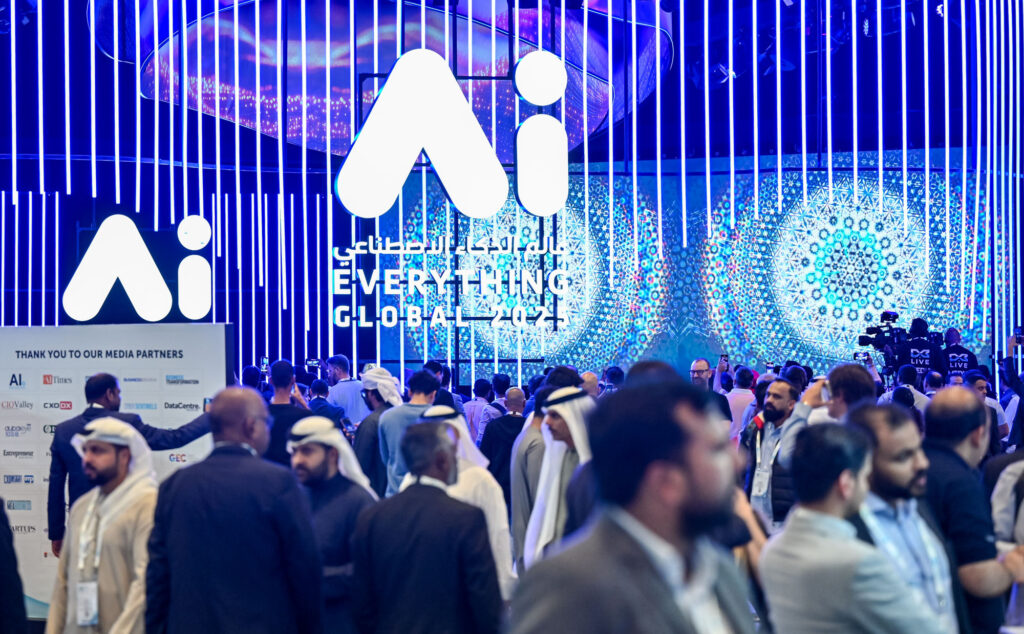
Artificial intelligence is getting a tougher test in Abu Dhabi. Not another chatbot demo. Not another model benchmark.
At AI Everything Abu Dhabi 2026, the focus is shifting toward what happens when AI becomes part of government operations, scientific research and the infrastructure that keeps industries running.
Microsoft, VDURA and IFS are among the companies bringing real-world deployments to the event, which takes place October 6–7 at ADNEC Centre Abu Dhabi. The examples range from AI tools reaching 35,000 government employees to industrial AI systems designed to cut costs and reduce repetitive work.
The event brings together hundreds of AI companies, policymakers, investors and technology leaders. The bigger question hanging over the show is simple: can AI move from impressive demonstrations to dependable infrastructure?
Microsoft Takes AI Deeper Into Abu Dhabi Government
Abu Dhabi is already pushing artificial intelligence into the daily machinery of government. Through its partnership with Microsoft, Microsoft 365 Copilot is being rolled out across government workplaces, putting generative AI directly into everyday tasks rather than keeping it restricted to specialist technology teams.
The rollout is part of a much broader effort to turn Abu Dhabi into an AI-native government. Government entities are increasingly experimenting with AI-powered workflows, automation and intelligent services that can help employees handle information faster and simplify administrative processes.
That shift matters because the next phase of government AI will not be judged by how impressive a chatbot sounds. It will be judged by whether employees can actually use these systems to make public services faster, more accurate and easier to manage.
AI Agents Start Moving From Advice to Action
The move toward agentic AI is another major theme at AI Everything Abu Dhabi 2026. Instead of simply answering questions or generating content, AI agents are being designed to carry out tasks, trigger workflows and interact with business systems with less human input.
Microsoft is expected to showcase its wider Copilot and Azure AI ecosystem alongside security and enterprise technologies. The direction is clear. Companies are no longer satisfied with AI tools that sit on the edge of operations. They want systems that can work inside existing business processes.
That creates a new set of challenges. Once an AI system can make decisions or initiate actions, questions around reliability, governance, permissions and human oversight become much harder to ignore. In government, those concerns become even more important because AI may eventually touch services used by millions of people.
VDURA Targets the Infrastructure Behind AI
The rapid growth of AI is also creating pressure far below the application layer. Models need huge amounts of data, and that data has to move quickly enough to keep expensive computing infrastructure working efficiently.
VDURA is using AI Everything Abu Dhabi to highlight its Data Platform V12, which is designed for environments such as AI factories, GPU clouds and large research systems. The platform focuses on managing massive datasets across different storage tiers without forcing organisations to keep everything on high-cost flash storage.
That infrastructure layer is becoming more important as companies scale training, inference and retrieval workloads. Powerful processors do not deliver much value if they spend too much time waiting for data.
AI infrastructure is therefore becoming a broader engineering problem. Compute remains important, but storage, networking and data management are becoming just as critical.
Scientific Research Pushes AI Infrastructure Further
Scientific research is one area where these infrastructure demands become particularly obvious. Universities and research institutions increasingly rely on AI models, simulation software and high-performance computing systems that generate enormous volumes of data.
New Mexico State University has deployed VDURA technology to support researchers working across areas including agriculture, aerospace and biomedicine. The system combines high-speed storage with larger-capacity infrastructure, allowing different research workloads to use the type of storage that makes the most sense for each task.
For researchers, this can make a practical difference. Training models and running simulations often require large datasets to be available quickly, while older or less frequently used information can remain on cheaper storage.
This kind of deployment shows how AI growth is changing the technology stack inside research institutions. Universities are not simply buying more computing power. They are redesigning the systems around that compute so scientists can use it effectively.
IFS Brings AI Into Industrial Operations
Industrial AI is another major part of the Abu Dhabi conversation. IFS is focusing on sectors where artificial intelligence has to work alongside physical assets, field workers and complex operational systems.
The company develops AI technology for industries such as energy, utilities, aviation, defence and manufacturing. Its systems are designed to help organisations identify problems, automate routine processes and support workers dealing with equipment in the field.
This is where enterprise AI becomes less abstract. Predicting that a machine could fail is useful, but companies still need someone to diagnose the issue, identify the correct part, schedule the repair and complete the work.
IFS is trying to connect those steps so AI becomes part of the operational process rather than just another analytics layer.
Kodiak Shows Where AI ROI Can Come From
Kodiak Gas Services offers a practical example of that approach. The company has used an IFS AI agent to help field technicians locate and order parts more quickly through conversational interactions.
The value comes from removing small delays that happen repeatedly across a large workforce. A technician who spends less time searching for parts can spend more time maintaining equipment and completing field work.
IFS says the deployment can produce millions of dollars in annual returns while also returning tens of thousands of work hours to Kodiak employees.
That is an important reminder about enterprise AI. The biggest savings do not always come from replacing entire jobs. Sometimes they come from eliminating thousands of repetitive tasks that quietly consume time every day.
Energy Companies Explore Agentic AI
Energy is also becoming a major testing ground for agentic AI. Abu Dhabi companies including ADNOC and AIQ are exploring systems that can support complex energy operations with increasingly advanced automation and decision-support capabilities.
AIQ’s ENERGYai platform is one example of this shift. The system is being developed for the energy sector, where artificial intelligence can help professionals work with technical data, operational information and large volumes of industry knowledge.
Energy is a difficult environment for autonomous systems because decisions can affect expensive infrastructure and critical operations. That means companies cannot simply deploy AI agents and allow them to act without controls.
The challenge is finding the right balance between automation and human supervision. In industries such as oil, gas, utilities and power generation, reliability will matter more than novelty.
Abu Dhabi Turns AI Ambition Into an Operational Test
AI Everything Abu Dhabi 2026 arrives at a moment when the emirate is trying to turn broad AI ambition into real operational capability.
Government deployments, sovereign infrastructure, scientific research and industrial automation are increasingly being connected under a wider strategy. Abu Dhabi is not simply positioning itself as a buyer of AI software. It is trying to build an ecosystem where AI becomes part of how institutions operate.
That makes the event more than another technology showcase. The real test is whether these systems can deliver measurable improvements in public services, research productivity and industrial performance.
AI has spent years proving what it can generate.
Abu Dhabi is increasingly asking what it can actually run.
Sources
IoT Now: New intelligence powers government, scientific discovery and critical infrastructure at AI Everything Abu Dhabi
https://iot-now.com/2026/10/05/158707-ai-everything-abu-dhabi-government-scientific-discovery-critical-infrastructure/
AI Everything Abu Dhabi: Official event website
https://www.aieverythingabudhabi.com/
Abu Dhabi Government: AI strategy and government transformation
https://www.aiabudhabi.gov.ae/
