


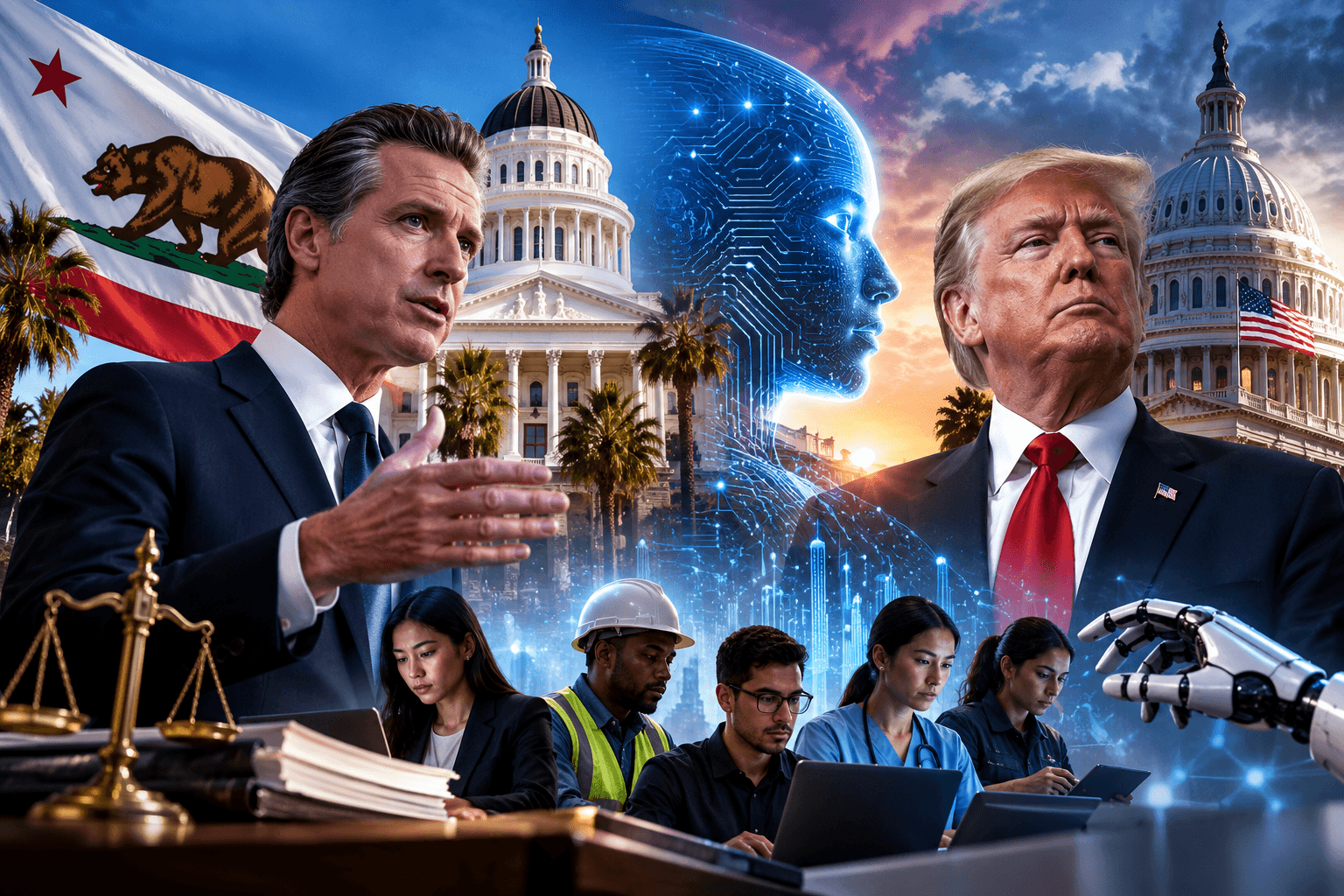
California is expanding its rules around artificial intelligence in the workplace, with Gov. Gavin Newsom signing legislation aimed at limiting how employers can use automated systems to make decisions about workers.
The new measures address several areas of workplace AI, including automated termination and disciplinary decisions, employee surveillance and biometric technology designed to assess emotional states. The laws form part of California’s broader effort to establish state-level rules for artificial intelligence as adoption spreads across businesses.
The timing also puts California’s approach alongside a very different direction coming from the federal government, where President Donald Trump has emphasized accelerating AI development and technological leadership.
California Tightens Rules Around AI-Powered Employment Decisions
One of the most important parts of California’s new AI rules concerns automated decisions that can directly affect a worker’s employment. Companies increasingly use software and AI systems to analyze employee performance, manage staffing and support human resources decisions. California’s legislation places limits on allowing those systems to make certain decisions without meaningful human involvement.
The new rules require human review in circumstances involving disciplinary actions and termination. Employers must also provide written notice when artificial intelligence is used in connection with certain mass layoffs, relocations or terminations. The approach reflects a basic distinction between using AI as a workplace tool and allowing an automated system to make consequential decisions about a person’s job.
For companies operating in California, that distinction could become an important part of AI governance. Human resources departments may need to document where automated systems are being used and establish procedures for human review when employment decisions are made.
California Targets Workplace Surveillance and Biometric AI
The legislation also addresses how employers monitor workers. California is restricting certain uses of surveillance technology in workplace bathrooms while placing additional boundaries around AI systems that analyze biometric information.
One particularly notable provision concerns technology designed to predict or assess a worker’s emotional state using biometric information. These systems can attempt to interpret signals such as facial expressions or other behavioral characteristics, turning those measurements into an automated assessment of how someone may be feeling.
California’s restrictions put those technologies under greater scrutiny when they are deployed in employment settings. The issue is not simply whether a system can process biometric information, but whether an employer should use an automated interpretation of that information when evaluating workers.
Newsom Keeps “Artificial Intelligence” Terminology for California
California is also taking a different position from the Trump administration over how AI is described in official government communications.
Newsom issued an executive order directing California state agencies to continue using the terms “artificial intelligence” and “AI.” The move came shortly after Trump issued a federal executive order directing executive-branch agencies to use “Super Intelligence” and “SI” instead of “Artificial Intelligence” and “AI” in official communications and other non-statutory documents.
The terminology does not change the underlying technology, but the disagreement illustrates the different approaches being taken by California and the federal government as policymakers respond to rapid advances in AI.
The White House order focuses on advancing what the administration describes as superintelligence and strengthening U.S. technological leadership. California’s approach has placed greater emphasis on establishing rules for how AI affects workers, consumers and communities.
California Continues Building Its AI Regulatory Framework
The new worker protections are part of a much larger collection of AI-related measures being developed in California.
Newsom has previously signed legislation covering other areas of AI safety and responsible deployment. California has also adopted measures addressing AI-generated impersonation, deepfakes and other uses of synthetic media.
The growing collection of laws means AI regulation is increasingly becoming a practical business issue. Companies are not only dealing with questions about how models are trained or how powerful they are. They also have to consider how AI is deployed inside ordinary business operations.
That includes recruitment systems, customer service tools, employee monitoring platforms, automated decision systems and software used to evaluate people.
Newsom and Trump Take Different Paths on AI Policy
The California legislation arrives amid an ongoing policy disagreement between Newsom and Trump over the federal government’s approach to artificial intelligence.
Newsom has called for stronger AI safeguards and criticized the Trump administration’s approach to federal regulation. Trump, meanwhile, has emphasized technological development and has pointed to voluntary commitments from technology companies as part of his administration’s approach.
The federal government’s September executive order places a strong focus on maintaining U.S. leadership in advanced AI and accelerating the development of systems described as “Super Intelligence.” California’s legislation takes a more targeted approach, focusing on specific consequences of AI deployment within the state.
The two approaches can exist at the same time. A company operating nationally may have to follow federal requirements while also complying with additional state rules in California.
California Also Moves to Support Local Journalism
AI was only one part of Newsom’s September 30 legislative agenda. The governor also signed legislation establishing a refundable tax credit intended to support qualifying local news organizations.
The program is designed to help eligible news organizations hire and retain journalists in California. It applies to qualifying digital, print and broadcast organizations and covers taxable years beginning January 1, 2027, through the end of 2031.
The measure arrives as news organizations face major changes in the digital media business. Generative AI has introduced new tools for research, production and publishing while also raising questions about copyright, attribution, misinformation and the value of original reporting.
The California journalism measure does not directly regulate generative AI. Instead, it provides financial support for organizations that continue employing journalists and producing local reporting.
AI Regulation Is Moving Closer to Everyday Business
California’s latest legislation illustrates how the AI policy debate is moving beyond frontier models and research labs.
The next phase is increasingly about what happens when AI enters ordinary workplaces. An automated hiring system can influence who gets an interview. An employee-monitoring platform can track workplace behavior. A biometric system can attempt to interpret a person’s emotional state. An automated decision tool can influence whether someone keeps a job.
Those are very different questions from how large a language model should be or how much computing power an AI company needs. They are also issues that businesses and workers can encounter directly.
California’s new rules establish additional requirements around some of those uses. For companies deploying AI in the state, understanding where automation ends and human responsibility begins is becoming an increasingly important part of compliance.
Sources
Associated Press — California Gov. Gavin Newsom signs laws to protect workers from AI risks
https://apnews.com/article/newsom-california-trump-ai-journalism-bills-1aa4935e3ee79519ae8b2458b2b9ebc1
Governor of California — California’s AI framework and worker protections
https://www.gov.ca.gov/2026/09/30/californias-nation-leading-ai-framework-just-got-stronger-governor-newsom-signs-more-first-in-the-nation-worker-protections-and-more/
Governor of California — Local journalism legislation
https://www.gov.ca.gov/2026/09/30/governor-newsom-signs-bill-strengthening-local-journalism-defending-a-free-press-as-cornerstone-of-democracy/
The White House — Inaugurating the Era of Super Intelligence
https://www.whitehouse.gov/presidential-actions/2026/09/inaugurating-the-era-of-super-intelligence/
