


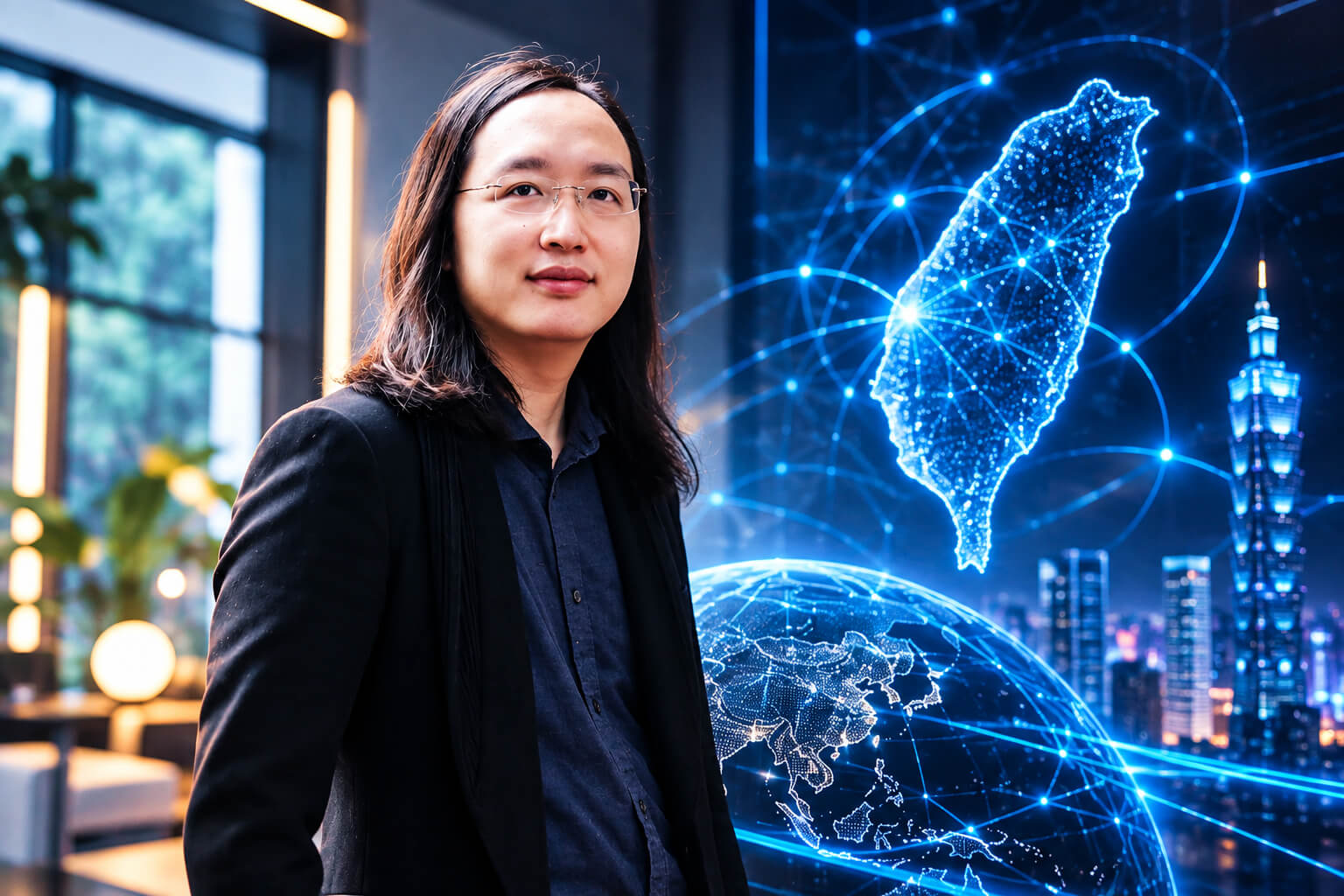
Audrey Tang has been nominated for the 2026 World AI Awards in the AI Leadership category, recognising a career that has put an unusual question at the centre of technology policy: what happens if artificial intelligence is used to strengthen collective decision-making rather than simply automate it?
Tang is a programmer, civic technologist and former Digital Minister of Taiwan, serving in the role from 2016 to 2024. Much of Tang’s work has focused on digital democracy, open government, public participation and, increasingly, ways of bringing citizens directly into conversations about how AI should behave.
That makes this a different kind of AI leadership story. There is no flagship foundation model or enterprise chatbot at its centre. Tang’s work instead asks how governments and communities can use technology to surface agreement, manage disagreement and keep human participation inside increasingly automated systems.
Putting citizens inside the AI conversation
While serving as Taiwan’s Digital Minister, Tang advocated a participatory approach to AI governance.
Taiwan’s Ministry of Digital Affairs worked with organisations including GovLab, the GETTING-Plurality Research Network, OpenAI and Anthropic on AI alignment assemblies. These experiments used collective-intelligence methods to involve people in discussions around AI policy, information integrity and the values that should shape model behaviour.
The underlying idea was straightforward but unusual: AI alignment should not be decided exclusively inside technology companies or government departments.
Tang also described an approach designed to account for Taiwan’s linguistic diversity. Rather than assuming one universal set of preferences, the work explored how communities speaking Taiwan’s different national languages could participate in determining the inputs and expectations surrounding AI systems.
It turns AI governance into a participation problem as much as a technical one.
Plurality offers an alternative AI philosophy
Tang’s thinking has since developed around Plurality, a collaborative technology framework created with economist and technologist E. Glen Weyl and a wider community of contributors.
The concept pushes against a familiar assumption in AI: that better technology necessarily means replacing more human judgement.
Plurality instead explores digital systems that augment the collective intelligence of communities. Drawing partly on Taiwan’s experiments with digital democracy, it combines ideas from network science, mechanism design and civic technology to explore how people with different interests can identify areas of agreement without erasing those differences.
The project itself follows that philosophy. Its book, Plurality: The Future of Collaborative Technology and Democracy, was developed openly with contributions from hundreds of participants and released into the public domain.
AI leadership without treating AI as the decision-maker
Tang’s earlier government work provides the practical backdrop.
Before becoming Taiwan’s first Digital Minister, Tang worked with civic technology communities and later advised government on open data and participatory policymaking. As minister, Tang’s portfolio included open government and digital participation before the establishment of Taiwan’s Ministry of Digital Affairs.
Tang later described the ministry’s approach around three principles: participation, progress and safety. For generative AI, that included public-sector guidelines, attention to local processing for sensitive information and work on evaluation methods intended to reflect different languages and communities.
It is a model of AI leadership built less around predicting what artificial intelligence will eventually become and more around deciding who gets a voice while it develops.
Graham Cooke, President of the World AI Awards, said:
“Audrey Tang’s nomination highlights an important dimension of AI leadership: ensuring that advances in technology are accompanied by serious thinking about participation, trust and collective decision-making.
“From digital democracy and participatory AI alignment to the broader idea of Plurality, Audrey’s work explores how artificial intelligence can augment human collaboration rather than simply replace human judgement. We congratulate Audrey Tang on the 2026 World AI Awards nomination and look forward to following the continued development of these ideas.”
The World AI Awards recognises organisations, individuals and technologies contributing to the development and application of artificial intelligence across industries.
Tang’s nomination in the AI Leadership category reflects one of the harder questions emerging around AI. Building more capable systems is one challenge. Working out how societies participate in decisions about those systems is another.
For Tang, the answer has consistently returned to the same place: technology should create more room for people to participate, not quietly make participation unnecessary.
Learn more about Audrey Tang and Taiwan’s international digital engagement through the Ministry of Foreign Affairs, Republic of China (Taiwan), and explore the Plurality project at plurality.net.
Discover the World AI Awards 2026, explore the nominees and learn more about the awards at worldawards.ai.
