


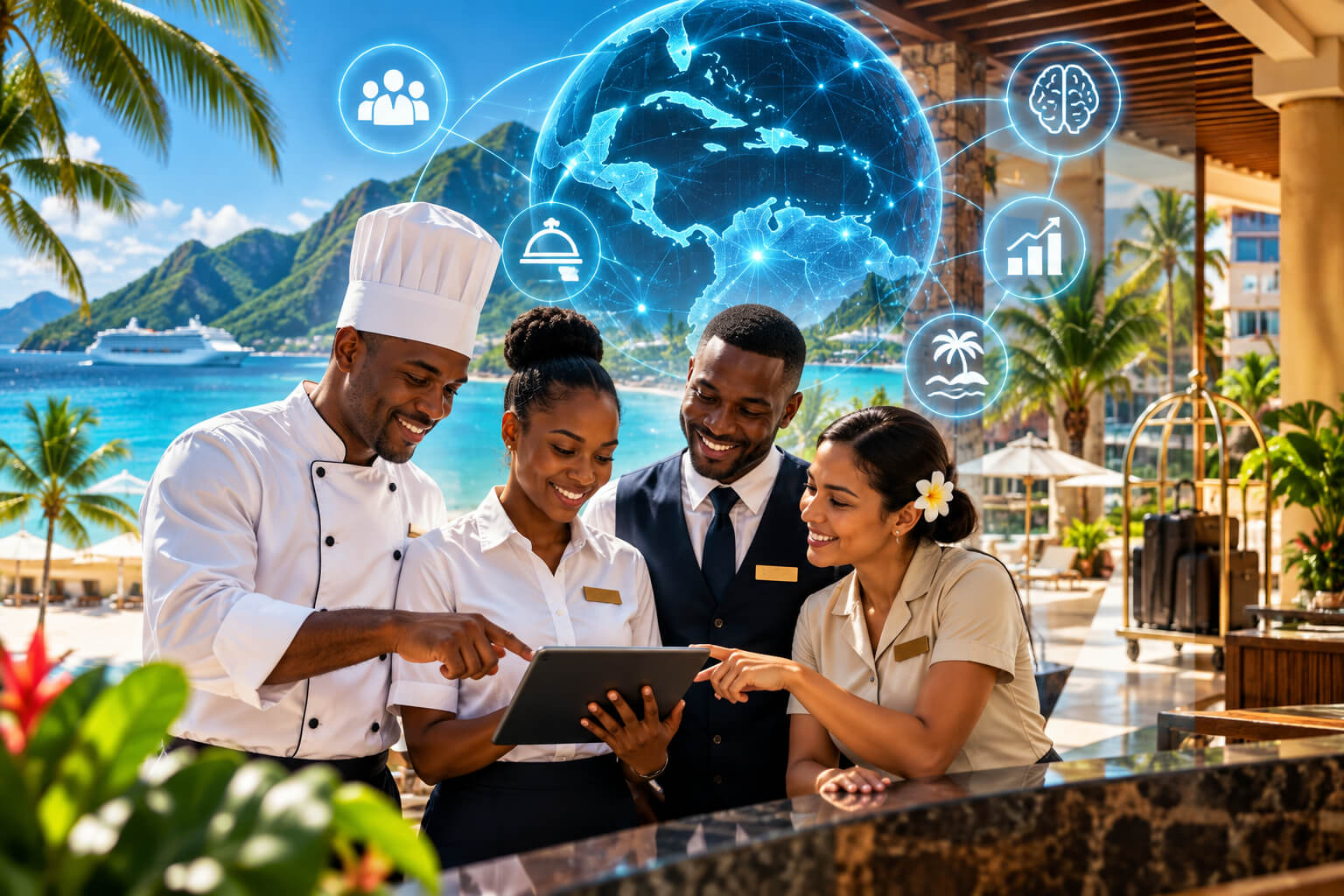
Artificial intelligence is moving deeper into hotels and tourism businesses, but the Caribbean Hotel and Tourism Association (CHTA) does not want the conversation to revolve around software alone. Its latest push is about the people expected to work alongside it.
CHTA has released the AI Workforce Transformation Guide for Caribbean Hospitality: Practical Strategies for People Management, Learning and Leadership, the third edition in its AI Guidebook Series. The new resource focuses on preparing hospitality employees, managers and business leaders for an industry where AI increasingly becomes part of everyday work.
Rather than treating AI adoption as another technology upgrade, the guide looks at what happens to jobs, skills, leadership and workplace policies once businesses actually start using these systems.
CHTA Shifts the AI Conversation Toward Workers
Hotels can introduce AI tools quickly. Preparing the people who use them is harder. That gap sits at the center of CHTA’s latest guide, which encourages Caribbean tourism businesses to think about employee development alongside productivity gains as AI spreads across daily operations. The guide offers practical ways to prepare teams, strengthen management practices and introduce AI responsibly. It also explores how existing roles may change as more routine work becomes automated or supported by intelligent systems.
That matters in hospitality, where efficiency is important but the customer experience still depends heavily on human interaction. CHTA President Sanovnik Destang has emphasized that the real value of AI will depend on how businesses use it to support employees while improving operations. The association also wants companies to preserve the personal connection that remains one of the strongest characteristics of Caribbean hospitality.
AI Is Changing Hospitality Jobs, Not Just Hotel Technology
The first part of the guide focuses on understanding AI in workforce transformation. It examines how artificial intelligence could reshape hospitality roles, workforce management and the skills employees need as technology becomes more embedded in hotel operations. Instead of asking only where AI can be deployed, CHTA is also pushing businesses to consider how people will work differently once those systems are introduced.
As AI takes over parts of administrative and repetitive work, employees may spend less time handling routine processes and more time dealing directly with guests, solving problems and making decisions that require human judgment. Workers will also need a better understanding of how AI systems operate, where their limitations are and when human intervention is necessary. Managers face the same challenge from a leadership perspective, particularly around governance, accountability and the responsible use of automated systems.
CHTA Wants Hotels to Move From AI Strategy to Actual Deployment
The second section of the guide shifts from strategy to implementation. CHTA provides hospitality leaders with practical resources that can help them move from discussing AI to actually introducing it within their organizations. These include tools for evaluating vendors, testing pilot projects, measuring return on investment and setting internal rules for responsible AI use.
The guide also includes resources such as an ethical AI charter, bias audit protocols, implementation road maps, pilot planning tools and sample policies. These materials are designed to help businesses avoid rushing into AI adoption simply because a new tool looks impressive. For hotels and tourism companies, a structured deployment process can make it easier to determine whether an AI system genuinely improves operations before it is expanded across the organization.
Responsible AI Becomes a Management Issue
CHTA’s inclusion of governance and bias-related tools shows that responsible AI is no longer just a technical concern. Hospitality companies are increasingly using systems that influence customer interactions, employee workflows and business decisions, which means leadership teams need to understand the risks as well as the potential benefits.
Questions around data access, human oversight and automation will become more important as AI systems gain greater autonomy. Businesses also need to decide which decisions can safely be delegated to software and which ones should remain under human control. At the same time, the number of AI vendors targeting the hospitality industry continues to grow, making structured evaluation increasingly important for hotels that do not want to invest in technology without clear operational value.
Caribbean Hospitality Is Building a Longer-Term AI Strategy
The workforce guide is not CHTA’s first move into artificial intelligence. It follows earlier editions of the association’s AI Guidebook Series, which looked more broadly at responsible AI adoption across Caribbean hospitality and tourism. Previous editions covered areas such as guest personalization, operational efficiency, privacy, staff training and organizational change.
The latest guide narrows that focus by concentrating more heavily on employees and leadership. Rather than simply asking what artificial intelligence can do, CHTA is asking what businesses need to do with their workforce once those capabilities become part of daily operations. That distinction matters because introducing software can be relatively fast, while changing how employees work, learn and make decisions often takes much longer.
Hospitality’s Human Advantage Still Matters
There is an obvious tension in hospitality AI adoption. Hotels want faster operations, stronger personalization and lower administrative workloads, but they also operate in an industry where removing too much human interaction can quickly become noticeable to guests.
CHTA’s approach suggests that AI does not need to replace the human side of hospitality. Automation could instead handle repetitive work behind the scenes, giving employees more time to focus on guest interactions that require empathy, judgment and personal attention. The real challenge will be making sure that this idea survives real-world deployment, particularly as companies face pressure to cut costs and increase productivity.
AI Skills Could Become Part of Everyday Hospitality Training
The next stage of hospitality AI adoption may look less like a technology project and more like workforce development. Front-desk teams could need training on AI-assisted customer service, while marketing departments may use generative tools as part of their daily workflows. Revenue managers may increasingly depend on predictive systems, while executives will need enough AI literacy to evaluate vendors, risks and investment decisions.
This does not mean every hotel employee needs to become an AI specialist. It does mean that basic AI literacy could gradually become another workplace skill, similar to learning hotel management systems, digital booking platforms or customer relationship management software. For Caribbean tourism businesses, building these skills locally may also determine how much long-term value the region captures from artificial intelligence.
CHTA’s AI Guide Takes a People-First Approach
There is no shortage of discussion about how AI could transform travel and hospitality. Much of that conversation focuses on automated booking, intelligent assistants, personalization tools and increasingly autonomous systems. CHTA is approaching the same transformation from a different direction by focusing on the workforce that still has to make the industry function.
Its new guide recognizes that productivity matters, but implementation cannot stop with technology. Training, leadership, governance and employee confidence will shape whether AI becomes genuinely useful or simply adds another layer of complexity to hospitality businesses. Caribbean tourism has traditionally relied on service, culture and personal connection as part of its appeal, and those are difficult qualities to automate.
The bigger question is whether AI can give hospitality employees more time to deliver those experiences instead of replacing the interactions that make them valuable.
How to Access the CHTA AI Workforce Transformation Guide
CHTA has made information about the AI Workforce Transformation Guide for Caribbean Hospitality available through its official channels. The guide forms part of the association’s wider AI education effort for hospitality businesses across the Caribbean.
CHTA members can access the full resource through the association’s member platforms, where they can review the implementation materials, workforce tools and practical guidance designed to support responsible AI adoption across hotel and tourism operations.
Sources
Breaking Travel News — CHTA Puts Workforce at Center of AI Transformation With New Caribbean Hospitality Guide
https://www.breakingtravelnews.com/news/article/chta-puts-workforce-at-center-of-ai-transformation-with-new-caribbean-hospi/
Caribbean Hotel and Tourism Association — AI Guidebook Series
https://caribbeanhotelandtourism.com/chta-today/chta-publications-ai-guidebook/
Caribbean Hotel and Tourism Association — Press Releases
https://caribbeanhotelandtourism.com/chta-today/press-releases/
