


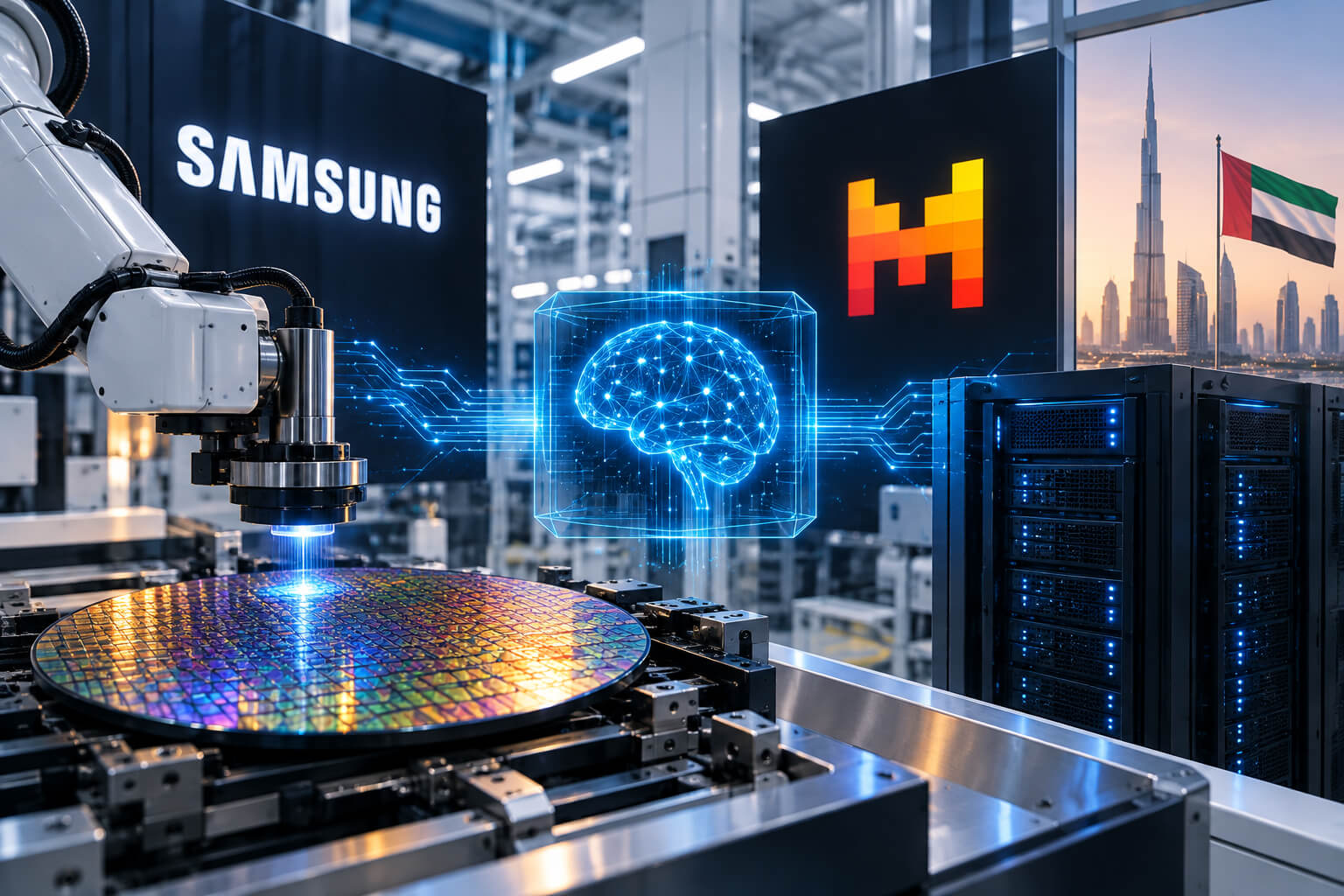
Samsung Electronics is pushing artificial intelligence deeper into semiconductor manufacturing. This comes through a new strategic partnership with French AI company Mistral AI.
The collaboration will focus on customized AI models designed for Samsung’s semiconductor operations. Rather than relying mainly on external cloud systems, Samsung plans to deploy AI inside its own infrastructure. This approach lets sensitive chip design and manufacturing data remain under tighter control.
The partnership includes Mistral AI’s software and flagship Mistral Large model. Samsung intends to adapt the technology for semiconductor engineering, manufacturing optimization, defect detection and other highly specialized workflows. These will span across its chip business.
The deal was announced alongside a South Korea-France state summit in Paris. Samsung also led Mistral AI’s latest funding round, giving the relationship a financial dimension in addition to the technical partnership.
Samsung Wants AI Built Around Semiconductor Work
Samsung is not looking for a general-purpose AI assistant that simply answers questions or summarizes documents. The company wants models trained and customized around the specific demands of semiconductor design and manufacturing.
Chip production generates massive amounts of highly technical information. This ranges from equipment data and process conditions to defect patterns and manufacturing results. By combining Samsung’s semiconductor expertise with Mistral AI’s model technology, the two companies aim to build AI systems. These systems can understand and work within those specialized environments.
This approach could become increasingly important as modern chips become more difficult to design and manufacture. Advanced memory and logic products require tighter process control. Even small improvements in manufacturing accuracy can influence yield, production efficiency and cost.
Young Hyun Jun, Vice Chairman and Head of Samsung Electronics’ Device Solutions division, said the growing complexity of AI semiconductor design and manufacturing requires continuous innovation. Samsung sees customized AI as another tool. This tool could help engineers manage that complexity.
On-Premises AI Keeps Sensitive Chip Data Inside Samsung
One of the most important parts of the agreement is Samsung’s plan to use customized on-premises AI models.
Instead of sending sensitive manufacturing or engineering information through external cloud platforms, Samsung can run the models inside infrastructure it controls. That gives the company greater oversight of where its data is stored. In addition, it gives more control of how it is processed and who can access it.
For a semiconductor manufacturer, that matters. Chip designs, process recipes, equipment settings and production data can represent some of the most valuable intellectual property inside the business. Keeping those datasets closer to internal systems may reduce exposure. At the same time, it allows teams to use advanced AI tools.
Mistral AI has increasingly positioned its technology around flexibility and private deployment. Samsung now provides a large industrial environment where that model can move beyond conventional enterprise use cases. As a result, it moves into highly specialized manufacturing operations.
AI Could Help Samsung Find Defects Earlier
Samsung also plans to use targeted AI models to improve manufacturing quality and process control.
One potential application is automated defect detection. Semiconductor fabs generate huge volumes of inspection and production data. Therefore, AI systems could help engineers identify unusual patterns faster than traditional manual analysis.
Samsung also expects AI to assist with equipment tuning and process optimization. A model that can recognize small changes in production conditions may help engineering teams respond sooner. This could reduce variability and stabilize manufacturing performance.
That could have a direct effect on semiconductor yield. Producing more usable chips from the same wafer can improve manufacturing economics without requiring additional production capacity. Even modest improvements can become significant when applied across high-volume fabs.
Mistral AI Moves Deeper Into Industrial AI
The partnership gives Mistral AI an opportunity to demonstrate its models inside one of the world’s most technically demanding manufacturing environments.
Arthur Mensch, co-founder and CEO of Mistral AI, has described artificial intelligence as an increasingly important part of building complex technologies that span both silicon and software. Under the partnership, Mistral brings its AI model expertise. Meanwhile, Samsung provides semiconductor knowledge, infrastructure and operational data.
This is considerably different from deploying an AI chatbot inside an office environment. Semiconductor manufacturing involves expensive equipment, microscopic tolerances and production decisions where errors can have real operational and financial consequences.
For Mistral AI, success in this environment could strengthen its position in industrial AI. The company will need to show that its models can deliver useful results. Also, the results must meet the reliability, security and control requirements expected inside a semiconductor fab.
Samsung Also Invests in Mistral AI
Samsung is also backing the partnership financially.
The company led Mistral AI’s latest funding round, creating a strategic relationship that goes beyond a standard software agreement. That investment suggests Samsung views Mistral as a potentially important technology partner rather than simply another AI vendor.
The deal also reflects a wider trend across the technology sector. AI developers need advanced chips and computing infrastructure to build more capable models. At the same time, semiconductor companies are increasingly using AI to improve how those chips are designed and manufactured.
Samsung operates on both sides of that relationship. It produces the hardware that powers AI systems while also adopting AI to improve its own semiconductor operations.
AI Is Becoming Part of the Chipmaking Process Itself
For much of the recent AI boom, semiconductor companies were mainly discussed as suppliers of the GPUs, memory and processors. These are needed to train and run artificial intelligence.
Now AI is moving back into the semiconductor manufacturing process itself.
Chipmakers can use specialized models to analyze production data, assist engineers, monitor equipment, detect defects and improve manufacturing efficiency. Instead of simply producing hardware for AI, semiconductor companies are beginning to use AI as part of the infrastructure. This is now found behind chip production.
Samsung’s partnership with Mistral AI fits directly into this shift. The company wants artificial intelligence to become part of how engineers understand manufacturing conditions. Additionally, it wants AI to help them respond to problems across increasingly complex production environments.
Samsung is also investing in other areas of next-generation semiconductor manufacturing, including its expanded collaboration with ASML around High NA EUV lithography. Together, these moves show how chipmakers are upgrading both the physical equipment inside their fabs and the intelligence surrounding those machines.
The semiconductor factory is no longer just becoming more automated. It is becoming more intelligent.
What the Samsung-Mistral Partnership Means for Semiconductor Manufacturing
The first benefits of the partnership may come from relatively focused applications such as defect detection, engineering analysis, manufacturing optimization and equipment monitoring.
The bigger opportunity lies in how those systems develop over time.
Once Samsung builds AI models around proprietary manufacturing information and semiconductor expertise, those tools could become part of the operational layer. This layer connects engineering, process control and production management. AI could help teams recognize manufacturing problems earlier, analyze complex process relationships and make better use of the enormous amount of data generated across fabs.
Samsung has the scale to test these systems across memory, logic and foundry operations. Mistral AI provides the model technology and deployment flexibility needed to customize them for highly sensitive industrial environments.
If the partnership produces measurable improvements in yield, manufacturing precision or development speed, specialized industrial AI could become another major competitive factor in the semiconductor industry.
The race is no longer only about building chips powerful enough to run AI.
It is also about using AI to build better chips.
Sources
Artificial Intelligence News — Samsung taps Mistral AI models for semiconductor manufacturing
https://www.artificialintelligence-news.com/news/samsung-mistral-ai-models-for-semiconductor-manufacturing/
Samsung Semiconductor Global Newsroom — Samsung and Mistral AI Announce Strategic Partnership for Intelligence-Driven Semiconductor Infrastructure
https://news.samsungsemiconductor.com/global/samsung-and-mistral-ai-announce-strategic-partnership-for-intelligence-driven-semiconductor-infrastructure/
