


Dubai Police is pushing artificial intelligence further into its day-to-day operations, but some of the most important changes are happening quietly behind the scenes.
The force has deployed 36 robotic process automation robots across policing and administrative functions while completing 104 strategic and operational technology projects over the past year. The latest figures give a clearer picture of how Dubai Police is moving beyond isolated AI experiments and putting automation into regular workflows.
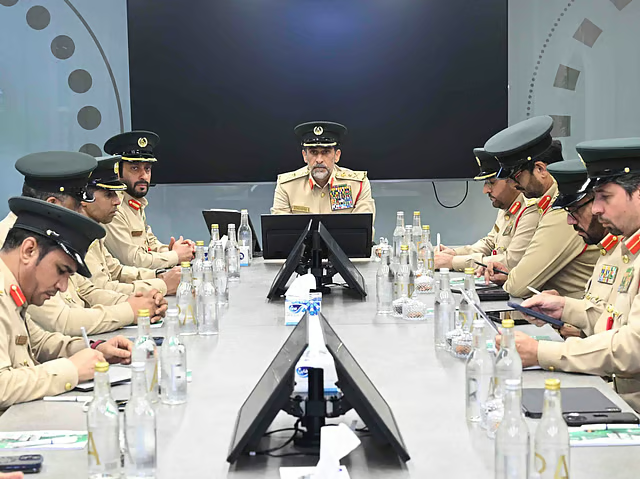
The developments were reviewed during Lieutenant General Abdulla Khalifa Al Marri’s annual inspection of the General Department of Artificial Intelligence. The Commander-in-Chief of Dubai Police examined the department’s performance, digital transformation work and technology systems supporting police operations and public services.
Dubai Police Puts 36 RPA Robots to Work
The 36 systems are robotic process automation tools rather than humanoid robots moving around police stations. They are designed to handle repetitive digital tasks, process routine information and reduce the amount of manual work required for certain administrative procedures.
Dubai Police says the technology is helping speed up internal processes, improve productivity and reduce repetitive workloads. That gives personnel more room to focus on specialist duties where human judgement, operational experience and direct engagement are still necessary.
The deployment also shows how AI adoption inside government organisations often begins with practical functions rather than highly visible futuristic systems. Automating repetitive procedures may not attract the same attention as autonomous patrol technology, but it can have a direct impact on efficiency across a large organisation.
104 Technology Projects Show the Scale of the Shift
Dubai Police says it completed 104 strategic and operational technology projects during the past year, showing that the AI push extends far beyond the 36 RPA robots. These projects cover systems designed to improve policing, administrative functions and digital services offered to the public.
The scale of the programme suggests that artificial intelligence is becoming part of a wider digital transformation strategy instead of remaining a separate innovation initiative. Different departments can use technology to automate processes, analyse information and improve the speed of service delivery.
System reliability also remains a central part of the strategy. Dubai Police reported a 99.97% continuity rate for public digital services, while its technology systems achieved 99.92% continuity during the current year. Those figures matter because increasingly automated services depend on stable infrastructure that can operate consistently with minimal disruption.
AI Is Moving Into Decision-Making and Police Operations
Dubai Police is also expanding the use of artificial intelligence in operational and administrative decision-making. The broader plan focuses on using data more effectively, automating procedures and building systems that can help personnel respond faster to changing situations.
AI-powered tools can help analyse large volumes of information more quickly than traditional manual processes. That could support officers and staff by identifying patterns, speeding up assessments and helping departments make better use of the data already available to them.
The larger shift is about integration. Instead of keeping AI tools inside small pilot programmes, Dubai Police appears to be embedding them into the digital infrastructure used across different parts of the organisation.
Dubai Police AI Platform Becomes Part of the Digital Backbone
The Dubai Police AI platform is another major part of the transformation. The platform supports data analysis, process automation, smart solutions and digital services for both employees and customers.
Having a central AI platform gives Dubai Police a foundation for developing new services without having to build every system from scratch. Different departments can use shared infrastructure for analytics, automation and digital workflows while maintaining a more consistent approach to technology deployment.
This type of platform could become increasingly important as the organisation introduces more AI tools. A common technology backbone can make it easier to connect data, expand successful projects and manage new applications across multiple departments.
Smart Police Stations Are Getting an AI Assistant
Dubai Police is also working on a smart assistant project for its Smart Police Stations. The system is designed to support police and security services through an integrated digital platform that can remain available around the clock.
Smart Police Stations already allow residents and visitors to access a range of police services without relying entirely on traditional staffed counters. Adding an AI-powered assistant could make these services easier to navigate, especially for routine requests that do not require direct intervention from an officer.
The project also fits Dubai’s broader push toward digital government services. The aim is to make more services available at any time while reducing unnecessary steps and giving users quicker access to information and support.
Dubai Police Wants AI and Human Expertise Working Together
Dubai Police’s expansion of automation does not mean human roles are disappearing. Lieutenant General Al Marri stressed the importance of developing specialised personnel alongside new AI systems and digital tools.
As artificial intelligence becomes more capable, organisations still need people who understand how to operate, supervise and improve the technology. Human oversight becomes even more important in policing because decisions may involve security, public safety and sensitive information.
The direction appears to be a combined model where automation handles repetitive work, AI supports analysis and employees remain responsible for specialist tasks, oversight and decisions that require context or judgement.
AI Innovation Produces Awards and Intellectual Property
The General Department of Artificial Intelligence also reported seven awards and certificates of recognition, along with 29 registered intellectual works connected to its projects and initiatives.
Those figures show that Dubai Police is not only adopting external technology but also developing its own digital solutions and intellectual property. This could help the organisation build systems that are more closely suited to its operational needs rather than relying entirely on off-the-shelf platforms.
Al Marri also called for continued development of AI capabilities, operational readiness and business continuity. Maintaining security, reliability and performance will become more important as these technologies become more deeply embedded across police operations.
Dubai Is Building a More Automated Model of Policing
The deployment of 36 RPA robots is only one part of a much broader shift. Dubai Police now has automation working across routine procedures, an expanding AI platform, smart assistance inside digital police stations and more than 100 technology projects completed within a year.
Taken together, these developments show AI moving from experimental projects toward a more permanent role inside police operations. The technology is increasingly becoming part of the infrastructure that supports staff, public services and internal decision-making.
The next phase will likely focus less on simply adding new tools and more on making sure those tools remain reliable, secure and properly supervised. Dubai Police’s model suggests that the future of AI in policing may not be defined by robots on the street, but by automation and intelligent systems operating quietly across the organisation.
Sources
Gulf News — “Dubai Police deploys 36 robots as AI expands across operations”
https://gulfnews.com/uae/dubai-police-deploys-36-robots-as-ai-expands-across-operations-1.500664843
Emirates 24|7 — Dubai Police AI and automation coverage
https://www.emirates247.com/
Khaleej Times — Dubai Police technology and AI coverage
https://www.khaleejtimes.com/
