


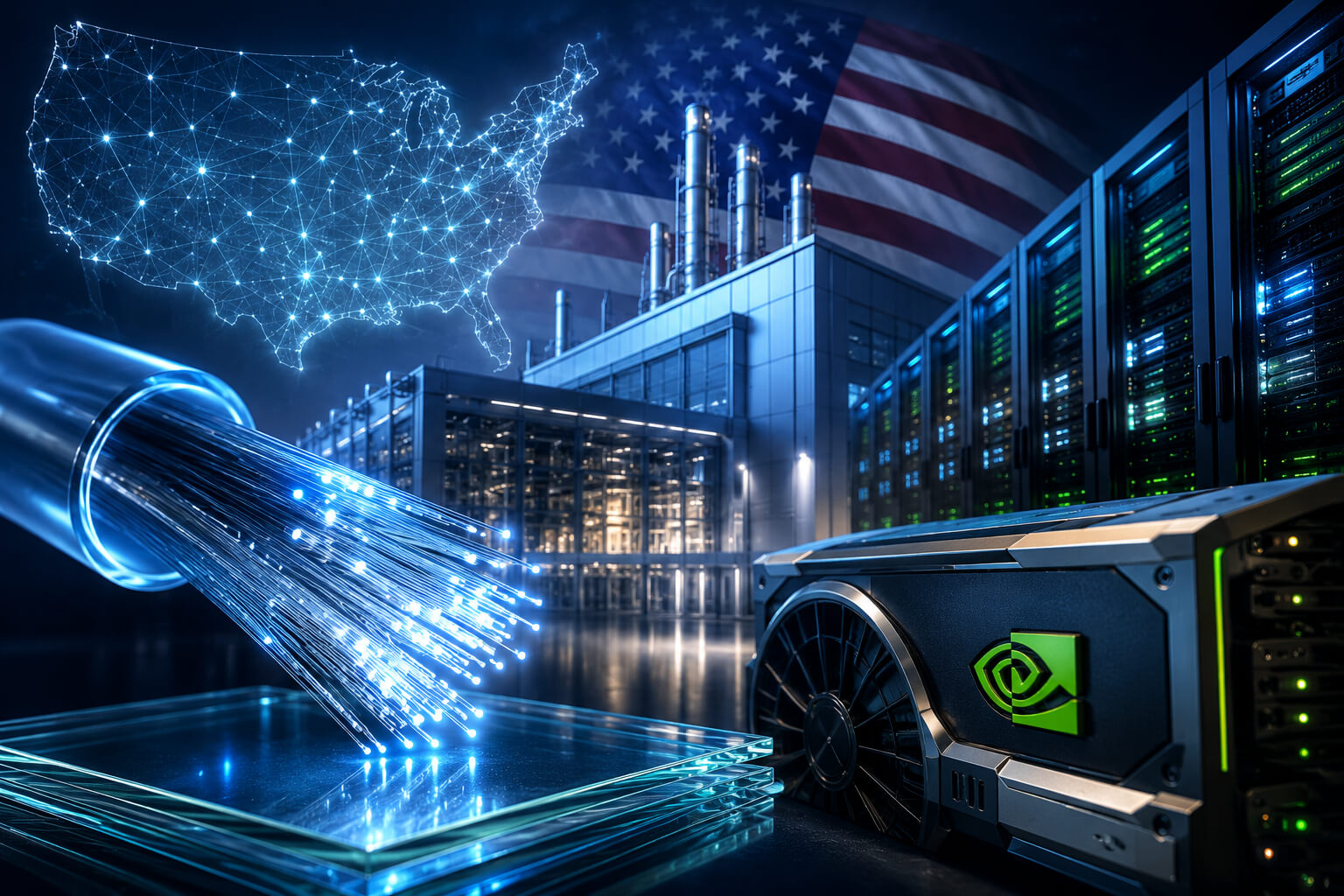
Artificial intelligence needs more than GPUs. The Corning AI data center boom is transforming infrastructure to meet those growing demands.
Behind every massive AI data center sits another piece of infrastructure that receives far less attention: optical fiber.
That is creating an unexpected winner from the AI boom. Corning, one of America’s oldest manufacturers, is seeing demand surge for its glass-based optical technology. The company now expects rapid growth as data center construction accelerates.
Corning is also working with NVIDIA on three advanced optical-manufacturing facilities in North Carolina and Texas. The expansion is expected to create more than 3,000 jobs. It could also increase Corning’s U.S. optical-manufacturing capacity tenfold.
AI Data Centers Need More Than Powerful Chips
GPUs usually dominate conversations about AI infrastructure. Yet those processors need extremely fast connections to exchange enormous amounts of information. Optical fiber provides those connections inside modern data centers. Corning produces the glass technology used to move that data. Demand is rising as companies build increasingly powerful AI facilities. That puts an old manufacturing business inside one of technology’s fastest-growing markets.
Corning Could Double in Size
Corning has been around for nearly 175 years, but its CEO sees unusual growth ahead. Chairman and CEO Wendell Weeks told Fox News that the company could double over the coming years. He described the current period as Corning’s fastest growth phase in nearly two centuries. Much of that momentum comes from optical-fiber demand linked to AI infrastructure. Corning expects many new hires to work in advanced manufacturing. A significant share of those jobs will be in the United States.
NVIDIA Partnership Will Expand US Optical Manufacturing
Corning is partnering with NVIDIA to expand domestic optical manufacturing. The companies plan three advanced manufacturing facilities across North Carolina and Texas. Corning expects the project to create more than 3,000 jobs. It also plans to increase its U.S. optical-manufacturing capacity by ten times. That is a significant expansion for a technology often overlooked in discussions about AI.
The AI Boom Is Reaching Factory Floors
AI’s economic impact isn’t staying inside Silicon Valley. Data centers require electrical systems, cooling equipment, construction materials, networking hardware, and huge amounts of optical fiber. That demand is reaching traditional manufacturing businesses. Corning’s Wilmington, North Carolina, operation is already experiencing the shift. Employees there are seeing stronger demand for products connected to AI infrastructure.
AI Could Create Advanced Manufacturing Jobs
Much of the AI jobs debate focuses on automation and displacement. Corning offers another side of that story. Weeks argues that AI is creating manufacturing work as companies expand physical infrastructure. Corning expects most of its new hires to work in advanced manufacturing roles. More than 3,000 jobs are expected from its planned optical-manufacturing expansion alone.
Glass Is Quietly Becoming Critical AI Infrastructure
The AI industry talks constantly about GPUs. Optical technology receives much less attention, even though those processors need fast connections. Inside data centers, fiber carries huge volumes of information between computing systems. Corning sits directly inside that supply chain. Its glass technology helps connect the hardware performing AI workloads. More computing capacity can therefore mean more demand for fiber.
Corning Has Reinvented Itself Before
Corning’s involvement in AI infrastructure may seem unusual at first. Many consumers still associate the company with kitchenware or smartphone glass. Its history, however, is filled with different applications for specialized glass. Optical communications have become another major business. Now AI data centers are creating a fresh source of demand. A company founded long before computers existed is becoming part of today’s AI infrastructure race.
AI Infrastructure Spending Is Spreading Beyond Chipmakers
NVIDIA has become one of the clearest beneficiaries of the AI investment cycle. But the infrastructure behind those GPUs involves a much larger supply chain. Networking equipment, power systems, construction, cooling, and fiber all become more important as data centers expand. Corning’s growth illustrates that ripple effect. Companies don’t need to build AI models themselves to benefit from the boom. Some simply provide the physical pieces that make AI computing possible.
The Physical Side of AI Is Getting Harder to Ignore
Generative AI can feel like a software story. The infrastructure behind it is anything but virtual.
Every new AI facility needs land, electricity, cooling, networking equipment, servers, and thousands of physical connections. Corning supplies one of those less visible pieces.
That makes its planned expansion worth watching. The company isn’t building another chatbot or foundation model. It is making the glass that helps AI machines communicate.
If AI data center construction keeps accelerating, suppliers like Corning could become major beneficiaries. The AI boom may ultimately reshape factories as much as software companies.
Sources
- Fox News — Massive AI boom puts one of America’s oldest manufacturers on path to double in size, CEO says
https://www.foxnews.com/politics/massive-ai-boom-puts-one-americas-oldest-manufacturers-path-double-size-ceo-says - Corning
https://www.corning.com/ - NVIDIA
https://www.nvidia.com/
