


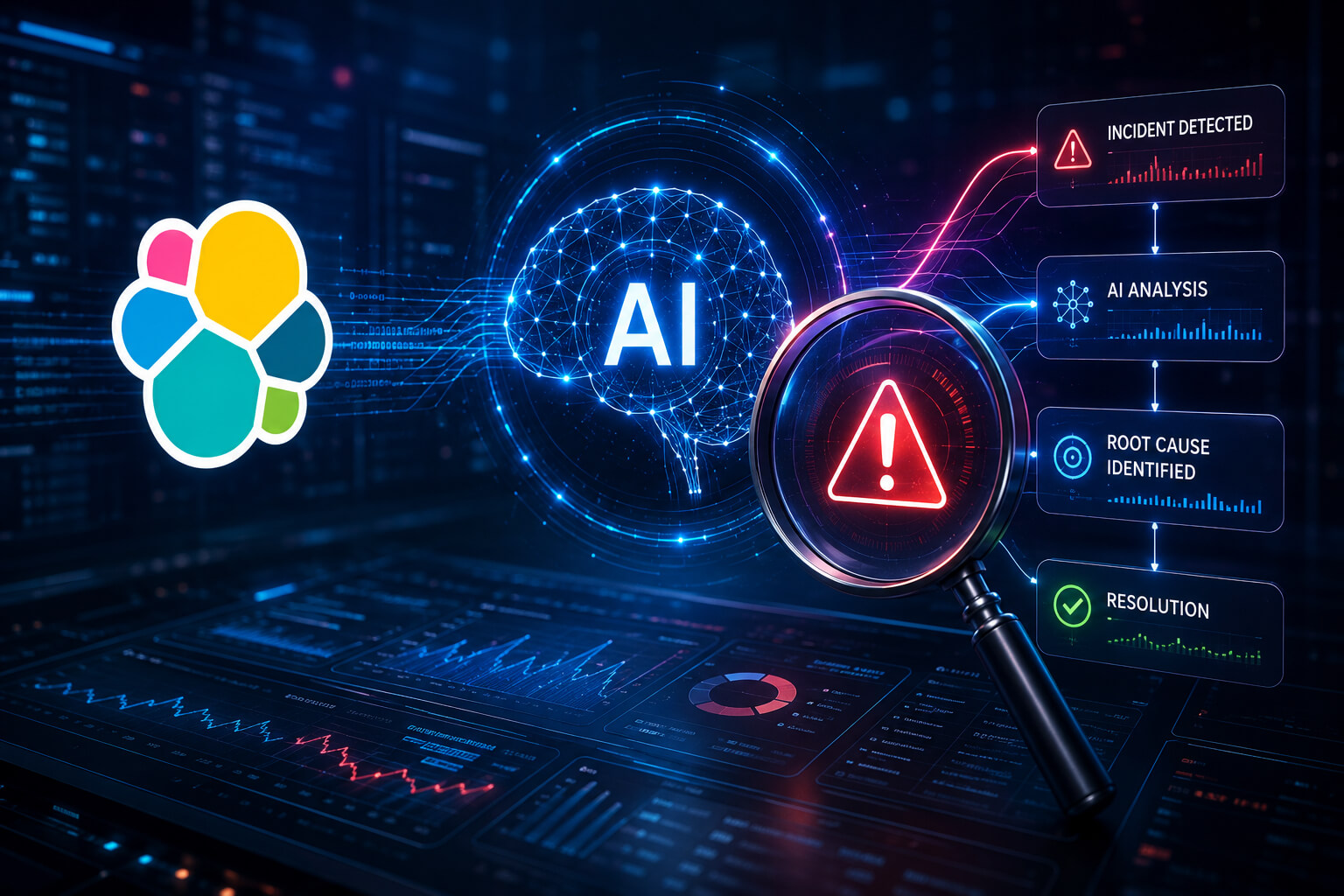
Elastic has finished its acquisition of Deductive AI, and this one is less about adding another chatbot to an enterprise software stack.
The target is a messier problem: production incidents.
Elastic said Deductive AI will become part of its broader push to bring AI-powered investigation and automation into Elastic Observability. Deductive’s technology is designed to investigate outages and software problems across code, telemetry and internal engineering knowledge rather than simply summarize an alert and hand the problem back to a human engineer.
That distinction matters. Modern engineering teams already have mountains of logs, metrics and traces. What they often lack is a quick explanation of what actually went wrong.
Elastic Wants AI to Investigate Incidents, Not Just Describe Them
Monitoring software has become very good at telling engineers that something is broken.
Finding out why? Still painfully manual in plenty of organizations.
A production problem can send an engineer jumping between application logs, infrastructure metrics, traces, source code, deployment records, internal documentation and conversations between engineering teams.
Deductive AI is built around removing some of that detective work.
Its AI SRE agent gathers evidence, develops possible explanations, tests those hypotheses and reasons across code, telemetry and organizational knowledge until it can narrow down a likely root cause.
That is considerably more ambitious than asking an AI model to summarize a few error messages.
Deductive AI Brings an AI SRE Agent Into Elastic Observability
Elastic already had AI moving into its observability products.
The Deductive acquisition gives it another layer.
Deductive describes its technology as an always-on AI site reliability engineer capable of troubleshooting production systems, building connections between technical information and coordinating multiple AI agents as they investigate an incident.
Elastic plans to combine that investigation engine with the huge amount of operational context already passing through Elastic Observability.
The interesting part is the context.
An AI agent trying to diagnose an outage without seeing the right telemetry is mostly guessing with confidence. Give it application logs, traces, infrastructure events, code changes and historical incident information, and suddenly there is something useful to reason over.
Production Incident Response Is Becoming an Agentic AI Use Case
AI coding assistants grabbed most of the attention during the first wave of developer-focused generative AI.
Incident response could become the next battleground.
It makes sense. AI-written software is helping organizations ship code faster, while cloud applications are becoming increasingly distributed and interconnected. More services can mean more dependencies. More dependencies mean more places for something strange to break.
Humans then have to untangle it at 2 a.m.
Deductive AI approaches that problem as a reasoning task. Instead of telling an engineer where to start looking, its agents are designed to conduct portions of the investigation themselves.
Elastic Is Building a Bigger Agentic Observability Strategy
This acquisition does not look isolated when placed next to Elastic’s other AI moves.
Elastic has been expanding the ability for AI agents to work directly with enterprise data, security information and operational telemetry.
Deductive AI fits neatly into that picture.
Search the data. Understand the relationships. Let an agent investigate what happened. Keep a human around for the decisions that actually require one.
That’s a more practical enterprise AI story than another assistant that can generate a nicely formatted incident summary after everything is already over.
Existing Deductive AI Customers Will Continue Receiving Support
Elastic says existing Deductive AI customers will continue to receive support while integration work moves forward.
More information about the product roadmap is expected as Elastic decides how deeply Deductive’s AI SRE capabilities will be folded into Elastic Observability.
There are still questions.
How much investigative autonomy will businesses actually give these agents? How will engineers verify the reasoning behind a proposed root cause? And what happens when an AI confidently reaches the wrong conclusion during a serious outage?
Those details will matter.
AI SRE Is Becoming a Serious Enterprise Software Category
The broader trend is becoming difficult to ignore.
Observability used to be mostly about collecting enough information so humans could investigate failures.
The emerging model is different.
Collect the information, connect it, give it to an AI agent and have that agent begin investigating before an engineer has finished reading the alert.
For Elastic, Deductive AI is another piece of that transition.
Whether AI can reliably determine root causes across sprawling production environments is still something engineering teams will test carefully.
But production incident investigation is exactly the kind of repetitive, evidence-heavy work where agentic AI could earn its place.
Not by talking more.
By figuring out what broke.
Sources
- PYMNTS — Elastic Closes Deductive AI Deal to Deliver AI-Powered Production Incident Investigation
https://www.pymnts.com/news/artificial-intelligence/2026/elastic-closes-deductive-ai-deal-deliver-ai-powered-production-incident-investigation/ - Elastic — Elastic Completes Acquisition of Deductive AI
https://ir.elastic.co/News–Events/news/news-details/2026/Elastic-Completes-Acquisition-of-Deductive-AI/default.aspx - Deductive AI
https://deductive.ai/
