


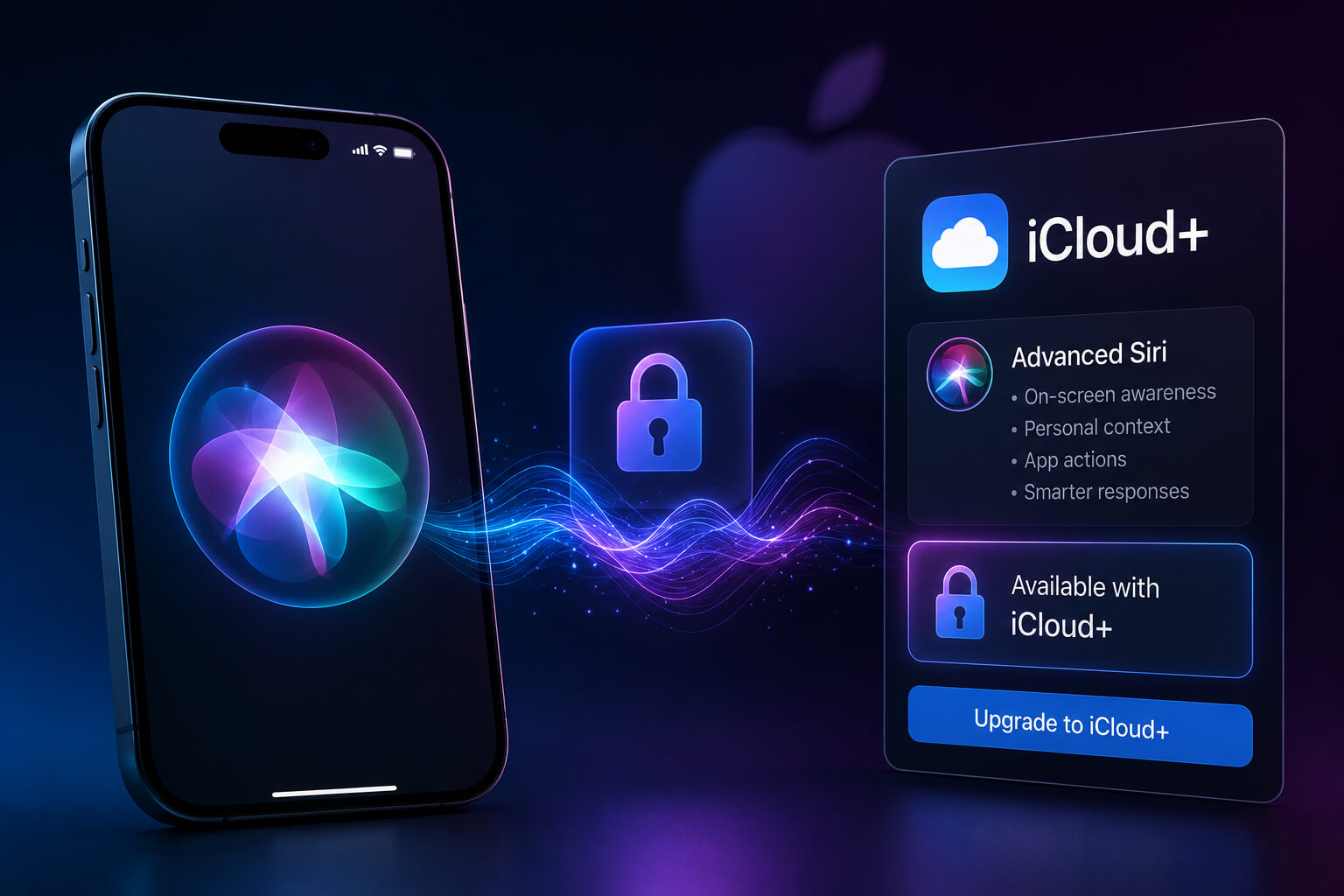
Apple’s long-awaited Siri overhaul may arrive with something users have not traditionally associated with the voice assistant: usage limits. Some are speculating this could be the result of a Siri AI paywall, which may restrict certain features behind a subscription.
The company is considering offering paid Siri AI upgrades through iCloud+, giving people the option to purchase additional computing capacity when the standard service is no longer enough.
Nothing has been finalised yet. Still, the idea reveals where Apple may be heading as Siri shifts from a lightweight voice assistant into a much more demanding generative AI product.
Heavy Siri AI Users May Have to Pay More
During Apple’s latest quarterly earnings call, outgoing CEO Tim Cook suggested that some users may eventually want more Siri AI capacity than the free service provides.
Apple could address that demand by adding upgrade options to its existing iCloud+ subscription plans. Users would effectively move further up the iCloud+ stack to receive more AI computing power or higher usage allowances.
Cook described the concept as something Apple is still exploring rather than a confirmed pricing structure.
The direction is clear enough, though. Apple expects some people to use Siri AI occasionally, while others may treat it like a daily research assistant, writing tool or productivity platform. Those heavier workloads cost more to process.
A paid tier would let Apple keep a basic version widely available without offering unlimited cloud-based AI usage to every device owner.
Siri Is Becoming Much More Than a Voice Assistant
The upgraded Siri is not simply the existing assistant with better answers.
Apple has described Siri AI as a more conversational system that can understand personal context, recognise information displayed on a user’s screen and complete actions across apps. It can search through messages, emails, photographs and notes while maintaining a longer, more natural conversation.
Users could ask Siri to locate a hotel confirmation buried in an old email, find a restaurant recommendation sent by a friend or edit and share photographs without moving between several apps.
That creates a very different computing burden from setting a timer or checking the weather.
Some requests can run directly on a device. More complicated tasks may require Apple’s Private Cloud Compute infrastructure or other cloud-based models. The more frequently users make those requests, the more expensive the service becomes to operate.
An iCloud+ upgrade would give Apple a familiar way to recover those costs without launching an entirely separate Siri subscription.
Apple Is Following an Established AI Pricing Model
A Siri AI paywall would not be unusual within the wider generative AI market.
OpenAI, Anthropic and other AI providers already offer free access with restrictions, then charge users who want higher message limits, faster processing or access to more capable models.
Apple has usually approached services differently because its hardware already carries premium pricing. Many customers expect major iPhone features to work without another monthly payment.
That expectation could make the details important.
Apple may keep Siri’s core features free while charging only for unusually high usage. It could also reserve certain advanced models or processing-intensive tools for higher iCloud+ plans. The company has not explained where that dividing line would sit.
Calling the paid option an iCloud+ upgrade rather than a separate “Siri Pro” service would probably soften the change. Millions of users already recognise iCloud+ as the place where Apple sells storage, privacy features and cloud services.
AI capacity could become another item in that bundle.
The New Siri Has Already Taken Apple Years to Deliver
Apple first promoted a more personal and context-aware Siri when it introduced Apple Intelligence in 2024. The most ambitious features did not arrive on the original schedule, leaving Apple behind competitors that were rapidly turning chatbots into broad digital assistants.
That delay became more than an embarrassing product problem.
Apple agreed in 2026 to pay $250 million to settle a class action lawsuit concerning how it marketed unfinished or delayed AI capabilities around the iPhone 15 and iPhone 16. The company did not admit wrongdoing, but the case added more pressure to deliver the Siri experience customers had been shown.
Apple finally introduced Siri AI at WWDC 2026. Developer testing began in June, while a broader beta release is planned for later in the year.
The upgraded assistant is also available through the iOS 27 beta, according to TechCrunch, with a wider rollout expected during the autumn.
Google Technology May Be Supporting Apple’s AI Push
Apple’s Siri rebuild has also required help from outside the company.
Reports previously indicated that Apple was preparing to use a customised version of Google’s Gemini model to support parts of the assistant. The arrangement would give Siri access to a much larger model while Apple continued improving its own AI technology.
That creates another financial consideration.
Running advanced AI models requires expensive chips, data-centre capacity and memory. Apple may control the hardware inside the iPhone, but many sophisticated Siri requests will still depend on costly cloud infrastructure.
The company is entering this phase while the wider technology industry faces pressure from component shortages and rising computing costs. Apple has already warned of significant supply constraints as AI demand pushes up memory prices.
Charging heavy users for additional Siri capacity starts to look less like an optional experiment in that environment.
It looks like infrastructure economics.
Apple Still Has to Prove Siri AI Is Worth Paying For
The bigger question is not whether Apple can create a paid Siri tier. It is whether people will find the assistant useful enough to reach its limits.
Siri has spent years developing a reputation for misunderstanding requests, providing narrow answers and handing basic questions to web search results. A new name and a more powerful model will not erase that frustration immediately.
Apple first needs to show that Siri AI can complete tasks reliably, handle context without becoming confused and protect personal information while searching across private apps.
Only then does a paid upgrade become realistic.
Power users already pay for AI subscriptions when the tools save time or produce consistently useful results. They may also pay for a stronger Siri that works across their iPhone, Mac, iPad and other Apple devices.
But Apple cannot charge premium prices simply because the computation is expensive. The experience has to feel premium too.
For now, the Siri AI paywall remains a possibility rather than a confirmed product. Cook’s comments show that Apple is already thinking beyond the launch, however.
The free voice assistant era may not disappear. It may just come with a meter attached.
