


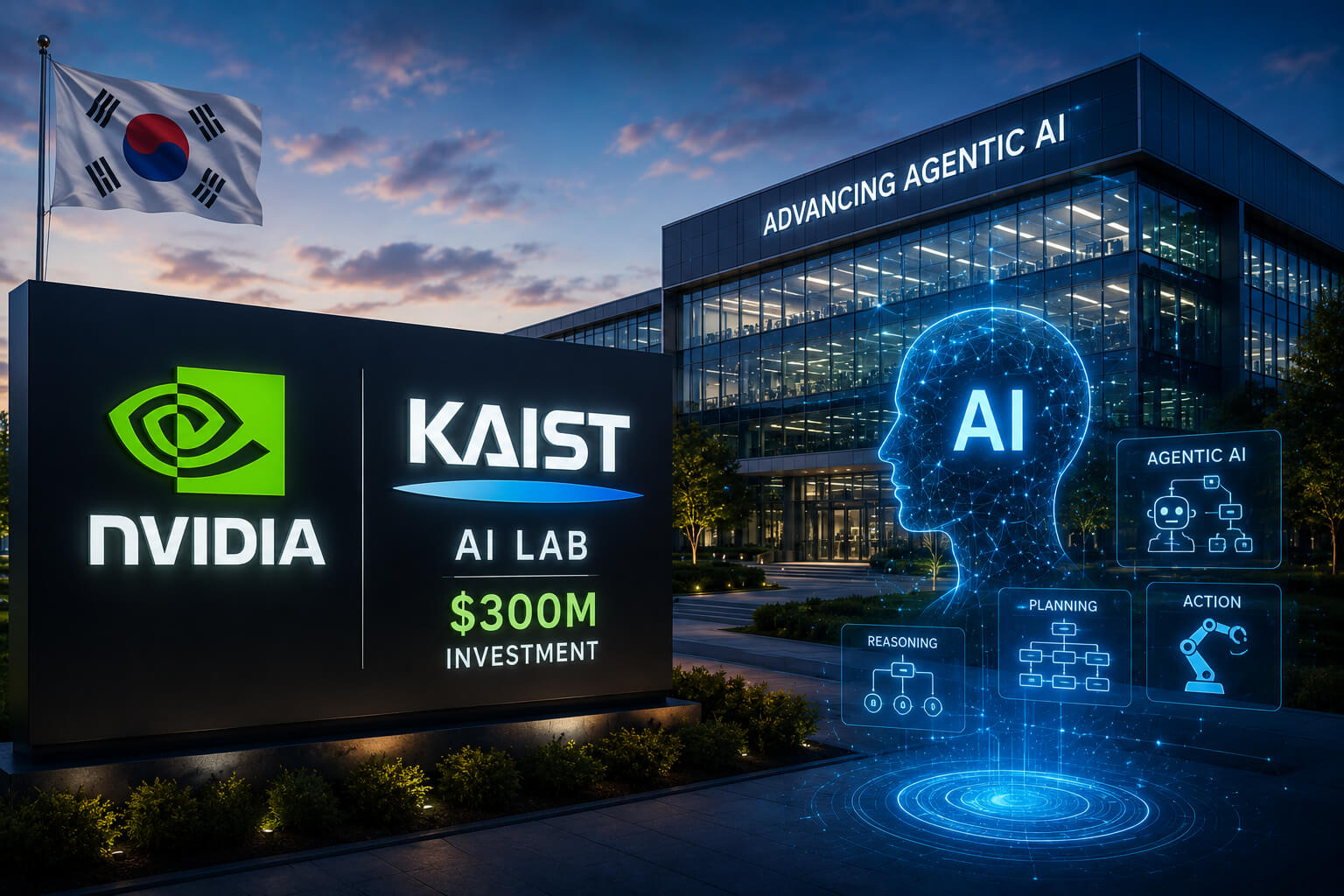
NVIDIA is putting considerably more than a few graphics processors into South Korea’s AI ambitions. The chipmaker has partnered with the Korea Advanced Institute of Science and Technology, better known as KAIST, to establish a joint artificial intelligence research laboratory in Seoul. The new facility will focus on agentic AI models and systems designed around the Korean language, local industries and the country’s long-term technology needs.
The collaboration carries an expected value of $300 million over its first five years. That includes annual computing contributions worth $50 million, giving KAIST researchers access to advanced NVIDIA AI infrastructure through local cloud partners.
This is not a small university sponsorship dressed up as an AI announcement. NVIDIA and KAIST are trying to connect academic research directly with enterprise deployment, talent development and national AI projects.
The NVIDIA KAIST AI Lab Will Focus on Agentic Systems
The laboratory will operate from the KAIST Kim Jaechul Graduate School of AI in Seoul.
Research will centre on agentic AI, a field involving systems that can reason through tasks, use tools and carry out multistep work with less constant human direction. Instead of building another general chatbot, the researchers plan to develop models and agents that make sense inside South Korea. That distinction matters.
A model may perform well in English while struggling with Korean sentence structure, cultural context or specialised business terminology. The problem becomes more obvious in sectors such as healthcare, manufacturing, finance and government, where small misunderstandings can turn into expensive mistakes. NVIDIA and KAIST want to build AI systems that better understand those local requirements rather than forcing Korean organisations to work around models trained mainly for global English-language use.
A $300 Million Collaboration Built Around Computing Power
AI research needs talent. It also needs enormous amounts of computing capacity. The five-year collaboration is expected to include $50 million in annual compute contributions, bringing the total value of the programme to approximately $300 million. Local NVIDIA Cloud Partners will provide the infrastructure, allowing researchers to work with the company’s latest AI computing systems.
That access could remove one of the biggest barriers facing university research teams. Powerful ideas often remain trapped in papers because academic institutions cannot match the computing resources available inside major technology companies. KAIST researchers will now have a clearer route from early experimentation to models that can operate at enterprise or national scale.
The arrangement also pushes NVIDIA deeper into the actual research process. It is not simply supplying hardware and leaving. Its researchers, models, software platforms and infrastructure will become part of the programme.
NVIDIA Nemotron Models Will Give Researchers a Starting Point
The laboratory plans to use NVIDIA’s Nemotron open models as part of its research. That should allow KAIST teams to adapt and fine-tune existing models instead of beginning every project from an empty screen. Researchers can concentrate on Korean-language performance, industry knowledge and agent behaviour while still working from a capable foundation.
There is a practical reason for taking this route. Training a frontier model entirely from scratch is expensive, slow and not always necessary.
A well-designed open model can serve as the base for specialised systems built around Korean companies, public institutions and research priorities. Those systems may eventually support areas such as advanced manufacturing, semiconductor development, robotics, healthcare, financial services and public administration. The real test will come later. Research models must move beyond laboratory demonstrations and survive inside complicated organisations with real data, security requirements and unreliable human workflows.
KAIST Researchers Will Receive Funding and NVIDIA Internships
The partnership also takes aim at South Korea’s AI talent pipeline. At least 10 KAIST researchers will receive funding each year. They will also gain internship opportunities at NVIDIA, while standout Korean researchers may be considered for full-time roles with the company.
The number sounds modest next to the $300 million headline. Its impact could run deeper. South Korea already has strong semiconductor, electronics and engineering industries. Keeping advanced AI researchers connected to those sectors remains another challenge entirely, especially when global technology companies can recruit talent across borders.
The joint laboratory gives researchers a reason to remain involved in South Korea’s academic ecosystem while still gaining access to NVIDIA’s global research network.
Hyunwoo Kim, an incoming KAIST faculty member, will lead the joint lab after joining the university. NVIDIA Chief Scientist Bill Dally described South Korea as one of the world’s most advanced technology ecosystems, with the new laboratory intended to support models and agent systems built specifically for the country.
The Lab Fits South Korea’s Bigger AI Infrastructure Push
The KAIST agreement did not appear in isolation. NVIDIA has been building deeper ties across South Korea’s technology sector, including work involving cloud infrastructure, telecommunications, semiconductors, robotics and industrial AI. The company previously announced plans to support more than 250,000 NVIDIA GPUs across sovereign clouds and AI factories in the country.
The joint laboratory adds research and talent to that infrastructure story. More GPUs can increase computing capacity. They do not automatically produce useful Korean-language models, experienced researchers or systems that understand local industries. Those pieces require universities, companies and public institutions to work together for years, not just during a launch event.
NVIDIA says the KAIST facility is the first joint AI laboratory between a Korean university and a global technology company. The lab was announced as South Korean political, business and research leaders met with NVIDIA and its partners to discuss the country’s broader AI direction.
NVIDIA Is Becoming More Than a Chip Supplier
NVIDIA’s role in national AI projects is changing. The company still sells the hardware underneath much of the AI economy. Increasingly, though, it also provides open models, development software, cloud partnerships, research funding and technical expertise.
That wider approach makes NVIDIA harder to replace. A country may buy chips from several suppliers over time. A research ecosystem built around one company’s infrastructure, software and models creates a much deeper relationship.
The KAIST lab shows how this strategy can work. NVIDIA supplies the computing stack and global research access. KAIST brings local scientific talent, language expertise and links to South Korea’s industrial priorities. Neither side has promised a breakthrough model yet. That would be premature. The important part is that they are building the machinery needed to produce one.
South Korea Wants AI Built for South Korea
The larger story is not just NVIDIA’s expansion. South Korea wants more control over how artificial intelligence develops inside the country. That means investing in computing infrastructure, but it also means developing models that understand Korean language, institutions and industries without relying entirely on systems designed elsewhere.
The NVIDIA KAIST AI lab is one attempt to close that gap. Success will not come from the dollar figure alone. It will depend on whether researchers can turn Nemotron-based experiments into useful products, whether promising talent remains connected to the local ecosystem and whether companies actually adopt what the laboratory produces.
Still, the direction is clear. South Korea does not want to remain only a manufacturer of the hardware that powers AI. It wants to build the intelligence running on top of it.
